Carpal Tunnel Syndrome Special Tests: Phalen, Tinel & Durkan Guide
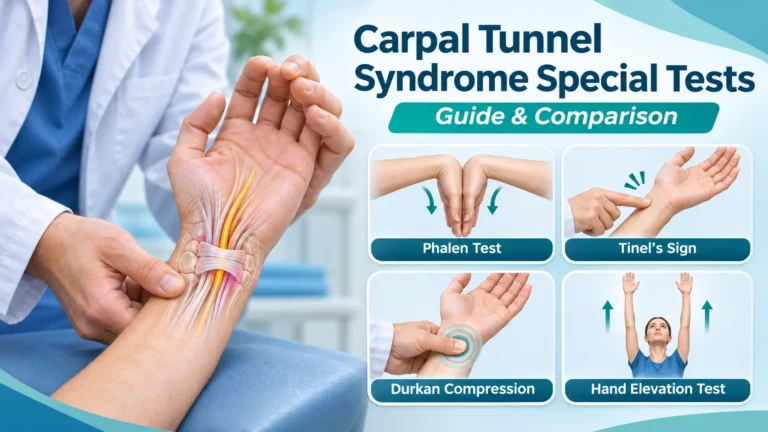
Carpal tunnel syndrome special tests help clinicians evaluate possible compression of the median nerve at the wrist. The best-known examination maneuvers are the Phalen test, Tinel sign, and Durkan (carpal compression) test. These should be interpreted alongside the patient’s symptom distribution, night symptoms, sensory findings, and thumb muscle function—not as separate, definitive diagnoses.
This clinical guide compares carpal tunnel tests, explains how to perform and interpret them, and summarizes current recommendations from the 2026 hand therapy clinical practice guideline and the 2024 American Academy of Orthopaedic Surgeons (AAOS) guideline. It is intended for physiotherapists, hand therapists, medical students, and other healthcare professionals.
Carpal tunnel syndrome special tests: quick comparison
| Test | Procedure | Positive finding / purpose |
|---|---|---|
| Phalen test | Maintain wrist flexion, commonly for up to 60 seconds | Reproduces familiar tingling or numbness in median-nerve digits |
| Tinel sign at wrist | Gently tap over the palmar course of the median nerve | Radiating paresthesia in median-nerve digits |
| Durkan carpal compression test | Apply direct, sustained pressure over the carpal tunnel, typically up to 30 seconds | Reproduction of characteristic median-nerve paresthesia |
| Reverse Phalen test | Hold wrists in extension with palms together, if tolerated | Provoked familiar median-distribution symptoms; less established than core tests |
| Flick sign | Ask whether shaking the hand relieves nighttime symptoms | Characteristic symptom-history clue, not a standalone examination |
| Semmes–Weinstein monofilament testing | Apply calibrated filaments to selected fingertip sites | Quantifies tactile sensory threshold |
| Two-point discrimination | Assess ability to distinguish two nearby points on a fingertip | Detects impaired discriminatory sensation, especially with more advanced deficits |
| Thumb abduction / thenar assessment | Assess abductor pollicis brevis strength and thenar bulk | Identifies median-nerve motor deficits and possible advanced disease |
| CTS-6 clinical score | Combine six characteristic historical and physical findings | Structured estimation of CTS probability; recommended by AAOS |
Important: A positive provocative test typically means reproduction of the patient’s usual numbness or tingling in the median nerve distribution. Wrist pain alone is not equivalent to a positive carpal tunnel test. A negative maneuver cannot independently rule CTS out.
What is carpal tunnel syndrome?
Carpal tunnel syndrome (CTS) is a median nerve compression neuropathy at the wrist. The median nerve passes through a confined tunnel beneath the transverse carpal ligament alongside finger flexor tendons. Increased pressure in that tunnel can affect sensory and, later, motor nerve function.
Typical symptoms include intermittent numbness, pins and needles, or burning in the thumb, index, middle, and radial half of the ring finger. Symptoms are commonly worse at night or with activities such as prolonged gripping, driving, or holding a phone. Patients may wake and shake their hands to obtain relief. Persistent sensory loss, impaired fine motor tasks, or weakness of thumb abduction can indicate more significant impairment.
Symptoms that mainly affect the little finger, pain that clearly originates in the neck, or widespread sensory loss require consideration of other causes. A full examination also looks for coexisting problems rather than assuming every hand complaint is CTS.
Before the tests: focused history and examination
- Symptom map: ask which digits are numb or tingly, whether symptoms are on one or both sides, and whether they spread proximally.
- Timing and triggers: establish nighttime awakening, symptom duration, repetitive or sustained wrist postures, and what provides relief.
- Function: ask about dropping objects, buttoning clothing, handling small objects, grip, and thumb pinch.
- Inspection: observe thumb muscle bulk, skin changes, swelling, deformity, and signs of other upper-limb conditions.
- Sensation: check relevant median and ulnar nerve territories and compare sides, preferably using standardized measures.
- Motor examination: assess thumb abduction and opposition, documenting pain-related limitation separately from objective weakness.
- Provocative maneuvers: perform Phalen, Tinel, and Durkan tests as tolerated, recording the exact symptom reproduced and the time to onset.
See the wrist and hand clinical examination guide for a broader examination approach.
1. Phalen test (wrist flexion test)
The Phalen test is one of the most commonly studied provocative maneuvers for carpal tunnel syndrome.
How to perform the Phalen test
- Ask the patient to sit comfortably with shoulders relaxed.
- Position the wrists in sustained flexion, often with the backs of the hands touching in a classic Phalen position. Avoid force or extreme discomfort.
- Hold the position for up to approximately 60 seconds or stop earlier if familiar symptoms develop.
- Ask which fingers are affected and whether symptoms match the patient’s usual complaint.
Positive Phalen test: familiar tingling or numbness reproduced in the median-nerve distribution. Nonspecific wrist discomfort or symptoms isolated to the little finger do not carry the same interpretation.
Limitations: the result depends on wrist position, symptom severity, test duration, and patient characteristics. A negative test does not exclude CTS. Read the detailed Phalen test article.
2. Tinel sign at the carpal tunnel
Tinel’s sign evaluates whether gentle percussion over the median nerve at the wrist produces tingling along the nerve distribution.
How to perform the Tinel test
- Place the forearm and hand in a supported, comfortable position with the palm facing upward.
- Gently tap with a fingertip or reflex hammer over the palmar wrist at the expected course of the median nerve.
- Ask whether a brief tingling or electric sensation travels into the thumb, index, middle, or radial ring finger.
Positive Tinel sign: radiating paresthesia into the median-nerve fingers, rather than localized tenderness at the tap site. The sign can occur with other nerve conditions and is not sufficient by itself to diagnose CTS.
Compare findings with sensation and the rest of the examination. For additional technique and interpretation, see Tinel’s test for carpal tunnel syndrome.
3. Durkan carpal compression test
The Durkan test, also called the carpal compression test, applies direct pressure over the carpal tunnel to provoke characteristic symptoms.
How to perform the Durkan test
- Support the patient’s forearm with the wrist relaxed, generally near neutral.
- Place the examiner’s thumbs over the volar carpal tunnel region.
- Apply firm but tolerable, sustained pressure, typically for up to about 30 seconds; do not force through significant pain.
- Ask whether the usual tingling or numbness appears in the median nerve digits.
Positive Durkan test: reproduction of familiar median-distribution paresthesia. Record onset time and the distribution of symptoms. Local pressure tenderness alone is not a definitive positive finding.
Explore the dedicated Durkan carpal compression test guide.
4. Reverse Phalen test and hand-elevation maneuvers
The reverse Phalen test uses sustained wrist extension instead of flexion, often with the palms together. Some clinicians also use a hand-elevation provocation maneuver. These may reproduce symptoms in certain patients, but their diagnostic evidence and standardization are less established than the main provocative tests.
They should be treated as optional observations rather than substitutes for Phalen, Tinel, Durkan, structured clinical scoring, or sensory and motor assessment. Stop if the position causes unacceptable discomfort.
5. Flick sign: a useful history clue
The flick sign refers to patients reporting that shaking or flicking the hand relieves nighttime numbness or tingling. Ask what the patient naturally does when the hand falls asleep at night rather than suggesting an answer. It is a symptom pattern, not proof of CTS.
Read our flick maneuver test article for additional context.
6. Sensory testing: monofilaments and two-point discrimination
Provocative maneuvers show whether particular positions or pressure reproduce symptoms. Sensory tests assess nerve function more directly.
Semmes–Weinstein monofilaments
Use calibrated monofilaments with the patient unable to see the contact. Apply them according to the chosen standardized protocol to median-nerve fingertips, compare relevant control sites, and document the smallest force reliably detected. Monofilament testing helps quantify tactile thresholds and monitor clinical change. The 2026 physical therapy clinical practice guideline recommends it for sensory assessment in suspected CTS.
Two-point discrimination
Assess the smallest separation at which the patient can reliably report two distinct points, avoiding excess pressure or visual cues. Abnormal results can support impaired sensory function but may be relatively insensitive in early or mild disease. Use a consistent protocol and document the actual distance.
7. Motor examination: thumb abduction and thenar atrophy
Inspect the thenar eminence (the muscular mound at the base of the thumb) for asymmetry or atrophy. To assess the abductor pollicis brevis, ask the patient to lift the thumb perpendicular to the palm while you apply gentle resistance. Compare both hands and record true weakness.
Thenar atrophy or persistent thumb weakness is clinically important because it may indicate more advanced median nerve dysfunction and warrants timely professional assessment. Do not infer an advanced deficit merely from pain with resisted movement.
8. CTS-6: combining special tests into a clinical score
The CTS-6 is a six-item clinical diagnostic score that integrates history and examination findings instead of relying on a single provocative maneuver. Its six elements are:
- Numbness predominantly or exclusively in the median nerve distribution.
- Nocturnal numbness.
- Thenar atrophy or weakness.
- Positive Phalen test.
- Abnormal two-point discrimination.
- Positive Tinel sign.
Items carry different weights within a 26-point total. Clinicians should use the validated scoring method rather than simply counting how many elements are present. The AAOS 2024 guideline strongly supports use of the CTS-6 for diagnosing CTS, in place of routine ultrasound or nerve conduction/electromyography for every uncomplicated patient. Additional testing still has a role when the diagnosis is uncertain, other neuropathies are suspected, or the findings may change management.
The 2026 rehabilitation guideline likewise supports combining characteristic symptoms, provocative tests, and sensory or motor measures. A CTS-6 score does not automatically determine treatment or imply a particular electrodiagnostic severity grade.
Which carpal tunnel special test is most accurate?
There is no single consistently reliable winner. A 2023 meta-analysis of examination maneuvers found substantial variability across clinical studies. Reported median sensitivities were approximately 70% for Phalen and 67% for Durkan, while discrimination testing had relatively high reported specificity in some studies. These pooled summaries depend on the populations, definitions, and reference standards studied; they are not fixed accuracy values for every patient.
Another 2023 systematic review found pooled sensitivity and specificity of about 57% and 67% for Phalen, and 45% and 78% for Tinel, respectively, highlighting how estimates differ between reviews. This is why the patient’s history and combined examination are more informative than isolated test results.
Practical conclusion: use a validated CTS-6 approach when appropriate, and interpret Phalen, Tinel, Durkan, sensory thresholds, and motor findings together. Avoid claiming that one maneuver alone confirms or rules out carpal tunnel syndrome.
Important differential diagnoses
| Condition | Clinical clues that may suggest it |
|---|---|
| Ulnar neuropathy | Symptoms mainly in the little finger and ulnar half of the ring finger; consider elbow and wrist sites |
| Cervical radiculopathy | Neck pain or radiating arm symptoms, myotomal weakness, reflex changes, or broader sensory patterns |
| Pronator syndrome or proximal median neuropathy | Forearm symptoms and median-distribution complaints related to more proximal nerve compression |
| Peripheral polyneuropathy | More diffuse or bilateral distal sensory loss, possibly with symptoms in the feet |
| Thumb CMC arthritis / tendinopathy | Mechanical pain without characteristic median-nerve paresthesia; assess local structures |
Some wrist and hand conditions may coexist with CTS. Our articles on Finkelstein’s test, thumb CMC grind testing, and Wartenberg’s sign address other possible causes of upper-limb symptoms.
When are nerve conduction studies or ultrasound needed?
In many typical presentations, the history and clinical examination are sufficient to establish a working diagnosis. Electrodiagnostic testing may be considered when findings are atypical, an alternate neuropathy is suspected, significant motor loss needs clarification, or specialist evaluation requires additional information. Ultrasound can assess the median nerve and surrounding structures in selected circumstances. The AAOS 2024 guideline does not recommend that every routine CTS evaluation automatically require these tests, and does not support MRI as a routine diagnostic test for CTS.
Persistent numbness, progressive weakness, thenar wasting, major functional deterioration, or sudden neurological symptoms warrant timely medical evaluation. Acute severe pain and rapidly progressive nerve symptoms after trauma or swelling may require urgent assessment.
Carpal tunnel examination checklist for clinicians
- Map tingling and numbness to the fingers; note nighttime symptoms and shaking for relief.
- Ask about symptom duration, work or daily activity limitations, relevant health conditions, and alternative neurological symptoms.
- Inspect thenar bulk and test thumb abduction strength.
- Assess sensory thresholds using a reproducible method, such as monofilaments.
- Perform the Phalen, Tinel, and Durkan maneuvers when tolerated, recording the exact symptom and digit distribution.
- Use CTS-6 scoring when applicable to synthesize the relevant history and test findings.
- Evaluate alternative causes of hand numbness, and decide whether electrodiagnostic testing, ultrasound, or referral is appropriate.
- Record baseline function and a follow-up plan instead of relying only on a positive/negative test label.
Frequently asked questions
What are the three main special tests for carpal tunnel syndrome?
Phalen’s test, Tinel’s sign at the wrist, and the Durkan carpal compression test are the commonly used provocative tests highlighted in the 2026 carpal tunnel clinical practice guideline.
What is a positive Phalen test?
Reproduction of familiar numbness or tingling in the median nerve distribution during sustained wrist flexion. Wrist discomfort without characteristic paresthesia should be documented separately.
Is Durkan more accurate than Phalen?
Studies report variable accuracy for both. Neither test is consistently superior in every patient population; a combined clinical examination is more informative.
Can Tinel’s sign rule out carpal tunnel syndrome?
No. A negative Tinel sign does not reliably exclude CTS, and a positive result can occur with other median nerve disorders.
What does CTS-6 stand for?
It is a six-item clinical diagnostic score that combines median nerve symptoms, nighttime numbness, thenar findings, Phalen and Tinel signs, and two-point discrimination.
Are nerve conduction studies always necessary?
No. A classic history and examination may be sufficient for diagnosis. Electrodiagnostic studies can help when the diagnosis is uncertain or clarification of another neurological disorder could affect care.
Key takeaways
Use Phalen, Tinel, and Durkan to provoke and document characteristic median-nerve symptoms, then integrate findings with the patient’s history, sensory examination, and thumb muscle assessment. The validated CTS-6 offers a more structured approach than an isolated maneuver. Watch for progressive sensory or motor loss and assess alternative causes of hand symptoms.
References and clinical guidelines
- Erickson M, et al. Hand Pain and Sensory Deficits: Carpal Tunnel Syndrome, Revision 2026. J Orthop Sports Phys Ther. 2026;56(4):CPG1–CPG79.
- American Academy of Orthopaedic Surgeons. Management of Carpal Tunnel Syndrome: Evidence-Based Clinical Practice Guideline. 2024.
- American Family Physician. Carpal Tunnel Syndrome: Point-of-Care Evidence Guide. 2024.
- Ozdag Y, et al. Sensitivity and Specificity of Examination Maneuvers for Carpal Tunnel Syndrome: A Meta-Analysis. 2023.
- Diagnostic Test Accuracy of Provocative Maneuvers for the Diagnosis of Carpal Tunnel Syndrome: A Systematic Review and Meta-Analysis. 2023.
- American Academy of Orthopaedic Surgeons. Carpal Tunnel Syndrome: Symptoms, Examination and Diagnostic Testing.