Elson Test: A Comprehensive Guide to Early Detection of Central Slip Injuries
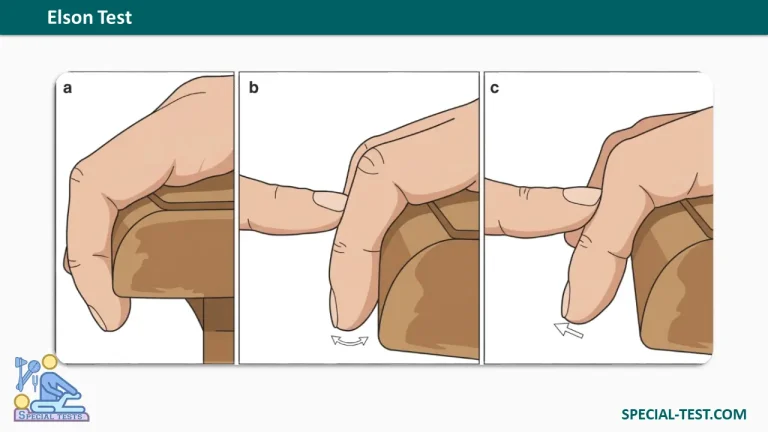
The Elson test is a specialized clinical examination maneuver used for the early detection of injuries to the central slip of the extensor tendon in the hand. Because central slip ruptures can be easily missed in their acute phase, the Elson test serves as a critical diagnostic tool to prevent the progression to a boutonniere deformity—a debilitating condition characterized by persistent flexion of the proximal interphalangeal (PIP) joint and hyperextension of the distal interphalangeal (DIP) joint.
Unlike the traditional Boyes test, which often only becomes positive at a later stage, the Elson test was specifically designed to yield immediate, reliable results following a complete rupture, giving patients the best chance for satisfactory treatment outcomes.
Anatomy and Biomechanics: Why the Elson Test Works
To understand the Elson test, one must first understand the intricate anatomy of the finger extensor mechanism. The extensor digitorum communis (EDC) tendon trifurcates into a central slip and two lateral bands. The central slip inserts on the dorsal base of the middle phalanx and is the primary extensor of the PIP joint. The lateral bands, meanwhile, continue distally to form the terminal tendon, which extends the DIP joint.
Under normal conditions, the central slip and lateral bands move in a coordinated fashion—a phenomenon known as the “checkrein” effect. The intact central slip restricts the proximal excursion of the lateral bands, preventing them from hyperextending the DIP joint when the PIP joint is flexed. However, when the central slip is ruptured, this checkrein mechanism is lost. The lateral bands become independent and, upon attempted extension, they migrate volarly and can hyperextend the DIP joint even while the PIP joint fails to extend. The Elson test exploits this exact biomechanical alteration.
How to Perform the Elson Test
The procedure is straightforward and can be performed in an office or emergency setting without specialized equipment. Proper technique is essential to obtain accurate results:
- Patient Positioning: The patient rests their hand on a table. The PIP joint of the involved finger is flexed to 90 degrees over the edge of the table, allowing the finger to hang freely.
- Examiner Action: The examiner palpates the middle phalanx of the involved finger. The patient is then instructed to actively attempt to extend the PIP joint against resistance applied by the examiner.
- Observation: The examiner carefully observes the behavior of both the PIP joint and the DIP joint during the patient’s effort.
A modification of the test, known as the Schreuders modification, involves having the patient push the middle phalanx of the injured finger against the dorsal side of the middle phalanx of the uninjured finger on the opposite hand. This allows for simultaneous bilateral comparison and may enhance diagnostic confidence.
Interpreting the Results: Positive vs. Negative
The diagnostic power of the Elson test lies in the contrasting behavior of the two interphalangeal joints.
Positive Elson Test
The test is considered POSITIVE if, during the attempted extension, the patient exhibits weak or absent extension at the PIP joint while the DIP joint becomes rigid or hyperextended. This pattern indicates that the extension force is being transmitted through the unopposed lateral bands to the distal phalanx, bypassing the incompetent central slip. A positive Elson test is a strong indicator of a complete rupture of the central slip and is considered the gold standard clinical examination for assessing central slip integrity.
Negative Elson Test
The test is considered NEGATIVE (normal) if the PIP joint is tight in extension while the DIP joint remains supple and flexible. In this scenario, the intact central slip is effectively extending the PIP joint and simultaneously checkreining the lateral bands, preventing them from hyperextending the DIP joint. A negative result suggests that the central slip is functionally intact.
Clinical Significance and Limitations
The early diagnosis of central slip injuries is paramount. If left untreated, a central slip rupture inevitably leads to a boutonniere deformity, which can cause significant functional impairment and may require complex surgical reconstruction in chronic cases. The Elson test allows clinicians to identify the injury in its acute phase, enabling prompt initiation of appropriate conservative management, such as splinting of the PIP joint in extension.
However, the Elson test has important limitations. It is designed to detect complete ruptures and is not sensitive enough to identify partial tendon tears. Furthermore, because the test requires active patient effort, it may be unreliable in patients experiencing significant pain or those who are unable to cooperate fully. A 2021 cadaveric study published in JHS Global Online (available via NCBI) found that the force differences at the DIP joint during the Elson test may be so small that they are clinically imperceptible immediately after injury, suggesting that delayed testing (after a few days) may increase the sensitivity of the test.
Elson Test FAQ
Q1: What is the primary purpose of the Elson test?
A: The Elson test is used for the early detection of central slip ruptures in the fingers, aiming to prevent the development of a boutonniere deformity.
Q2: Can the Elson test detect a partial central slip tear?
A: No. The Elson test is generally considered reliable only for detecting complete ruptures. It may not be sensitive enough to identify partial tears, and a negative test does not entirely rule out a partial injury.
Q3: What is the difference between the Elson test and the Boyes test?
A: The Boyes test evaluates DIP joint flexion with the PIP joint held in extension and often becomes positive only at a late stage. The Elson test evaluates DIP joint rigidity during attempted PIP extension and can be positive immediately after a complete acute injury.
Q4: Is the Elson test painful?
A: The test involves active resistance and may cause some discomfort, particularly over the dorsal aspect of the PIP joint if an injury is present. Pain may limit proper examination and reduce test reliability.
Q5: What should I do if the Elson test is positive?
A: A positive Elson test is a medical finding that requires prompt evaluation by a qualified hand surgeon or orthopedic specialist. Treatment typically involves splinting the PIP joint in full extension to allow the tendon to heal and to prevent a boutonniere deformity from developing.
References
- Elson RA. Rupture of the central slip of the extensor hood of the finger. A test for early diagnosis. J Bone Joint Surg Br. 1986;68(2):229-231. PubMed: https://pubmed.ncbi.nlm.nih.gov/3958008/
- Rubin J, et al. Diagnosis of closed central slip injuries. A cadaveric analysis of non-invasive tests. J Hand Surg Br. 1996;21(5):614-616. PubMed: https://pubmed.ncbi.nlm.nih.gov/9230945/
- Houston T, et al. Experimental Evaluation of the Elson Test Efficiency Following Central Slip Injury. J Hand Surg Glob Online. 2021;3(6):335-342. NCBI/PMC: https://www.ncbi.nlm.nih.gov/pmc/articles/PMC8991862/
- OrthoFixar. Elson Test for Central Slip Rupture: Diagnosis & Positive Findings. Orthofixar.com: https://orthofixar.com/special-test/elson-test/
- Grandizio LC, Klena JC. Sagittal band, boutonniere, and pulley injuries in the athlete. Curr Rev Musculoskelet Med. 2017;10(1):17-22. NCBI/PMC: https://pmc.ncbi.nlm.nih.gov/articles/PMC5344850/