Phalen’s Test: How to Perform It, Positive Signs & Accuracy
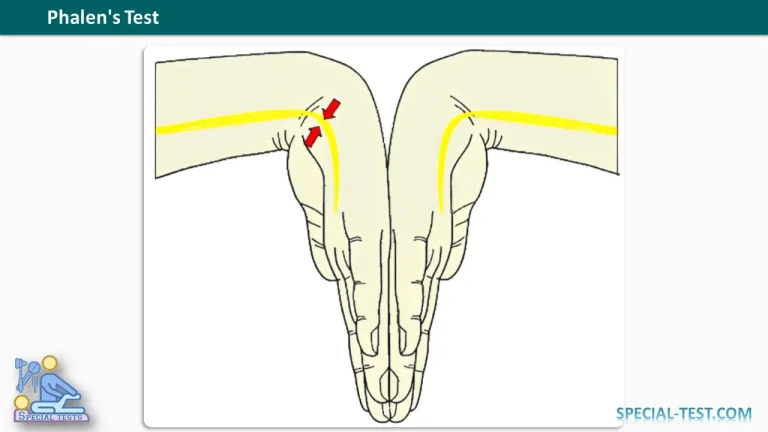
Phalen’s Test, also known as the wrist flexion test, is a commonly performed orthopedic special test used to evaluate carpal tunnel syndrome (CTS). It helps identify possible compression of the median nerve at the wrist by reproducing characteristic symptoms such as numbness, tingling, and paresthesia in the hand.
The test is frequently used by orthopedic surgeons, neurologists, physical therapists, and other healthcare professionals during the clinical examination of patients with suspected median nerve compression.
Although Phalen’s test is simple, quick, and noninvasive, its findings should always be interpreted alongside the patient’s medical history, physical examination, and additional diagnostic tests when indicated.
What Is Phalen’s Test Used For?
The primary purpose of Phalen’s test is to assess for carpal tunnel syndrome, a condition caused by compression of the median nerve as it passes through the carpal tunnel at the wrist.
The carpal tunnel is a narrow anatomical passageway containing the median nerve and nine flexor tendons. Increased pressure within this tunnel can interfere with median nerve function and produce neurological symptoms.
Common symptoms of carpal tunnel syndrome include:
- Numbness and tingling in the thumb, index finger, middle finger, and radial half of the ring finger.
- Burning sensations or paresthesia in the median nerve distribution.
- Hand discomfort that becomes worse at night.
- Weakness during gripping or performing fine motor activities.
- Reduced thumb strength or thenar muscle atrophy in advanced cases.
Phalen’s test attempts to reproduce these symptoms through sustained wrist flexion, which increases pressure within the carpal tunnel.
How to Perform Phalen’s Test
Phalen’s test can be performed with the patient sitting comfortably, with the upper limbs relaxed.
Step-by-step procedure:
- Patient position: Ask the patient to sit comfortably with the elbows flexed and forearms positioned in front of the body.
- Wrist positioning: Instruct the patient to allow both wrists to fall into maximal palmar flexion under gravity. Alternatively, the patient may place the backs of both hands together while keeping the wrists flexed.
- Maintain the position: Ask the patient to hold the wrist-flexed position for up to 60 seconds. Some descriptions of the traditional maneuver use a duration of 1–2 minutes.
- Observe symptoms: Monitor for the development of numbness, tingling, or paresthesia in the median nerve distribution.
- Record the findings: Document whether symptoms appear, which fingers are affected, and how quickly symptoms develop.
The test may be stopped earlier if the patient’s characteristic symptoms are reproduced.
Clinical tip: Reproduction of the patient’s familiar neurological symptoms is more meaningful than nonspecific wrist discomfort alone.
What Is a Positive Phalen’s Test?
A positive Phalen’s test occurs when sustained wrist flexion reproduces numbness, tingling, or paresthesia in the sensory distribution of the median nerve.
Symptoms typically involve:
- Thumb
- Index finger
- Middle finger
- Radial (thumb-side) half of the ring finger
The little finger is usually spared because its sensation is primarily supplied by the ulnar nerve.
Symptoms may appear within the first several seconds of wrist flexion. Some descriptions emphasize symptom reproduction within approximately 45 seconds, although examination protocols vary.
A positive result increases clinical suspicion of carpal tunnel syndrome, particularly when the reproduced sensations match the patient’s usual symptoms.
However, a positive Phalen’s test does not independently confirm carpal tunnel syndrome, because false-positive findings can occur.
What Is a Negative Phalen’s Test?
A negative Phalen’s test occurs when sustained wrist flexion fails to reproduce characteristic median nerve symptoms during the examination.
However, a negative result does not exclude carpal tunnel syndrome.
Patients with mild, intermittent, or even established median nerve dysfunction may have a negative test despite having CTS.
Therefore, clinicians should avoid using Phalen’s test as the sole method of confirming or ruling out the diagnosis.
Phalen’s Test Sensitivity and Specificity
The diagnostic accuracy of Phalen’s test varies considerably between studies because of differences in patient populations, testing techniques, diagnostic criteria, and reference standards.
A 2023 systematic review and meta-analysis by Dabbagh and colleagues reported the following pooled diagnostic performance based on seven studies involving 604 patients:
| Diagnostic Measure | Result |
|---|---|
| Sensitivity | 57% |
| Specificity | 67% |
| Sensitivity 95% confidence interval | 44–68% |
| Specificity 95% confidence interval | 52–79% |
Another 2023 meta-analysis by Ozdag and colleagues reported a median sensitivity of 70% across studies evaluating Phalen’s test.
Sensitivity represents the proportion of patients with carpal tunnel syndrome who have a positive test.
Specificity represents the proportion of individuals without carpal tunnel syndrome who have a negative test.
Individual studies have reported substantially different accuracy estimates. Therefore, sensitivity and specificity should not be presented as fixed universal values.
Clinical interpretation: Phalen’s test has limited diagnostic accuracy when used alone. Combining it with other examination findings improves clinical assessment.
Phalen’s Test vs. Reverse Phalen’s Test
Both Phalen’s test and reverse Phalen’s test are provocative maneuvers used to assess possible median nerve compression.
However, the main difference is wrist positioning.
| Feature | Phalen’s Test | Reverse Phalen’s Test |
|---|---|---|
| Wrist position | Palmar flexion | Wrist extension |
| Common position | Backs of hands together | Palms together (prayer position) |
| Main purpose | Reproduce median nerve symptoms | Reproduce median nerve symptoms |
| Positive result | Median nerve paresthesia | Median nerve paresthesia |
The reverse Phalen’s test is also called the prayer test. It involves holding the wrists in extension, often with the palms pressed together.
The available evidence does not establish that either maneuver can reliably diagnose CTS when used independently.
Clinical Significance of Phalen’s Test
Phalen’s test is a useful component of a comprehensive assessment for carpal tunnel syndrome.
Other commonly used clinical examinations include:
- Tinel’s sign: Percussion over the median nerve at the wrist to reproduce paresthesia.
- Durkan’s carpal compression test: Direct pressure over the carpal tunnel to provoke median nerve symptoms.
- Sensory examination: Assessment of sensation in the median nerve distribution.
- Motor examination: Evaluation of thumb opposition, thumb abduction, and thenar muscle function.
When the diagnosis remains uncertain, nerve conduction studies and electromyography may provide additional information about median nerve dysfunction and help identify alternative neurological conditions.
Persistent numbness, progressive weakness, or thenar muscle wasting warrants further clinical assessment.
Frequently Asked Questions (FAQ)
1. What is Phalen’s test used to diagnose?
Phalen’s test is primarily used to evaluate carpal tunnel syndrome, a condition resulting from compression of the median nerve at the wrist.
2. How long should Phalen’s test be performed?
The maneuver is commonly maintained for up to 60 seconds, although some traditional descriptions recommend holding wrist flexion for up to two minutes. The test can be stopped once characteristic symptoms develop.
3. What indicates a positive Phalen’s test?
A positive result occurs when wrist flexion reproduces numbness, tingling, or paresthesia in the median nerve distribution, particularly the thumb, index finger, middle finger, and radial half of the ring finger.
4. Is Phalen’s test reliable for diagnosing carpal tunnel syndrome?
Phalen’s test provides useful clinical information but has variable sensitivity and specificity. Research indicates that it should be combined with the patient’s history and other diagnostic findings rather than used alone.
5. Can Phalen’s test be negative in someone with carpal tunnel syndrome?
Yes. A negative result does not rule out carpal tunnel syndrome. False-negative findings can occur, including in patients whose symptoms are intermittent.
6. What is the difference between Phalen’s and Tinel’s tests?
Phalen’s test uses sustained wrist flexion to reproduce median nerve symptoms, whereas Tinel’s sign involves tapping over the median nerve at the wrist to provoke tingling or paresthesia.
7. Can Phalen’s test be performed at home?
The wrist-flexion maneuver is simple, but interpreting the results requires consideration of symptoms and other clinical findings. A positive self-test cannot establish a diagnosis, and persistent symptoms should be assessed by a healthcare professional.
Conclusion
Phalen’s test is an important orthopedic examination maneuver for evaluating suspected carpal tunnel syndrome. By maintaining the wrist in palmar flexion, the test attempts to reproduce numbness and paresthesia caused by median nerve compression.
A positive test supports clinical suspicion of CTS, while a negative result does not exclude the condition.
Because its sensitivity and specificity vary across studies, Phalen’s test should be interpreted as part of a comprehensive clinical assessment rather than as a definitive diagnostic test.
References
- Orthofixar. Phalen & Reverse Phalen Test: Procedure, Positive Findings, and Diagnostic Accuracy.
https://orthofixar.com/special-test/phalen-test/ - Dabbagh A, et al. (2023). Diagnostic Test Accuracy of Provocative Maneuvers for the Diagnosis of Carpal Tunnel Syndrome: A Systematic Review and Meta-Analysis. Physical Therapy.
https://pubmed.ncbi.nlm.nih.gov/37366626/ - Ozdag Y, et al. (2023). Sensitivity and Specificity of Examination Maneuvers for Carpal Tunnel Syndrome: A Meta-Analysis.
https://pubmed.ncbi.nlm.nih.gov/37621797/ - NCBI Bookshelf – StatPearls. Carpal Tunnel Syndrome: Clinical Examination, Evaluation, and Diagnosis.
https://www.ncbi.nlm.nih.gov/books/NBK448179/ - Sze KP, Leong AZ. (2025). Carpal Tunnel Syndrome in Primary Care. Singapore Medical Journal.
https://pmc.ncbi.nlm.nih.gov/articles/PMC12503408/ - Sensitivity and Specificity of Clinical Testing for Carpal Tunnel Syndrome. Study evaluating the diagnostic performance of provocative tests.
https://pubmed.ncbi.nlm.nih.gov/24222987/