Lunotriquetral Ballottement Test (Reagan Test): Procedure, Accuracy & Clinical Use
What Is the Lunotriquetral Ballottement Test Used For?
The Lunotriquetral Ballottement Test is a specialized provocative maneuver used during a wrist examination to assess the integrity of the lunotriquetral (LT) ligament. This ligament is a critical stabilizer of the proximal carpal row, connecting the lunate and triquetrum bones. Injury to this structure can lead to lunotriquetral instability, a condition that often presents as ulnar-sided wrist pain, weakness, and a sensation of giving way or clicking during activity.
Because LT ligament injuries are relatively uncommon and can be difficult to diagnose—radiographs are frequently normal—a thorough physical examination is essential. The ballottement test, first described by Reagan, Linscheid, and Dobyns, aims to isolate the lunate and triquetrum and apply stress to their intervening ligament to detect excessive motion or pain.
How to Perform the Lunotriquetral Ballottement Test
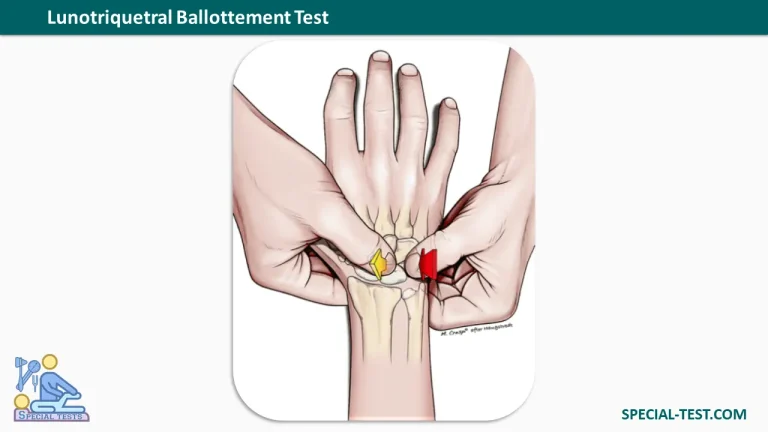
The test is performed with the patient seated and the forearm resting on a treatment table. The examiner uses both hands to stabilize and manipulate the carpal bones separately.
- Stabilize the Lunate: The examiner grasps the patient’s wrist with one hand, placing the thumb over the dorsum of the lunate and the index finger over the volar surface of the carpal tunnel.
- Secure the Triquetrum/Pisotriquetral Unit: The examiner’s other hand secures the triquetrum and pisiform between the thumb (on the dorsal triquetrum) and the index finger (on the volar pisiform).
- Apply Shear Stress: The examiner then attempts to displace the two bones in opposite directions. The hand holding the triquetrum pushes dorsally (upward) while the hand stabilizing the lunate pushes volarly (downward). This creates an anterior-posterior (dorsopalmar) shear force across the LT joint.
- Reverse the Stress: The maneuver is then reversed, pushing the triquetrum volarly and the lunate dorsally, to assess laxity in both directions.
- Compare Sides: The test is always compared with the asymptomatic, contralateral wrist to establish a baseline for normal ligamentous laxity.
What Is a Positive Lunotriquetral Ballottement Test?
A test is considered positive if the examiner detects increased laxity (excessive excursion of the triquetrum relative to the lunate) compared to the normal side, and if the maneuver reproduces the patient’s pain at the LT joint. The examiner may also palpate a painful crepitus or feel a “clunk” as the bones shear against one another. These findings suggest a tear or attenuation of the lunotriquetral interosseous ligament.
Test Accuracy: Sensitivity and Specificity
While the ballottement test is a standard part of the wrist examination, it is important to interpret its results within the broader clinical context. Its diagnostic accuracy has been investigated in several studies.
A landmark 1995 study by LaStayo et al., published in the Journal of Hand Therapy, compared provocative wrist tests against arthroscopic findings (the gold standard) in 50 painful wrists. The study reported the following metrics for the Lunotriquetral Ballottement Test:
- Sensitivity: 64%
- Specificity: 44%
- Positive Predictive Value (PPV): 24%
- Negative Predictive Value (NPV): 81%
These values indicate that the test is moderately sensitive but has low specificity. This means a positive test is not definitive on its own (as there is a high rate of false positives), but a negative test is reasonably useful for ruling out a significant LT ligament injury (given the high negative predictive value). Other studies have reported similar figures, with sensitivity around 59.6% and specificity around 39.6%. Consequently, a positive ballottement test should be corroborated with other clinical signs (e.g., localized tenderness, Kleinman’s shear test) and advanced imaging, with wrist arthroscopy remaining the definitive diagnostic standard.
Frequently Asked Questions (FAQ)
What is another name for the Lunotriquetral Ballottement Test?
It is also widely known as the Reagan Test, named after the authors who originally described the maneuver. It is sometimes referred to as the LT shuck test.
What are the symptoms of a lunotriquetral ligament injury?
Patients typically present with ulnar-sided wrist pain, which may be accompanied by weakness, a sensation of instability or giving way, and sometimes a painful clicking or clunking sensation during wrist motion, especially with loading or rotation.
Can the ballottement test diagnose a TFCC tear?
No. The ballottement test is designed to assess the lunotriquetral interosseous ligament. While LT ligament injuries can occur alongside triangular fibrocartilage complex (TFCC) tears, the ballottement test is not specific for the TFCC. Other tests and imaging (like MRI) are required to evaluate the TFCC.
Is the Lunotriquetral Ballottement Test reliable?
It has moderate reliability. As a provocative test, it is a valuable screening tool. However, because of its low specificity (44%), a positive result must be interpreted with caution and correlated with the patient’s history, mechanism of injury (e.g., hyperextension or hyperpronation trauma), and other physical examination findings.
What is the gold standard for diagnosing an LT ligament tear?
Wrist arthroscopy is considered the gold standard for diagnosis, as it allows direct visualization of the ligament and the degree of instability (e.g., using the Geissler classification). MRI arthrography can also be helpful but is less definitive than arthroscopy.
References
- Orthofixar. Lunotriquetral Ballottement Test. Available at: https://orthofixar.com/special-test/lunotriquetral-ballottement-test/
- LaStayo P, et al. Clinical provocative tests used in evaluating wrist pain: a descriptive study. J Hand Ther. 1995 Jan-Mar;8(1):10-7. Available at: https://pubmed.ncbi.nlm.nih.gov/7742888/
- Zelenski NA, et al. Lunotriquetral Instability: Diagnosis, Management, and Current Concept Review. J Am Acad Orthop Surg. 2024 Dec 27;33(17):e1017-e1028. Available at: https://pubmed.ncbi.nlm.nih.gov/40833339/
- Arthroscopic Thermal Shrinkage of Lunotriquetral Ligament Incomplete Tear without Triangular Fibrocartilage Complex Perforation. PMC (NCBI). Available at: https://pmc.ncbi.nlm.nih.gov/articles/PMC11781848/