Tinel’s Test for Carpal Tunnel Syndrome: Purpose, Technique & Accuracy
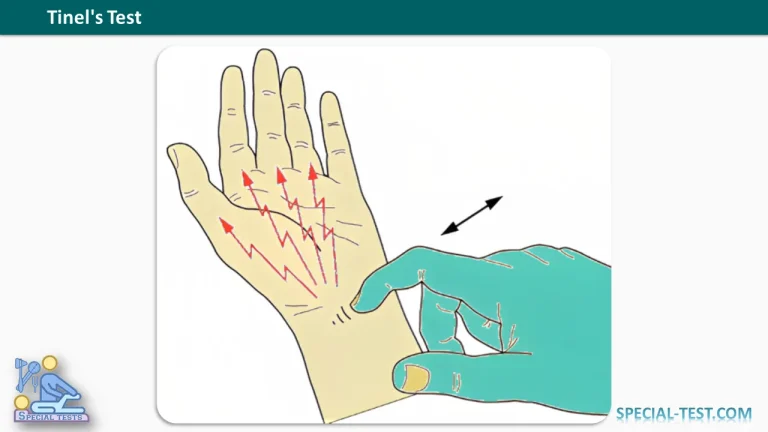
Tinel’s test is a quick, non-invasive provocative examination used primarily to support the clinical evaluation of carpal tunnel syndrome (CTS) and other peripheral nerve compression or injury syndromes. It is sometimes called the Hoffmann–Tinel sign and is widely used in hand and orthopedic examinations because it requires no specialized equipment. However, Tinel’s test is not a stand-alone diagnostic test: its results must be interpreted alongside the patient’s history, symptom pattern, other provocative tests, and—when indicated—electrodiagnostic studies.
What Is the Tinel’s Test Used For?
Tinel’s test is used to evaluate nerve injury, neuroma formation, and nerve compression. It is especially associated with carpal tunnel syndrome and tarsal tunnel syndrome, but it can also be applied to other peripheral nerves, such as the ulnar nerve at the cubital tunnel. In the context of CTS, the examiner taps over the median nerve at the volar wrist to see whether this reproduces tingling or “pins-and-needles” sensations in the median nerve distribution.
The test is named after Jules Tinel and Paul Hoffmann, who independently described the phenomenon in 1915. Percussion over an injured or compressed nerve can produce a distal tingling sensation, and the sign may also be used to monitor nerve regeneration after injury.
How to Perform the Tinel’s Test at the Wrist
A standard approach to the Tinel’s test for carpal tunnel syndrome is as follows:
- Position the patient: The patient is usually seated with the elbow flexed about 30 degrees, the forearm supinated, and the wrist in a neutral position.
- Locate the median nerve: The median nerve at the wrist lies in the midline, between the tendons of the palmaris longus and flexor carpi radialis, near the distal wrist crease.
- Percuss lightly: The examiner uses two fingers or a reflex hammer to tap lightly over the median nerve at the volar wrist. The taps should be firm enough to stimulate the nerve but not excessively forceful.
- Ask about symptoms: The patient is asked whether the tapping produces tingling, numbness, or electrical sensations and where those sensations are felt.
Some clinicians perform several taps along the course of the median nerve, while others use a single percussion. Technique varies between studies, which partly explains the wide range of reported accuracy.
What Is a Positive Tinel’s Sign?
A positive Tinel’s sign is present when percussion over the median nerve reproduces paresthesia in the median nerve distribution—typically the thumb, index finger, middle finger, and the radial half of the ring finger. The sensation may radiate distally into the hand.
It is important to distinguish a true Tinel’s sign from local tenderness. A genuine Tinel’s sign is generally not painful; pain on tapping may instead suggest a neuroma or a neuroma-like response. A positive Tinel’s sign supports clinical suspicion of median nerve compression, but it does not by itself confirm carpal tunnel syndrome.
Tinel’s Test Accuracy: Sensitivity and Specificity
The reported accuracy of Tinel’s test varies considerably across studies. Some clinical resources, including OrthoFixar, list an approximate sensitivity of 70% and specificity of 90% for the Tinel test. However, higher-level evidence provides a more nuanced picture.
A systematic review published in PubMed reported pooled estimates of approximately 50% sensitivity and 77% specificity for Tinel’s test in carpal tunnel syndrome. A more recent 2023 PubMed meta-analysis reported a pooled sensitivity of 0.45 and specificity of 0.78 for the Tinel sign. An NCBI-affiliated summary table similarly lists Tinel’s sign sensitivity at 36–50% and specificity at 77%.
These findings indicate that Tinel’s test generally has low sensitivity and moderate-to-high specificity. In practical terms, a positive Tinel’s sign may increase suspicion of CTS, but a negative test does not exclude the diagnosis. Because sensitivity is limited, clinicians usually combine Tinel’s test with other findings, such as the Phalen test, carpal compression test, sensory examination, hand symptom diagrams, and nerve conduction studies.
How Tinel’s Test Fits Into Carpal Tunnel Diagnosis
Carpal tunnel syndrome is a clinical diagnosis. Tinel’s test is best used as an adjunctive maneuver, not as a replacement for a thorough history and physical examination. The test may be less reliable in advanced disease, and the Tinel sign may be absent when nerve compression has been present for a long time.
A clinician may also use Tinel’s test to evaluate other nerve entrapment sites, such as the cubital tunnel or tarsal tunnel. However, the meaning of a positive result depends on the nerve being tested and the patient’s symptom distribution.
FAQ
What does a positive Tinel test mean?
A positive Tinel test means that light percussion over the median nerve at the wrist reproduces tingling or paresthesia in the median nerve distribution. It supports the possibility of carpal tunnel syndrome, but it is not definitive and should be interpreted with other clinical findings.
Can Tinel’s test be negative if I have carpal tunnel syndrome?
Yes. Tinel’s test has limited sensitivity, and a negative result does not rule out carpal tunnel syndrome. Many patients with confirmed CTS may have a negative Tinel sign.
Is Tinel’s test the same as Phalen’s test?
No. Tinel’s test uses percussion over the nerve, while Phalen’s test uses sustained wrist flexion to increase carpal tunnel pressure. Both are provocative tests for CTS, but they use different mechanisms.
Does a positive Tinel sign always mean surgery is needed?
No. A positive Tinel sign is only one piece of clinical information. Treatment decisions depend on symptom severity, duration, nerve studies, response to conservative care, and the presence of weakness or muscle atrophy.
When should I seek medical evaluation for possible carpal tunnel syndrome?
You should seek evaluation if you have persistent numbness, tingling, pain, weakness, or night symptoms in the thumb, index, middle, or ring fingers. A clinician can perform a comprehensive examination and determine whether further testing is needed.
References
- MacDermid JC, et al. Clinical diagnosis of carpal tunnel syndrome: a systematic review. J Hand Ther. 2004. PubMed. https://pubmed.ncbi.nlm.nih.gov/15162113/
- Dabbagh A, et al. Diagnostic Test Accuracy of Provocative Maneuvers for the Diagnosis of Carpal Tunnel Syndrome: A Systematic Review and Meta-Analysis. Phys Ther. 2023. PubMed. https://pubmed.ncbi.nlm.nih.gov/37366626/
- OrthoFixar. Tinel Test: Procedure, Positive Sign, and Diagnostic Accuracy. https://orthofixar.com/special-test/tinel-test/
- NCBI/StatPearls. Hoffmann Tinel Sign. https://www.statpearls.com/articlelibrary/viewarticle/22960/
- NCBI PMC. Table 6: Sensitivity and specificity of various clinical tests in diagnosing CTS. https://pmc.ncbi.nlm.nih.gov/articles/PMC10039760/table/TAB6/