Durkan Test (Carpal Compression Test): A Complete Guide to Accuracy, Technique, and Clinical Use in Carpal Tunnel Syndrome
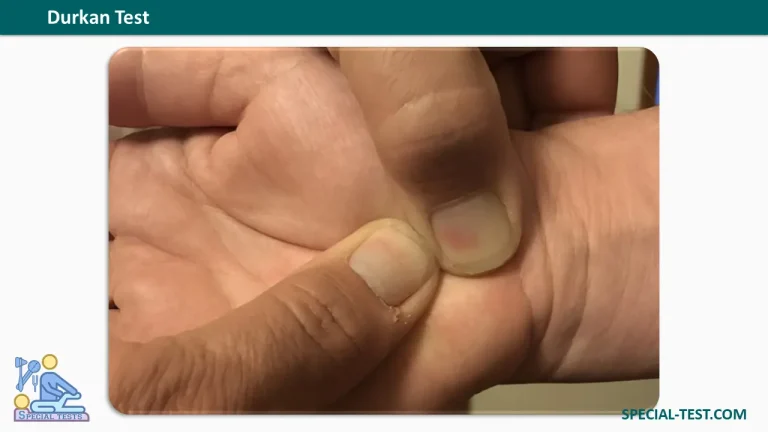
The Durkan test—also widely known as the carpal compression test (CCT)—is one of the most studied provocative maneuvers for carpal tunnel syndrome (CTS). It was first described by J.A. Durkan in 1991 and remains a cornerstone of the physical examination for median nerve compression at the wrist. Unlike the Tinel sign or Phalen test, the Durkan test applies direct, sustained pressure over the carpal tunnel, making it a physiologically targeted provocation of the median nerve. This article explains what the Durkan test is used for, how to perform it correctly, how to interpret a positive result, and what the published literature says about its diagnostic accuracy.
What Is the Durkan Test Used For?
The Durkan test is used to screen for and support the diagnosis of carpal tunnel syndrome, a compression neuropathy of the median nerve within the carpal tunnel. It is indicated when a patient reports symptoms suggestive of CTS—such as nocturnal numbness, tingling, pain, or paresthesia in the median nerve distribution (the thumb, index finger, middle finger, and the radial half of the ring finger). The test is inexpensive, requires no equipment beyond the examiner’s hands (or an optional manometer), and can be completed in under a minute, making it highly suitable for primary care and orthopedic clinics.
How to Perform the Durkan Test
Proper technique is essential for reliable results. The patient is seated with the elbow flexed approximately 30 degrees, the forearm supinated, and the wrist in a neutral position. The examiner then places both thumbs over the transverse carpal ligament and applies firm, direct pressure over the carpal tunnel. The standard pressure is often described as 6 pounds of pressure (or a comparable force delivered with an atomizer bulb attached to a manometer), maintained for 30 to 60 seconds. Some protocols allow up to 1 to 2 minutes, but most clinical studies use a 30-second threshold. The examiner should note the time interval between the onset of pressure and the reproduction of symptoms; in confirmed CTS, the average interval is approximately 16 seconds.
What Is a Positive Durkan Test?
The test is considered positive when the patient’s typical symptoms—numbness, pain, or paresthesia—are reproduced in the median nerve distribution during the period of compression. A negative test is recorded when no such symptoms occur within the designated time frame. Because the Durkan test is a provocative maneuver, a positive result does not confirm CTS in isolation; it must be interpreted alongside the history, other provocative tests, and, when necessary, electrodiagnostic studies.
Test Accuracy: Sensitivity and Specificity
The diagnostic accuracy of the Durkan test varies across studies because of differences in reference standards, patient populations, and technique. The table below summarizes key findings from trusted sources.
| Source | Sensitivity | Specificity | Notes |
|---|---|---|---|
| Richter study (reported by Orthofixar) | 87 % | 96 % | High clinical diagnostic value; combination with Phalen test reached 94 % sensitivity and 96 % specificity |
| PubMed study (1999, Value of clinical diagnosis in CTS) | 0.87 | 0.96 | Electrophysiologically confirmed CTS; Durkan + Phalen: 0.94 sensitivity, 0.96 specificity |
| PubMed study (2020, Accuracy of Provocative Tests) | 0.71 | 0.22 | Electrodiagnostic reference standard; lower specificity in this cohort |
| Systematic review (PMC, 2023) | Range 0.36–0.86 | Range 0.33–0.62 | Five studies; methodological heterogeneity noted |
| NCBI integrated review (2023) | 64 % | 83 % | Described as “the best of all the provocation tests” for CTS |
A commonly cited benchmark from the Durkan test literature is sensitivity of approximately 87 % and specificity of approximately 90 % in favor of the test’s clinical utility. The variation across studies underscores an important principle: no single provocative test is definitive. The Durkan test performs best when used as part of a battery of clinical tests and when findings are concordant with the patient’s symptom history.
Durkan Test vs. Other Provocative Tests for CTS
Compared with the Tinel sign and the Phalen test, the Durkan test generally demonstrates higher sensitivity but variable specificity. In a direct comparison using electrodiagnostic studies as the reference standard, the Durkan test had a sensitivity of 0.71, compared with 0.47 for Tinel and 0.50 for Phalen. A combination of the Durkan test with the Phalen test has been reported to achieve a sensitivity of 94 % and a specificity of 96 %, approaching the performance of nerve conduction studies. This makes the Durkan test particularly valuable as an early screening tool before ordering electrodiagnostic testing.
Clinical Utility and Limitations
The Durkan test is best used as a quick, low-cost adjunct in the physical examination of patients with suspected CTS. It is not a standalone diagnostic test. Electrodiagnostic studies (nerve conduction studies and electromyography) remain the standard confirmatory modality, although they can be normal in mild CTS. Clinicians should integrate Durkan test results with the patient’s history, symptom distribution, thenar muscle examination, and other provocative maneuvers to arrive at an accurate diagnosis.
FAQ
Q1: What is the Durkan test used for?
The Durkan test is a provocative clinical maneuver used to help diagnose carpal tunnel syndrome by applying direct pressure over the median nerve at the wrist and reproducing the patient’s symptoms.
Q2: How long should pressure be applied during the Durkan test?
Standard protocols apply pressure for 30 to 60 seconds, although some sources allow up to 1–2 minutes. A positive response often occurs within 16 seconds in confirmed CTS.
Q3: What does a positive Durkan test feel like?
Patients typically report numbness, tingling, pain, or paresthesia in the thumb, index, middle, and radial half of the ring finger—the median nerve distribution.
Q4: Is the Durkan test better than the Phalen test?
The Durkan test generally has higher sensitivity than the Phalen test, but specificity varies. Combining the two tests improves diagnostic performance substantially.
Q5: Can the Durkan test replace nerve conduction studies?
No. The Durkan test is a screening and supportive tool. Electrodiagnostic studies remain the reference standard for confirming CTS, especially in atypical or severe cases.
References
- Orthofixar. Durkan Test (Carpal Compression Test). https://orthofixar.com/special-test/durkan-test-carpal-compression-test/
- PubMed. Value of clinical diagnosis in carpal tunnel syndrome (1999). Sensitivity 0.87, specificity 0.96. https://pubmed.ncbi.nlm.nih.gov/
- PubMed. Accuracy of Provocative Tests for Carpal Tunnel Syndrome (2020). Durkan sensitivity 0.71, specificity 0.22. https://pubmed.ncbi.nlm.nih.gov/35415497/
- PMC (NCBI). Diagnostic Test Accuracy of Provocative Maneuvers for the Diagnosis of Carpal Tunnel Syndrome: A Systematic Review and Meta-Analysis (2023). https://pmc.ncbi.nlm.nih.gov/articles/PMC10294560/
- PMC (NCBI). An Integrated Review of Carpal Tunnel Syndrome: New Insights to an Old Problem (2023). Durkan test sensitivity 64 %, specificity 83 %. https://pmc.ncbi.nlm.nih.gov/articles/PMC10250024/
- PubMed. The diagnostic value of clinical examinations when diagnosing carpal tunnel syndrome assisted by nerve conduction studies (2019). Durkan sensitivity 95.6 %. https://pubmed.ncbi.nlm.nih.gov/
- PubMed. A new diagnostic test for carpal tunnel syndrome (Durkan original description). https://pubmed.ncbi.nlm.nih.gov/