Thumb CMC Grind Test: Purpose, Procedure & Positive Signs
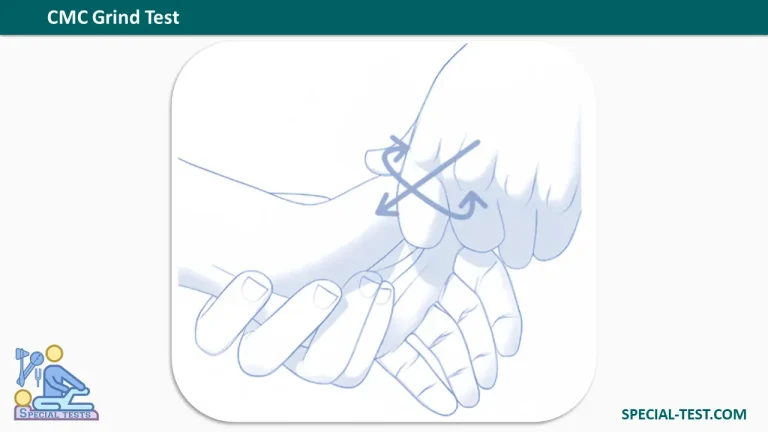
The Thumb CMC Grind Test, also known as the Carpometacarpal Grind Test or Thumb Basal Joint Grind Test, is a clinical orthopedic examination used to assess for osteoarthritis of the first carpometacarpal (CMC) joint. This test helps healthcare professionals investigate pain at the base of the thumb, particularly when thumb CMC osteoarthritis is suspected.
The test involves applying gentle axial compression to the first metacarpal while rotating it against the trapezium. Reproduction of pain at the thumb CMC joint suggests possible degenerative joint disease.
Although the CMC Grind Test is widely used in orthopedic and hand examinations, research demonstrates that it has relatively low sensitivity and moderate-to-high specificity. Therefore, its findings should be interpreted alongside the patient’s medical history, other physical examination tests, and imaging when appropriate.
What Is the Purpose of the Thumb CMC Grind Test?
The primary purpose of the Thumb CMC Grind Test is to evaluate pain associated with osteoarthritis of the thumb carpometacarpal joint, also called basal thumb arthritis or trapeziometacarpal osteoarthritis.
The first CMC joint is a saddle-shaped synovial joint formed between the trapezium bone of the wrist and the base of the first metacarpal. It allows essential thumb movements, including opposition, flexion, extension, abduction, and adduction.
Degenerative changes affecting this joint can cause pain, stiffness, tenderness, reduced pinch strength, and difficulty performing everyday activities.
The CMC Grind Test is particularly useful during the clinical assessment of patients who experience:
- Pain or tenderness at the base of the thumb.
- Discomfort when gripping or pinching objects.
- Pain when turning keys, opening jars, or writing.
- Stiffness and reduced thumb mobility.
- Joint crepitus or a grinding sensation during thumb movement.
The test is intended to provoke symptoms associated with CMC joint osteoarthritis rather than directly assess ligament integrity.
How to Perform the Thumb CMC Grind Test
The CMC Grind Test procedure involves applying controlled axial compression and rotational movement to the thumb metacarpal.
Patient Position
The patient is typically seated comfortably, with the forearm and hand supported in a relaxed position. The examiner positions the hand to allow access to the base of the thumb.
Examiner Position and Technique
- Stabilize the thumb base: The examiner supports the region around the first carpometacarpal joint with one hand.
- Grasp the first metacarpal: Using the opposite hand, the examiner holds the thumb metacarpal securely.
- Apply axial compression: A gentle longitudinal compressive force is directed along the first metacarpal toward the trapezium.
- Perform rotational movement: While maintaining controlled compression, the examiner gently rotates or circumducts the metacarpal at the CMC joint.
- Evaluate the response: The examiner asks whether the maneuver reproduces the patient’s familiar pain at the thumb base and observes for associated crepitus.
The procedure should be performed gently, without excessive force. Severe pain or suspected acute injury warrants stopping the maneuver and reassessing the patient.
What Is a Positive Thumb CMC Grind Test?
A positive CMC Grind Test occurs when axial compression combined with rotation reproduces pain localized to the first carpometacarpal joint.
Patients with thumb basal joint osteoarthritis may report sharp or aching pain during the examination. Some patients also experience crepitus, described as a grinding, clicking, or crackling sensation.
The characteristic findings include:
- Localized pain: Reproduction of the patient’s usual pain at the base of the thumb is the primary positive finding.
- Crepitus: A grinding sensation may accompany the maneuver, although crepitus alone is not sufficient to establish a positive test.
- Tenderness: The joint may be painful to palpation, particularly in symptomatic osteoarthritis.
A positive result supports the clinical suspicion of thumb CMC osteoarthritis. However, it does not independently confirm the diagnosis, because other conditions affecting the thumb base can produce similar symptoms.
What Does a Negative CMC Grind Test Mean?
A negative result occurs when the maneuver does not reproduce characteristic pain at the thumb carpometacarpal joint.
However, a negative Thumb CMC Grind Test does not rule out osteoarthritis.
Some patients with radiographic evidence of CMC osteoarthritis may have a negative grind test. This limitation is particularly important because published studies have demonstrated relatively low sensitivity.
Consequently, clinicians should consider additional provocative tests, localized joint tenderness, functional symptoms, and imaging when evaluating suspected thumb basal joint arthritis.
Thumb CMC Grind Test: Sensitivity and Specificity
The diagnostic accuracy of the Thumb CMC Grind Test has been investigated in several clinical studies.
In a study by Merritt and colleagues published in the Journal of Hand Therapy in 2010, researchers evaluated 70 thumbs from 54 participants. Two physical therapists performed the grind test, with radiographic assessment used as the reference standard.
The reported diagnostic values were:
| Diagnostic Parameter | Result |
|---|---|
| Sensitivity | 42%–53% |
| Specificity | 80%–93% |
| Positive likelihood ratio | 2.65–6.00 |
| Negative likelihood ratio | 0.59–0.62 |
| Interrater reliability (kappa) | 0.48 |
The commonly cited values of 42% sensitivity and 80% specificity represent results from one examiner in that study.
Clinical Interpretation
Sensitivity describes the ability of a clinical test to correctly identify patients with the condition. The relatively low sensitivity of the CMC Grind Test means that it may fail to detect thumb osteoarthritis in some affected patients.
Specificity describes the ability of a test to correctly identify patients without the condition. Its relatively higher specificity means that a positive result may provide useful supporting evidence for CMC osteoarthritis.
A 2016 study by Model and colleagues reported a sensitivity of 41% and specificity of 100% for the grind test in its study population.
Furthermore, a 2025 systematic review of diagnostic methods for thumb osteoarthritis concluded that the grind test does not demonstrate consistently high diagnostic accuracy compared with certain alternative clinical examination maneuvers.
These findings emphasize that the Thumb CMC Grind Test should not be used as the sole diagnostic tool for basal thumb osteoarthritis.
Other Clinical Tests for Thumb CMC Osteoarthritis
Several additional examination techniques may help clinicians evaluate patients with suspected thumb basal joint arthritis.
1. Thumb CMC Lever Test
The examiner grasps the first metacarpal near its base and gently moves it in radial and ulnar directions to reproduce symptoms.
A study by Model and colleagues found that the lever test demonstrated higher sensitivity than the grind test and more effectively reproduced patients’ characteristic basal thumb pain.
2. Metacarpal Pressure-Shear Test
This test applies a shearing force across the thumb CMC joint to provoke symptoms associated with osteoarthritis.
Research by Sela and colleagues found that the pressure-shear test demonstrated 99% sensitivity and 95% specificity in their study population, outperforming the traditional grind test.
3. Thumb Adduction and Extension Tests
These maneuvers assess whether specific thumb movements reproduce pain associated with trapeziometacarpal joint osteoarthritis.
Published research indicates that these tests can provide greater sensitivity than the traditional grind test.
Clinical Importance and Limitations
The Thumb CMC Grind Test remains a familiar component of the orthopedic examination because it is straightforward to perform, requires no specialized equipment, and can help reproduce symptoms associated with basal thumb osteoarthritis.
However, several limitations should be considered.
First, diagnostic accuracy varies between studies and examiners. Second, a negative result cannot reliably exclude radiographic osteoarthritis. Third, localized pain may arise from other conditions, including traumatic injuries affecting the thumb base.
The test should therefore be incorporated into a comprehensive clinical assessment rather than interpreted in isolation.
When clinically indicated, plain radiographs may help identify joint-space narrowing, osteophytes, subchondral changes, and other degenerative findings associated with thumb CMC osteoarthritis.
Frequently Asked Questions (FAQs)
1. What is the Thumb CMC Grind Test used for?
The Thumb CMC Grind Test is primarily used to evaluate suspected osteoarthritis of the first carpometacarpal joint. It helps determine whether compression and rotation reproduce characteristic pain at the base of the thumb.
2. How do you perform a CMC Grind Test?
The examiner stabilizes the thumb base, grasps the first metacarpal, applies gentle axial compression toward the trapezium, and rotates the metacarpal. The patient’s pain response is then evaluated.
3. What indicates a positive CMC Grind Test?
A positive result is indicated by reproduction of pain localized to the thumb CMC joint during axial compression and rotation. Crepitus may also be present.
4. What is the sensitivity and specificity of the CMC Grind Test?
One clinical study reported sensitivity ranging from 42% to 53% and specificity ranging from 80% to 93%, depending on the examiner. Other studies have reported different values, so these figures should not be considered universal.
5. Can a negative CMC Grind Test rule out thumb arthritis?
No. Because the grind test has relatively low sensitivity, a negative result does not reliably exclude thumb CMC osteoarthritis. Additional physical examination findings and radiographs may be necessary.
6. Is the Thumb CMC Grind Test painful?
The maneuver may reproduce pain in patients with symptomatic thumb CMC osteoarthritis. It should be performed with gentle, controlled pressure and stopped if severe discomfort occurs.
7. Is the CMC Grind Test better than the Lever Test?
Not necessarily. Research has shown that the lever test may be more sensitive and better at reproducing typical basal thumb pain. The two tests can be used as complementary examination techniques.
8. Does a positive CMC Grind Test confirm osteoarthritis?
No. A positive result increases clinical suspicion of thumb basal joint osteoarthritis, but diagnosis requires consideration of symptoms, examination findings, and imaging when appropriate.
Conclusion
The Thumb CMC Grind Test is a commonly used orthopedic examination maneuver for assessing suspected osteoarthritis of the first carpometacarpal joint.
It is performed by applying axial compression and controlled rotation to the thumb metacarpal. Reproduction of characteristic pain at the thumb base indicates a positive result, which may be accompanied by crepitus.
Although the test is useful as part of a clinical examination, its relatively low sensitivity limits its effectiveness for excluding thumb CMC osteoarthritis. Diagnostic accuracy can be improved by combining the grind test with other clinical maneuvers, patient history, and appropriate imaging.
References
- Merritt MM, Roddey TS, Costello C, Olson S. Diagnostic value of clinical grind test for carpometacarpal osteoarthritis of the thumb. Journal of Hand Therapy. 2010;23(3):261–267. PubMed – PMID: 20452743
- Model Z, Liu AY, Kang L, et al. Evaluation of Physical Examination Tests for Thumb Basal Joint Osteoarthritis. Hand (N Y). 2016;11(1):108–112. NCBI – Full Text
- Sela Y, Seftchick J, Wang WL, Baratz ME. The diagnostic clinical value of thumb metacarpal grind, pressure-shear, flexion, and extension tests for carpometacarpal osteoarthritis. Journal of Hand Therapy. 2019;32(1):35–40. PubMed – PMID: 29150383
- He Y, et al. Diagnostic accuracy of history taking, physical examination, and auxiliary examination for thumb osteoarthritis: a systematic review. Annals of Medicine. 2025;57(1):2524086. NCBI – Full Text
- Trapeziometacarpal Arthritis: A Prospective Clinical Evaluation of the Thumb Adduction and Extension Provocative Tests. Journal of Hand Surgery. 2015. PubMed – PMID: 25986651
- Thumb CMC Grind Test: Basal Joint Osteoarthritis. Orthofixar. Orthofixar – Clinical Examination Guide