Flick Maneuver Test for Carpal Tunnel Syndrome: Procedure, Positive Sign & Accuracy
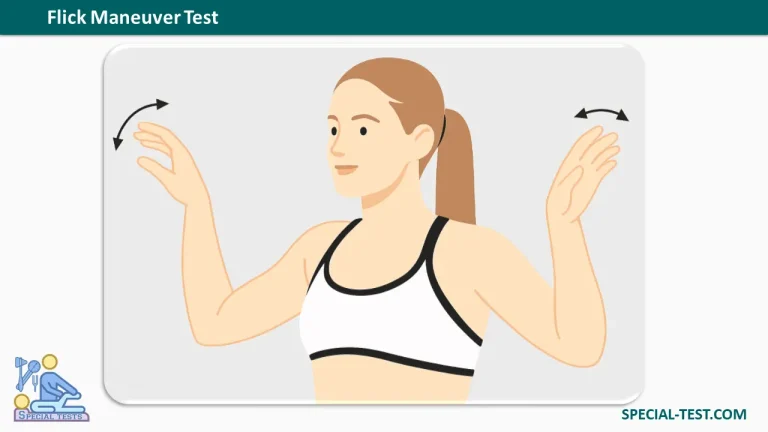
The Flick Maneuver Test, also known as the Flick Sign or Flick Test, is a simple clinical examination technique used to evaluate patients with suspected carpal tunnel syndrome (CTS). It involves shaking or flicking the hands and wrists to determine whether symptoms such as numbness, tingling, and paresthesia improve.
The test is based on the observation that patients with carpal tunnel syndrome frequently shake their hands to relieve discomfort, particularly when symptoms occur at night.
Although the Flick Maneuver Test is quick, inexpensive, and easy to perform, research demonstrates that its diagnostic accuracy is limited. Therefore, it should be interpreted alongside the patient’s medical history, neurological examination, and other diagnostic findings.
What Is the Flick Maneuver Test Used For?
The Flick Maneuver Test is primarily used to assess carpal tunnel syndrome, a common peripheral nerve entrapment disorder caused by compression of the median nerve as it passes through the carpal tunnel at the wrist.
Carpal tunnel syndrome typically produces sensory disturbances in the median nerve distribution, including:
- Thumb
- Index finger
- Middle finger
- Radial (thumb-side) half of the ring finger
Patients commonly report numbness, tingling, burning sensations, or pain in the affected hand. Symptoms may become more noticeable at night, during prolonged wrist positioning, or while performing repetitive hand activities.
Some patients instinctively shake or flick their hands to obtain temporary symptom relief. This characteristic behavior forms the basis of the Flick Maneuver Test.
The test may provide additional clinical evidence supporting median nerve compression at the wrist. However, a positive Flick Sign does not independently confirm carpal tunnel syndrome.
How to Perform the Flick Maneuver Test
The Flick Maneuver Test requires no specialized equipment and can be performed during a routine clinical examination.
Patient Position
The patient may be seated or standing comfortably, with the hands and wrists free to move.
Ideally, the patient should be experiencing numbness, tingling, or paresthesia in the median nerve distribution when the maneuver is performed.
Test Procedure
- Assess the symptoms: Ask the patient to describe the location, severity, and characteristics of any numbness or tingling in the hand.
- Identify the affected area: Confirm whether symptoms involve the thumb, index finger, middle finger, or radial half of the ring finger.
- Perform the maneuver: Instruct the patient to vigorously shake the hand or flick the wrist, similar to shaking water from the fingers or shaking down a thermometer.
- Evaluate symptom changes: Ask whether the tingling, numbness, or discomfort improves after shaking.
- Record the findings: Document the patient’s response, including whether symptom relief is complete, partial, or absent.
Original Flick Sign Assessment
The Flick Sign can also be assessed through the patient’s history.
The examiner asks:
“What do you do with your hand when your symptoms are at their worst?”
If the patient spontaneously demonstrates shaking or flicking the wrist and fingers, this is considered a positive historical Flick Sign.
This approach was described by Pryse-Phillips in a 1984 study investigating the diagnostic value of the sign in carpal tunnel syndrome. [1]
What Is a Positive Flick Maneuver Test?
A positive Flick Maneuver Test occurs when shaking or flicking the hand produces noticeable improvement or relief of numbness, tingling, or paresthesia.
The finding is compatible with median nerve compression, particularly when symptoms follow the characteristic distribution of carpal tunnel syndrome.
A positive result may include:
- Reduced tingling in the thumb, index finger, or middle finger.
- Temporary relief of nighttime hand numbness.
- Improvement in hand paresthesia after vigorous wrist shaking.
- A spontaneous flicking movement demonstrated when describing symptom relief.
However, similar symptoms and relief behaviors can occur in other conditions. Consequently, a positive Flick Sign should be considered a supportive finding rather than definitive evidence of carpal tunnel syndrome.
What Is a Negative Flick Maneuver Test?
A negative Flick Maneuver Test occurs when shaking or flicking the hand does not produce meaningful symptom relief.
The patient may continue experiencing numbness, tingling, or discomfort despite performing the maneuver.
Importantly, a negative Flick Maneuver Test does not rule out carpal tunnel syndrome.
Many patients with electrodiagnostically confirmed median nerve compression do not demonstrate a positive Flick Sign.
The relatively low sensitivity of the test limits its usefulness as an independent screening or exclusion test.
Flick Maneuver Test Accuracy: Sensitivity and Specificity
The diagnostic accuracy of the Flick Maneuver Test was investigated by Hansen, Micklesen, and Robinson in a study published in the American Journal of Physical Medicine & Rehabilitation in 2004.
The study included 142 patients referred for electrodiagnostic evaluation of suspected carpal tunnel syndrome. Clinical findings were compared with nerve conduction study results.
The reported diagnostic values were:
| Diagnostic Parameter | Result |
|---|---|
| Sensitivity | 37% |
| Specificity | 74% |
| Positive Predictive Value | 74% |
| Negative Predictive Value | 37% |
Understanding the Results
Sensitivity of 37%: Approximately 37% of patients with electrodiagnostically confirmed carpal tunnel syndrome demonstrated a positive Flick Maneuver Test. This indicates that the test misses a substantial proportion of affected patients.
Specificity of 74%: Approximately 74% of patients without carpal tunnel syndrome had a negative test result, while about 26% demonstrated false-positive findings.
Positive Predictive Value of 74%: In the study population, 74% of patients with a positive Flick Sign had electrodiagnostically confirmed carpal tunnel syndrome. This value depends on disease prevalence and should not be generalized to all clinical populations.
The researchers concluded that the Flick Maneuver had limited diagnostic utility because of its relatively low sensitivity and moderate specificity. [2]
A 2023 systematic review and meta-analysis of provocative tests for carpal tunnel syndrome also reported these findings and emphasized the limitations of individual clinical examination maneuvers. [3]
Clinical Significance of the Flick Maneuver Test
The Flick Maneuver Test remains a useful component of the clinical assessment of suspected carpal tunnel syndrome, especially when evaluating patients with intermittent or nocturnal hand paresthesia.
Its main clinical advantages include simplicity, rapid administration, and the absence of specialized equipment.
Nevertheless, the test should not be used alone to diagnose median nerve compression.
A comprehensive evaluation may also include:
- Phalen Test: Sustained wrist flexion used to reproduce symptoms associated with median nerve compression.
- Tinel Sign: Percussion over the median nerve at the wrist to assess for tingling in its sensory distribution.
- Durkan Carpal Compression Test: Direct pressure over the carpal tunnel to reproduce characteristic symptoms.
- Sensory Examination: Assessment of sensation in the median nerve distribution.
- Motor Examination: Evaluation of thumb abduction, opposition, and thenar muscle weakness.
- Nerve Conduction Studies: Electrodiagnostic assessment of median nerve function when clinically indicated.
Electrodiagnostic testing or ultrasound may be useful in patients with atypical presentations, diagnostic uncertainty, or when another neurological disorder is suspected. [4]
Limitations of the Flick Maneuver Test
Despite its simplicity, the Flick Maneuver Test has several important limitations.
First, its low sensitivity means that many patients with carpal tunnel syndrome will have a negative result.
Second, improvement after shaking the hand is not specific to median nerve compression. Other neurological or musculoskeletal conditions may produce overlapping symptoms.
Third, the test depends partly on the patient’s subjective perception of symptom improvement. Results may therefore vary according to symptom severity and whether paresthesia is present during the examination.
Finally, the diagnostic performance reported in individual studies may differ according to patient selection, disease severity, and the reference standard used.
For these reasons, clinicians should interpret the Flick Sign in the context of the complete clinical examination rather than as a stand-alone diagnostic test.
Frequently Asked Questions (FAQs)
1. What is the Flick Maneuver Test?
The Flick Maneuver Test is a clinical examination used to assess suspected carpal tunnel syndrome. The patient shakes or flicks the wrist and hand to determine whether numbness or tingling improves.
2. What does a positive Flick Sign indicate?
A positive Flick Sign occurs when hand shaking or wrist flicking relieves paresthesia. This finding may support a diagnosis of carpal tunnel syndrome, particularly when symptoms occur in the median nerve distribution. However, it is not diagnostic by itself.
3. What is the sensitivity of the Flick Maneuver Test?
The Flick Maneuver Test demonstrated a sensitivity of 37% in the 2004 study by Hansen and colleagues. This indicates that many patients with confirmed carpal tunnel syndrome do not have a positive test result.
4. What is the specificity of the Flick Maneuver Test?
The reported specificity is 74%, meaning approximately 74% of patients without carpal tunnel syndrome had a negative test result in the study population.
5. Can a negative Flick Test rule out carpal tunnel syndrome?
No. Because the test has low sensitivity, a negative result cannot reliably exclude carpal tunnel syndrome. Additional clinical assessment may be required.
6. Why do patients with carpal tunnel syndrome shake their hands?
Some patients experience temporary relief of numbness or tingling when they shake or reposition their hands. This characteristic behavior is commonly associated with nighttime symptoms of carpal tunnel syndrome. The precise mechanism of temporary relief is not fully established.
7. What is the difference between the Flick Test and Phalen Test?
The Flick Test evaluates improvement in existing symptoms following hand shaking or the patient’s spontaneous shaking behavior. In contrast, the Phalen Test involves sustained wrist flexion to reproduce symptoms associated with median nerve compression.
Both tests contribute to clinical evaluation but have limitations when used individually.
8. Is the Flick Maneuver Test enough to diagnose carpal tunnel syndrome?
No. Diagnosis requires consideration of the patient’s symptoms, medical history, sensory and motor examination findings, and other relevant clinical tests. Electrodiagnostic studies or ultrasound may be appropriate when the diagnosis is uncertain.
Conclusion
The Flick Maneuver Test is a simple clinical assessment used to support the diagnosis of carpal tunnel syndrome. A positive result involves improvement of hand numbness or tingling after shaking or flicking the wrist.
Although the maneuver is quick and requires no equipment, its reported sensitivity of 37% and specificity of 74% demonstrate important diagnostic limitations.
Therefore, the Flick Maneuver Test should be used as part of a comprehensive assessment that includes clinical history, neurological examination, and additional diagnostic testing when indicated.
References
- Pryse-Phillips WE. Validation of a diagnostic sign in carpal tunnel syndrome. J Neurol Neurosurg Psychiatry. 1984;47(8):870–872. doi:10.1136/jnnp.47.8.870. PubMed – PMID: 6470728.
- Hansen PA, Micklesen P, Robinson LR. Clinical utility of the flick maneuver in diagnosing carpal tunnel syndrome. Am J Phys Med Rehabil. 2004;83(5):363–367. doi:10.1097/01.phm.0000124439.14757.99. PubMed – PMID: 15100625.
- Dabbagh A, et al. Diagnostic Test Accuracy of Provocative Maneuvers for the Diagnosis of Carpal Tunnel Syndrome: A Systematic Review and Meta-Analysis. Physical Therapy. 2023;103(6). doi:10.1093/ptj/pzad029. NCBI – Full Text.
- Wipperman J, Goerl K. Carpal Tunnel Syndrome: Diagnosis and Management. Am Fam Physician. 2016;94(12):993–999. PubMed – PMID: 28075090.
- OrthoFixar. Flick Maneuver Test: Diagnostic Screening for Carpal Tunnel Syndrome. OrthoFixar – Clinical Test Overview.