The Boyes Test: A Clinical Examination for Central Slip Integrity in Extensor Hood Injuries
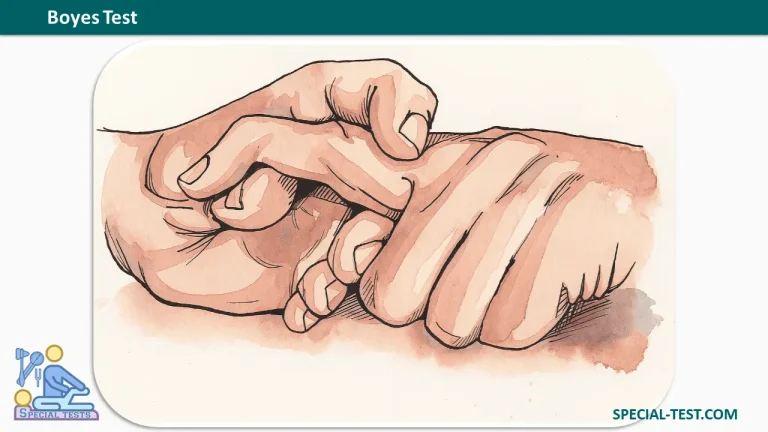
The Boyes Test is a specialized orthopedic examination maneuver used to assess the integrity of the central slip of the extensor hood in the fingers. The central slip is a critical component of the finger’s extensor mechanism, inserting onto the base of the middle phalanx and primarily responsible for extending the proximal interphalangeal (PIP) joint. When this structure is disrupted—whether through trauma, laceration, or closed rupture—the patient is at risk of developing a boutonnière deformity, a progressive and disabling condition characterized by PIP joint flexion and distal interphalangeal (DIP) joint hyperextension. The Boyes Test was designed as a non-invasive clinical tool to help clinicians detect central slip compromise before the deformity becomes fixed and irreversible.
Anatomy and Clinical Relevance of the Central Slip
The extensor hood is a complex fibrous expansion over the dorsum of the proximal phalanx. The extrinsic extensor tendon continues distally as the central slip, which inserts onto the dorsal base of the middle phalanx and the PIP joint capsule. Flanking the central slip are the lateral bands, which are formed by contributions from the intrinsic muscles and the extensor tendon itself. In a normal finger, the central slip and lateral bands work in concert: the central slip extends the PIP joint, while the lateral bands extend the DIP joint. When the central slip ruptures, the balanced forces are lost. The lateral bands migrate volarly and become flexors of the PIP joint, while their unopposed pull on the distal phalanx produces DIP joint hyperextension. This cascade is the hallmark of a boutonnière deformity. Early recognition of central slip injury is therefore paramount, and the Boyes Test was introduced as a bedside screening tool for this purpose.
How to Perform the Boyes Test
The Boyes Test is simple to perform and requires no specialized equipment. The examiner should first ensure the patient is comfortable and that the hand is accessible for examination. The technique proceeds as follows:
- The examiner holds the finger to be examined in slight extension at the proximal interphalangeal (PIP) joint. Stabilizing the PIP joint is essential; failure to properly immobilize this joint is one of the most common mistakes during the examination.
- While maintaining the PIP joint in this extended position, the patient is asked to actively flex the distal interphalangeal (DIP) joint.
- The examiner observes the patient’s ability to perform this isolated DIP flexion. The test is considered positive if the patient is unable to flex the DIP joint or experiences significant difficulty doing so. A positive result suggests a loss of central slip integrity, as the normal tenodesis effect—where PIP extension creates passive tension on the extensor mechanism that allows DIP flexion—is disrupted.
- Conversely, the test is negative if the patient can easily flex the DIP joint with a normal range of motion, indicating that the central slip is likely intact.
Interpretation and Evidence-Based Considerations
A positive Boyes Test is a warning sign of central slip compromise, but clinicians must interpret the result with an understanding of its limitations. Landmark research has clarified the test’s role in clinical practice. Elson’s 1986 study in the Journal of Bone and Joint Surgery noted that while early diagnosis of central slip rupture offers the best chance of satisfactory treatment, Boyes’ test becomes positive only at a late stage. This is a critical caveat: a negative Boyes Test in the acute setting does not rule out a central slip injury. The test may only become positive once the extensor mechanism has sufficiently failed, allowing the lateral bands to migrate and disrupt the normal DIP flexion tenodesis.
A cadaveric analysis by Rubin et al., published in the Journal of Hand Surgery (British and European Volume) in 1996, further scrutinized the test’s diagnostic accuracy. Using fresh frozen cadaver fingers, the authors simulated both a pre-boutonnière deformity (isolated central slip division) and a passively correctable boutonnière deformity (division of the central slip, triangular ligament, and oblique fibers). The Boyes Test—which evaluates DIP joint flexion—was found not to be reliable for the diagnosis of either injury. The same study identified Elson’s test as the only maneuver able to discern central slip integrity in both simulated injury models. These findings do not render the Boyes Test obsolete, but they do position it as a supplementary examination rather than a definitive diagnostic tool. Contemporary clinical resources, such as Orthofixar, continue to list the Boyes Test as a specialized technique for evaluating central slip integrity, particularly in emergency medicine, orthopedics, and hand surgery settings.
Clinical Significance and When to Use the Boyes Test
The Boyes Test is indicated whenever a clinician suspects injury to the finger’s extensor mechanism. Typical scenarios include finger trauma, suspected tendon damage, post-surgical evaluation, chronic finger pain or dysfunction, and sports-related hand injuries. The test is quick, cost-effective, and requires minimal patient discomfort, making it a practical screening tool in both primary care and specialist hand clinics. However, because of its limited sensitivity in acute injuries, a negative Boyes Test should never be used as the sole basis for excluding a central slip rupture. Clinicians should pair the Boyes Test with Elson’s test, which evaluates DIP joint rigidity while the patient actively extends a flexed PIP joint, and with imaging when the clinical picture remains uncertain. Differential diagnoses to consider include mallet finger injuries, swan neck deformity, fractures of the middle phalanx, and ligamentous injuries of the PIP joint.
FAQ: Boyes Test and Central Slip Injuries
What exactly does the Boyes Test detect?
The Boyes Test is designed to detect compromise of the central slip of the extensor hood. A positive result—inability to flex the DIP joint while the PIP is held in extension—suggests that the central slip is no longer providing the normal tenodesis effect required for isolated DIP flexion.
Is the Boyes Test reliable in acute central slip injuries?
According to peer-reviewed evidence, the Boyes Test may become positive only at a late stage of central slip rupture. Cadaveric studies have found it unreliable for diagnosing both pre-boutonnière and passively correctable boutonnière injuries. It is best used as part of a broader clinical assessment rather than as a stand-alone diagnostic test.
How does the Boyes Test compare to Elson’s Test?
Elson’s test has been shown in cadaveric research to be more reliable than the Boyes Test for discerning central slip integrity. Elson’s test evaluates DIP joint rigidity while the patient actively extends a flexed PIP joint, whereas the Boyes Test evaluates the patient’s ability to flex the DIP joint with the PIP held in extension. Many hand surgeons perform both maneuvers to improve diagnostic confidence.
Can a negative Boyes Test rule out a central slip injury?
No. A negative Boyes Test does not exclude a central slip injury, particularly in the acute phase. The test’s late positivity means that a patient with a recent rupture may still be able to flex the DIP joint during the examination. Clinical suspicion should guide further evaluation, including Elson’s test and imaging.
What happens if a central slip injury is missed?
An undiagnosed central slip rupture can progress to a boutonnière deformity, characterized by PIP joint flexion, DIP joint hyperextension, loss of finger extension, chronic pain, and reduced grip strength. Early diagnosis and appropriate splinting or surgical repair offer the best chance of restoring normal extensor mechanism function.
References
- Orthofixar. Boyes Test for Central Slip Injuries. Available at: https://orthofixar.com/special-test/boyes-test-for-central-slip-injury/
- Elson RA. Rupture of the central slip of the extensor hood of the finger. A test for early diagnosis. J Bone Joint Surg Br. 1986;68(2):229–231. PubMed: https://pubmed.ncbi.nlm.nih.gov/3958008/
- Rubin J, et al. Diagnosis of closed central slip injuries. A cadaveric analysis of non-invasive tests. J Hand Surg Br. 1996;21(5):614–616. PubMed: https://pubmed.ncbi.nlm.nih.gov/9230945/