Piano Key Sign: A Comprehensive Guide to Assessing DRUJ Instability and TFCC Tears
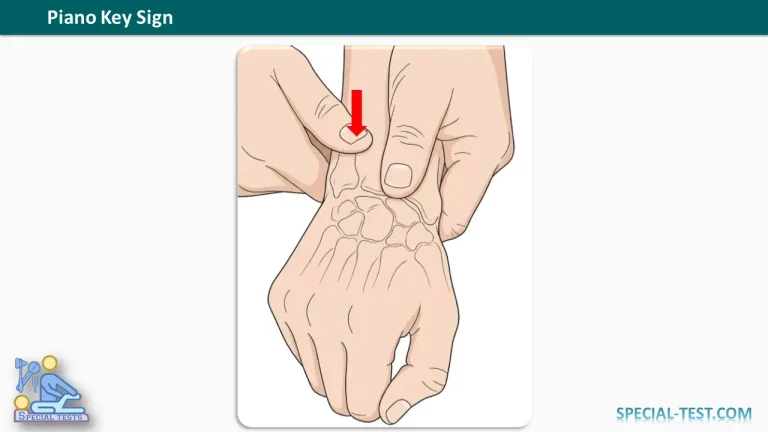
The Piano Key Sign is a widely used provocative maneuver in wrist examination, specifically designed to evaluate the stability of the distal radioulnar joint (DRUJ) and the integrity of the triangular fibrocartilage complex (TFCC). This clinical test derives its name from the characteristic spring-back motion of the ulnar head, which resembles the action of depressing and releasing a key on a piano. For clinicians, understanding the correct technique and interpretation of the Piano Key Sign is essential for diagnosing ulnar-sided wrist pain, a condition that is notoriously challenging to evaluate.
What Is the Piano Key Sign Used For?
The primary purpose of the Piano Key Sign is to assess the stability of the DRUJ and to detect lesions of the TFCC, which serves as the main stabilizer of this joint. The DRUJ is a uniaxial pivot joint that connects the distal radius and ulna, and the TFCC—a fibrocartilage disk interposed between the medial proximal carpal row and the distal ulna—plays a critical role in enhancing joint congruity and cushioning compressive forces. When the TFCC is torn or the DRUJ becomes unstable, the ulnar head may exhibit excessive translation, which is precisely what the Piano Key Sign aims to uncover. Clinically, this test is employed in the evaluation of ulnar-sided wrist pain, a condition that may arise from ligament tears, TFCC injuries, or distal radius fractures. A review published in the Journal of the American Academy of Orthopaedic Surgeons emphasizes that an anatomically based, methodical physical examination coupled with provocative maneuvers—including the piano key test—further defines the differential diagnosis of ulnar-sided wrist pain.
How to Perform the Piano Key Sign
The technique for eliciting the Piano Key Sign is straightforward but requires careful attention to hand positioning and force application. According to the detailed guide provided by Orthofixar, the clinician firmly stabilizes the distal radius with one hand and grasps the head of the ulna between the thumb and the index finger of the other hand. The ulnar head is then depressed in an anterior (palmar) direction, much like depressing a key on a piano. Importantly, the test is typically performed with the forearm in pronation, although some sources suggest comparing the affected wrist with the contralateral side in both pronation and supination to account for natural joint laxity. A biomechanical study using cadaver specimens confirmed that the piano-key test involves passive translation of the ulna in the dorsal-volar direction relative to the radius, and that this translation can be quantified to assess instability.
What Constitutes a Positive Result?
A positive Piano Key Sign is characterized by two key findings: either excessive anterior (palmar) movement of the ulnar head or a pronounced spring-back of the ulna into a high posterior (dorsal) position upon release. Additionally, the patient may report discomfort or pain during the maneuver. Orthofixar notes that the sign is positive for a TFCC tear or triquetral instability when these features are present. In clinical practice, a positive test suggests that the ulnar head is abnormally mobile, which points toward a disruption of the stabilizing structures of the DRUJ. It is important to compare the affected wrist with the uninjured contralateral wrist to distinguish pathological laxity from normal physiological laxity.
Diagnostic Accuracy and Clinical Significance
The diagnostic performance of the Piano Key Sign has been investigated in several studies. A descriptive study cited by Orthofixar reported a sensitivity of 66% and a specificity of 64% for the test. However, other investigations have reported a higher sensitivity of approximately 81.7% and a specificity of 73.5% when the test is used to detect TFCC injuries. These figures underscore that while the Piano Key Sign is a valuable clinical tool, it is not definitive in isolation. A biomechanical study published in the Journal of Hand Surgery (European Volume) found that after complete release of the triangular ligament, only the DRUJ ballottement test demonstrated statistically significant accuracy in evaluating instability, suggesting that the piano key test may be less sensitive in certain scenarios. Consequently, experts recommend combining the Piano Key Sign with other provocative tests—such as the ulnar fovea sign and the distal ulnar ballottement test—to improve diagnostic yield. The sign may also be positive in cases of DRUJ synovitis, further expanding its clinical relevance beyond traumatic instability.
Frequently Asked Questions (FAQ)
1. What does a positive Piano Key Sign indicate?
A positive Piano Key Sign typically indicates instability of the distal radioulnar joint (DRUJ) or a tear of the triangular fibrocartilage complex (TFCC). It may also be positive in cases of DRUJ synovitis.
2. In which forearm position should the Piano Key Sign be performed?
The test is most commonly performed with the forearm in pronation, but comparing both pronation and supination with the contralateral wrist is advised to account for individual variations in joint laxity.
3. Is the Piano Key Sign reliable for diagnosing TFCC tears?
The test demonstrates moderate reliability. Reported sensitivity ranges from 57% to 81.7%, and specificity ranges from 64% to 73.5%. It is best used as part of a comprehensive clinical examination rather than as a stand-alone diagnostic tool.
4. Can the Piano Key Sign be positive without a TFCC tear?
Yes. The sign may be positive in other conditions that affect DRUJ stability, such as ligamentous laxity, inflammatory arthritis with synovitis, or after distal radius fractures. Therefore, imaging and clinical correlation are often necessary.
5. How does the Piano Key Sign compare to other wrist tests?
The Piano Key Sign is one of several provocative maneuvers for ulnar-sided wrist pain. It is often used alongside the ulnar fovea sign, the ballottement test, and the ulnocarpal stress test to increase diagnostic accuracy. Combining tests generally yields higher specificity than using any single test alone.
References
- Orthofixar. Piano Key Sign Test: Assessing DRUJ Instability And TFCC Tears. Available at: https://orthofixar.com/special-test/piano-key-sign/
- Moriya T, et al. Effect of triangular ligament tears on distal radioulnar joint instability and evaluation of three clinical tests: a biomechanical study. J Hand Surg Eur Vol. 2009;34(2):219-223. PMID: 19282400. Available at: https://pubmed.ncbi.nlm.nih.gov/19282400/
- DaSilva MF, et al. Evaluation of Ulnar-sided Wrist Pain. J Am Acad Orthop Surg. 2017;25(8):e150-e156. PMID: 28737618. Available at: https://pubmed.ncbi.nlm.nih.gov/28737618/
- PMC Article. Predictive factors of distal radioulnar joint instability after surgical treatment of distal radius fractures. Medicine (Baltimore). 2023;102(41):e40057. PMCID: PMC10695496. Available at: https://pmc.ncbi.nlm.nih.gov/articles/PMC10695496/