Naffziger Test: Purpose, Procedure, Positive Sign, and Clinical Significance
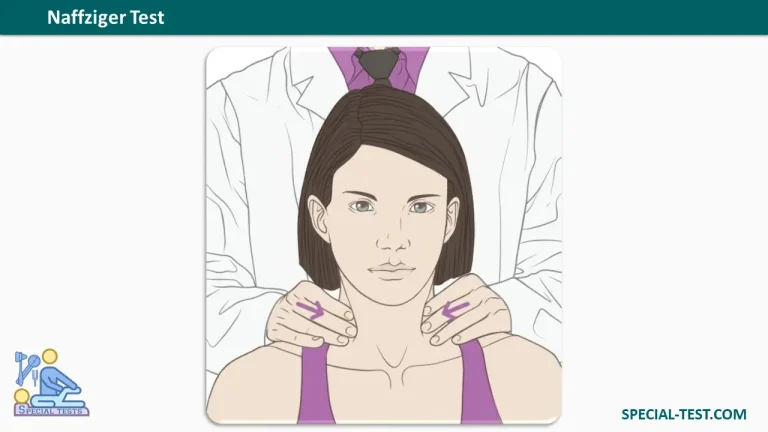
The Naffziger Test, also called Naffziger’s Sign or the Jugular Compression Test, is a traditional neurological examination maneuver used to assess possible spinal nerve root compression in the cervical, thoracic, and lumbar regions. The test involves compression of the jugular veins followed by coughing to determine whether these actions reproduce spinal or radicular pain.
The test is named after Howard Christian Naffziger (1884–1961), an American neurosurgeon. Although historically used to investigate nerve root irritation and potential space-occupying spinal lesions, the Naffziger Test is not a definitive diagnostic procedure and has a limited role in contemporary clinical practice. [1]
What Is the Naffziger Test Used For?
The primary purpose of the Naffziger Test is to identify symptoms that may suggest irritation or compression of spinal nerve roots.
It has historically been used in the assessment of:
- Cervical radiculopathy: Irritation or compression of cervical nerve roots, potentially causing neck pain radiating into the shoulder or upper extremity.
- Thoracic radiculopathy: Nerve root involvement in the thoracic spine, which may produce pain radiating around the chest or trunk.
- Lumbar radiculopathy: Compression or inflammation of lumbar nerve roots, potentially producing lower back pain, sciatica, numbness, or weakness.
- Intervertebral disc herniation: Displacement of disc material that may compress nearby spinal nerve roots.
- Space-occupying spinal lesions: Abnormal structures, including tumors, that may exert pressure on neural tissues.
A positive Naffziger Test may raise suspicion of a spinal nerve root disorder, but it cannot establish the location, severity, or underlying cause of compression. [1, 3]
How Does the Naffziger Test Work?
The Naffziger Test is based on the relationship between venous pressure, cerebrospinal fluid pressure, and the sensitivity of spinal neural structures.
The jugular veins are major blood vessels responsible for draining venous blood from the head and neck. Compression of these veins can impede venous drainage and may increase intracranial venous and cerebrospinal fluid pressure.
Historically, the Naffziger maneuver was intended to increase pressure within the spinal thecal sac, particularly when combined with coughing.
The spinal thecal sac is the protective meningeal covering surrounding the spinal cord and associated nerve roots. A pressure change may aggravate symptoms when neural structures are already irritated or compressed.
However, reproducing symptoms through this mechanism does not prove that a specific nerve root is compressed or that a spinal tumor is present.
How to Perform the Naffziger Test
The following steps describe the traditional Naffziger Test procedure for educational purposes. Because it involves compression of vascular structures in the neck, it should not be attempted as a self-examination or performed routinely without appropriate clinical expertise.
Patient Position
- The patient is placed in a comfortable seated position, with the head and neck maintained in a neutral alignment.
- The examiner stands behind the patient.
- The examiner identifies the anatomical location of the jugular veins on either side of the neck, adjacent to the carotid arteries.
Historical Test Procedure
- In the traditional description, the examiner applies pressure over the jugular veins for approximately 30 seconds.
- The maneuver may produce facial flushing due to restricted venous drainage.
- The patient is then asked to cough while the examiner observes whether the patient’s characteristic spinal or radiating pain is reproduced.
- The examiner records the location, distribution, and nature of any symptoms.
Historical note: Naffziger originally described a prolonged compression technique lasting up to 10 minutes. This is a historical description, not a recommendation for modern clinical use. [1]
Safety Precautions
The examination must be discontinued immediately if the patient develops:
- Dizziness or light-headedness.
- Faintness or altered consciousness.
- Visual disturbances.
- Unusual discomfort or neurological symptoms.
Compression near the carotid sinus can affect cardiovascular reflexes. Published guidance concerning carotid sinus manipulation demonstrates why neck vascular compression requires particular caution. [6]
What Is a Positive Naffziger Test?
A positive Naffziger Test occurs when the maneuver reproduces or aggravates the patient’s characteristic spinal or radicular pain, particularly after coughing.
Possible positive findings include:
- Increased lower back pain during coughing.
- Reproduction of pain radiating from the lumbar spine into the lower extremity.
- Aggravation of existing symptoms consistent with nerve root irritation.
- Reproduction of characteristic pain in another spinal region.
A positive response may suggest spinal nerve root irritation, nerve root compression, or a space-occupying lesion. However, these possibilities require further clinical assessment.
Importantly, a positive Naffziger Test does not establish a diagnosis of spinal tumor, disc herniation, or any particular neurological disorder. [1]
What Is a Negative Naffziger Test?
A negative Naffziger Test occurs when the historical maneuver does not reproduce or worsen the patient’s characteristic symptoms.
However, a negative result does not exclude spinal nerve root compression.
Patients with confirmed radiculopathy may have negative provocative examination findings. Therefore, the result must be considered alongside the medical history, neurological assessment, and other relevant examinations.
Clinical Accuracy and Diagnostic Value
The available scientific evidence regarding the Naffziger Test is limited.
A study published in Spine in 2000 by Vroomen and colleagues evaluated the consistency of clinical examination findings in 91 patients with suspected lumbar nerve root involvement.
The researchers reported that Naffziger’s sign, straight leg raising, crossed straight leg raising, and Bragard’s sign were among the more consistent nerve root tension signs, with interobserver agreement measured by kappa values greater than 0.66. [2]
However, interobserver reliability is not the same as diagnostic accuracy. Agreement between examiners does not establish that a test accurately detects nerve root compression.
A subsequent investigation of patients with suspected lumbosacral nerve root compression demonstrated that clinical history and physical examination findings must be interpreted together, rather than relying on an isolated examination sign. [4]
Furthermore, a systematic review of clinical examination findings for low back pain reported limited evidence for the prognostic value of Naffziger’s sign. [5]
Consequently, there is insufficient evidence to recommend the Naffziger Test as a standalone diagnostic method or to assign it reliable sensitivity and specificity values.
Naffziger Test Compared With Other Spinal Examination Tests
Several other physical examination maneuvers are used when spinal radiculopathy is suspected.
Straight Leg Raise Test (SLR): Commonly used to assess lumbosacral nerve root irritation, especially in patients presenting with sciatica.
Slump Test: A neurodynamic examination that evaluates symptom reproduction during progressive positioning of the spine and lower extremities.
Spurling Test: A cervical spine provocative maneuver used to support the clinical assessment of suspected cervical radiculopathy.
Valsalva Maneuver: Involves forced expiration against a closed airway, increasing intrathoracic pressure and potentially reproducing symptoms associated with cervical nerve root irritation.
Unlike the Naffziger Test, these examinations do not require direct compression of the jugular veins.
A systematic review published in the European Spine Journal found that Spurling’s test, cervical distraction, and the Valsalva maneuver may provide useful clinical information in selected patients, although the supporting evidence has important limitations. [7]
Clinical Significance of the Naffziger Test
The Naffziger Test remains relevant primarily as a historical neurological examination sign and an educational topic in orthopedic assessment.
In contemporary practice, the investigation of suspected radiculopathy generally relies on a combination of:
- Detailed history of pain onset, location, and radiation.
- Sensory testing and evaluation of dermatomal abnormalities.
- Muscle strength and myotomal examination.
- Deep tendon reflex assessment.
- Appropriate provocative and neurodynamic tests.
- Magnetic resonance imaging (MRI) when clinically indicated.
- Electrodiagnostic testing in selected cases.
MRI is particularly valuable when serious spinal pathology is suspected or when neurological deficits require further investigation. [3]
Progressive weakness, bowel or bladder dysfunction, or saddle anesthesia may indicate a neurological emergency and require urgent medical assessment. [8]
Frequently Asked Questions (FAQs)
1. What is the purpose of the Naffziger Test?
The Naffziger Test is a traditional examination used to investigate possible spinal nerve root irritation or compression. It has historically been applied to cervical, thoracic, and lumbar spinal disorders.
2. How is the Naffziger Test performed?
Historically, the patient sits while an examiner compresses the jugular veins for approximately 30 seconds and then asks the patient to cough. The examiner observes whether familiar spinal or radiating pain is reproduced. Because of potential risks from neck compression, this description is educational rather than a recommendation to perform the maneuver.
3. What indicates a positive Naffziger Test?
A positive test is characterized by reproduction or worsening of the patient’s typical spinal or radicular pain during the maneuver, particularly with coughing.
4. Does a positive Naffziger Test confirm a herniated disc?
No. A positive result may suggest nerve root irritation, but it cannot confirm a herniated disc. Diagnosis requires appropriate clinical evaluation and, when indicated, imaging.
5. Can the Naffziger Test detect a spinal tumor?
The test was historically associated with identifying possible space-occupying spinal lesions. However, it cannot reliably detect or diagnose a spinal tumor. Suspected tumors require medical evaluation and appropriate imaging, usually MRI.
6. Is the Naffziger Test safe?
The maneuver involves pressure over important vascular structures in the neck. Dizziness, faintness, and other adverse responses are potential concerns. It should not be performed by patients on themselves, and its limited diagnostic value does not justify routine unsupervised use.
7. Is the Naffziger Test still commonly used?
The Naffziger Test is mainly of historical and educational interest. Modern assessment of spinal nerve root compression emphasizes neurological examination, better-studied provocative tests, and diagnostic imaging when necessary.
Conclusion
The Naffziger Test is a historical neurological examination technique designed to investigate possible spinal nerve root compression through jugular vein compression and coughing.
Reproduction of spinal or radicular pain represents a positive finding and may suggest irritation of neural structures. Nevertheless, the test has limited supporting evidence, does not establish a definitive diagnosis, and carries potential safety concerns because of its effects on neck vascular structures.
For accurate evaluation of suspected cervical, thoracic, or lumbar radiculopathy, clinicians should rely on a comprehensive neurological assessment, appropriate physical examination findings, and imaging when clinically indicated.
References
- OrthoFixar. Naffziger Test: Clinical Examination for Spinal Nerve Root Compression. https://orthofixar.com/special-test/naffziger-test/
- Vroomen PC, de Krom MC, Knottnerus JA. Consistency of history taking and physical examination in patients with suspected lumbar nerve root involvement. Spine. 2000;25(1):91–97. PMID: 10647166. PubMed
- Margetis K, Magnus W, Mesfin FB. Cervical Radiculopathy. StatPearls. NCBI Bookshelf. NCBI
- Vroomen PCAJ, et al. Diagnostic value of history and physical examination in patients suspected of lumbosacral nerve root compression. J Neurol Neurosurg Psychiatry. 2002;72(5):630–634. PubMed Central
- Clinical examination findings as prognostic factors in low back pain: a systematic review of the literature. PubMed Central
- Carotid Sinus Hypersensitivity. StatPearls. NCBI Bookshelf. NCBI
- Rubinstein SM, Pool JJM, van Tulder MW, Riphagen II, de Vet HCW. A systematic review of the diagnostic accuracy of provocative tests of the neck for diagnosing cervical radiculopathy. European Spine Journal. 2007. PMID: 17013656. PubMed
- Low Back Pain: Evaluation and Management. StatPearls. NCBI Bookshelf. NCBI