Slump Test: Procedure, Positive Results & Accuracy
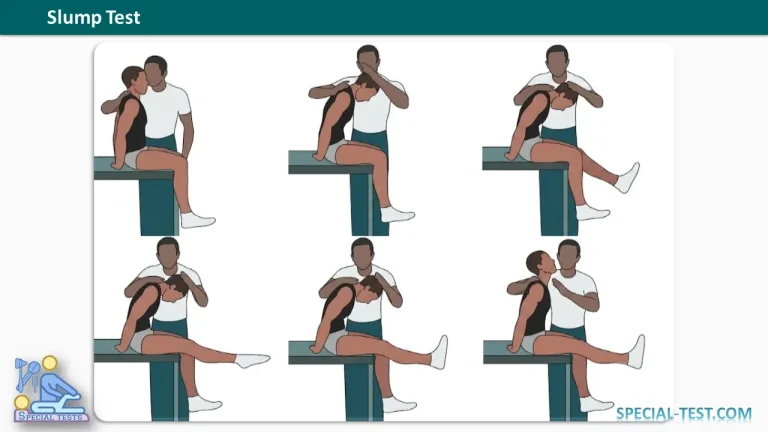
The Slump Test is a commonly used orthopedic and neurological examination technique designed to assess neural mechanosensitivity and identify possible lumbar nerve root irritation. It is particularly useful in evaluating patients with low back pain, sciatica, radiating leg pain, and suspected lumbar disc herniation.
Also known as the Seated Slump Test, this neurodynamic examination progressively increases mechanical loading on the neural structures of the spine and lower extremity. By observing how symptoms change during specific movements, healthcare professionals can determine whether neural tissue may contribute to a patient’s symptoms.
What Is the Slump Test Used For?
The primary purpose of the Slump Test is to assess the involvement of neural structures in patients experiencing lower back and leg symptoms.
The test is commonly used when evaluating:
- Lumbar disc herniation: A herniated intervertebral disc may irritate or compress a lumbar nerve root, producing radiating symptoms.
- Lumbar radiculopathy: Nerve root irritation or dysfunction may cause radiating pain, numbness, tingling, or weakness in the lower extremity.
- Sciatica: Pain radiating from the lower back or buttock into the leg may indicate irritation of neural structures associated with the sciatic nerve.
- Increased neural mechanosensitivity: The test helps determine whether neural tissues are unusually sensitive to mechanical loading or movement.
Although the Slump Test is useful for evaluating suspected disc-related nerve irritation, it cannot independently confirm a disc bulge, lumbar disc herniation, or nerve root compression. Its findings must be interpreted alongside the patient’s history, neurological examination, and imaging when clinically indicated.
How to Perform the Slump Test
The Slump Test is performed with the patient sitting on the edge of an examination table, allowing both lower legs to hang freely.
The examiner should perform the procedure progressively, monitoring symptoms throughout each stage.
Step 1: Starting Position
Ask the patient to sit upright on the examination table with the hips and knees approximately flexed to 90 degrees. The patient’s hands may be positioned behind the back.
Initially, the head and neck should remain in a neutral position, with the patient looking straight ahead.
Step 2: Thoracic and Lumbar Flexion
Instruct the patient to slump forward by flexing the thoracic and lumbar spine.
The examiner may gently maintain the slumped position while assessing whether the movement reproduces any symptoms.
Step 3: Cervical Flexion
Ask the patient to flex the neck by bringing the chin toward the chest.
This movement increases mechanical loading along the neural structures and may reproduce or intensify existing symptoms.
Step 4: Knee Extension
While maintaining the slumped spinal position and cervical flexion, ask the patient to slowly extend one knee.
The examiner observes the available knee extension and asks about pain, tingling, numbness, or other sensations.
Step 5: Ankle Dorsiflexion
Next, dorsiflex the ankle of the tested leg by bringing the toes toward the shin.
Ankle dorsiflexion further increases mechanical loading on neural structures in the posterior lower extremity.
Step 6: Cervical Extension (Structural Differentiation)
If familiar symptoms are reproduced, ask the patient to extend the cervical spine by lifting the head while maintaining the lower-extremity position.
A reduction in familiar leg symptoms with cervical extension supports a neural contribution to the patient’s symptoms.
The examination can be repeated on the opposite leg to compare responses.
The test should be performed gently by a trained clinician and should not involve forcefully pushing through severe pain.
What Is a Positive Slump Test?
A positive Slump Test is generally characterized by reproduction of the patient’s familiar radiating leg pain or other concordant neural symptoms during the examination, particularly when those symptoms change with structural differentiation.
Findings that support a positive result include:
- Reproduction of familiar radicular pain during knee extension or ankle dorsiflexion.
- Increased radiating symptoms when the spine and neck are flexed.
- Reduction of symptoms when cervical flexion is released.
- A meaningful difference in symptom reproduction between the affected and unaffected legs.
However, isolated posterior thigh tightness or stretching discomfort does not necessarily indicate lumbar radiculopathy.
Research involving asymptomatic individuals has demonstrated that sensory responses are common during the Slump Test. Therefore, clinicians must distinguish normal stretching sensations from reproduction of the patient’s familiar symptoms.
Slump Test Sensitivity and Specificity
The diagnostic accuracy of the Slump Test has been evaluated in several clinical studies.
A 2008 study by Majlesi and colleagues assessed 75 patients, including 38 with MRI-confirmed lumbar disc herniation and 37 without disc bulging or herniation.
The reported diagnostic accuracy of the Slump Test was:
| Diagnostic parameter | Result |
|---|---|
| Sensitivity | 84% |
| Specificity | 83% |
Sensitivity of 84% means that the test correctly identified approximately 84% of patients with lumbar disc herniation in that study.
Specificity of 83% means that approximately 83% of patients without lumbar disc herniation were correctly identified as having a negative test.
Importantly, these values apply to the study population and its diagnostic criteria. They should not be considered fixed values for every patient or clinical setting.
Other investigations have reported different results. For example, a smaller diagnostic accuracy study reported 80% sensitivity and approximately 71% specificity for the Slump Test.
Slump Test vs. Straight Leg Raise Test
Both the Slump Test and the Straight Leg Raise (SLR) Test, also known as the Lasègue Test, are used in the clinical assessment of suspected lumbar nerve root irritation.
The primary difference is the patient’s position and the combination of movements used to load neural tissues.
The Slump Test is performed while sitting and incorporates spinal flexion, cervical flexion, knee extension, and ankle dorsiflexion.
In contrast, the Straight Leg Raise Test is performed with the patient lying supine while the examiner raises the extended lower extremity.
In the 2008 study by Majlesi et al., the findings were:
| Clinical test | Sensitivity | Specificity |
|---|---|---|
| Slump Test | 84% | 83% |
| Straight Leg Raise Test | 52% | 89% |
These findings suggest that the Slump Test was more sensitive for detecting lumbar disc herniation in that particular population, whereas the SLR Test demonstrated slightly higher specificity.
Nevertheless, subsequent research has shown variability in diagnostic performance. Neither test should be used as a standalone method to establish the diagnosis.
Clinical Significance of the Slump Test
The Slump Test provides valuable information during the assessment of patients with suspected lumbar radicular pain.
A positive result may support the suspicion of neural mechanosensitivity, particularly when the findings correspond with the patient’s symptoms and neurological examination.
A comprehensive clinical assessment may also include muscle strength testing, sensory examination, deep tendon reflexes, and other neurodynamic tests.
When symptoms persist, progress, or raise concern for significant neurological compression, additional investigations such as lumbar MRI may be appropriate.
New bladder or bowel dysfunction, saddle anesthesia, or progressive neurological weakness requires urgent medical evaluation rather than reliance on the Slump Test.
Frequently Asked Questions (FAQ)
1. What does the Slump Test detect?
The Slump Test evaluates neural mechanosensitivity and helps identify whether lumbar nerve root irritation may contribute to radiating leg symptoms. It is frequently used in patients with suspected sciatica or lumbar disc herniation.
2. What indicates a positive Slump Test?
A positive result typically involves reproduction of the patient’s familiar radiating pain or neural symptoms during the test, with symptoms changing when neural loading is modified, especially through cervical extension.
3. Can the Slump Test diagnose a herniated disc?
No. A positive Slump Test may support clinical suspicion of lumbar disc herniation, but it cannot confirm the presence, location, or severity of a disc lesion. Additional clinical assessment and, when indicated, MRI are required.
4. What is the sensitivity and specificity of the Slump Test?
A frequently cited study reported 84% sensitivity and 83% specificity for lumbar disc herniation. However, diagnostic accuracy varies between studies and patient populations.
5. What is the difference between the Slump Test and the Straight Leg Raise Test?
The Slump Test is performed in a seated position and combines spinal, neck, knee, and ankle movements. The Straight Leg Raise Test is performed while lying on the back and primarily involves raising the extended leg.
6. Does a positive Slump Test always indicate sciatica?
No. A positive result suggests that neural structures may contribute to symptoms, but it does not establish the exact cause. Other findings are needed to distinguish lumbar radiculopathy from alternative sources of leg pain.
7. Can healthy individuals have symptoms during the Slump Test?
Yes. Healthy individuals may experience stretching, tightness, or other sensations during the test. These responses are not necessarily pathological. Reproduction of familiar symptoms and their response to structural differentiation are more clinically meaningful.
8. Is the Slump Test painful?
The test may temporarily reproduce familiar symptoms in individuals with neural irritation. It should be performed gradually and discontinued or modified if severe or intolerable symptoms develop.
Conclusion
The Slump Test is an important neurodynamic examination used in the evaluation of lumbar radiculopathy, sciatica, and suspected lumbar disc herniation.
By combining spinal flexion, cervical flexion, knee extension, and ankle dorsiflexion, the examination helps clinicians assess neural mechanosensitivity.
Although one study reported a sensitivity of 84% and specificity of 83%, the accuracy of the Slump Test varies across clinical populations. The most useful interpretation comes from correlating test results with the patient’s history, neurological findings, and other appropriate investigations.
References
- Majlesi J, Togay H, Unalan H, Toprak S. (2008). The sensitivity and specificity of the Slump and the Straight Leg Raising tests in patients with lumbar disc herniation. Journal of Clinical Rheumatology, 14(2), 87–91. PubMed – PMID: 18391677
- Walsh J, Flatley M, Johnston N, Bennett K. (2007). Slump Test: Sensory Responses in Asymptomatic Subjects. Journal of Manual & Manipulative Therapy, 15(4), 231–238. NCBI PubMed Central
- Accuracy of Straight Leg Raise and Slump Tests in Detecting Lumbar Disc Herniation: A Pilot Study. PubMed – PMID: 26255334
- Accuracy of Clinical Tests in Detecting Disk Herniation and Nerve Root Compression in Subjects With Lumbar Radicular Symptoms. PubMed – PMID: 29253501
- Lumbar Disc Herniation. StatPearls. NCBI Bookshelf. Read on NCBI
- Slump Test for Diagnosing Lumbar Disc Herniation. Orthofixar. Read on Orthofixar
- Recommendations for Diagnosis and Treatment of Lumbosacral Radicular Pain: A Systematic Review of Clinical Practice Guidelines. NCBI PubMed Central