Cervical Distraction Test: Procedure, Positive Sign & Accuracy
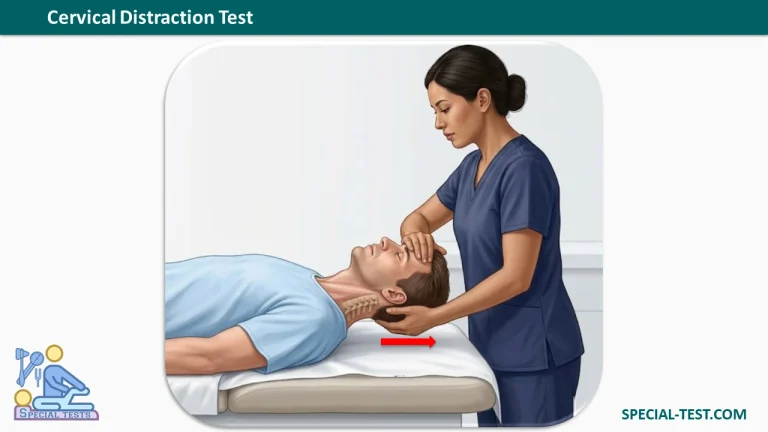
The Cervical Distraction Test, also known as the Neck Distraction Test or Cervical Traction Test, is a clinical orthopedic examination used to assess patients with suspected cervical radiculopathy. The test involves applying gentle longitudinal traction to the cervical spine to determine whether neck pain and radiating upper-limb symptoms decrease.
The Cervical Distraction Test is particularly useful in patients experiencing neck pain associated with arm pain, tingling, numbness, or other symptoms suggesting cervical nerve root involvement. A reduction in radicular symptoms during traction is considered a positive finding.
Although this test has relatively high specificity in several earlier studies, it should be interpreted alongside the patient’s medical history, neurological examination, and other cervical spine special tests. [1,2]
What Is the Purpose of the Cervical Distraction Test?
The primary purpose of the Cervical Distraction Test is to help identify cervical nerve root irritation or compression associated with cervical radiculopathy.
Cervical radiculopathy occurs when a cervical spinal nerve root becomes compressed or irritated, potentially producing pain, sensory disturbances, and muscle weakness in the corresponding upper extremity.
Common causes include cervical disc herniation, degenerative changes of the cervical spine, and narrowing of the intervertebral foramina.
The Cervical Distraction Test evaluates whether gently unloading the cervical spine reduces symptoms associated with nerve root irritation.
The test may be particularly informative when patients report:
- Neck pain radiating into the shoulder, arm, or hand.
- Tingling or numbness in the upper extremity.
- Pain aggravated by certain cervical movements.
- Symptoms suggesting cervical nerve root involvement.
However, symptom relief during distraction does not independently establish the precise cause or anatomical location of nerve root compression. [2,5]
How to Perform the Cervical Distraction Test
The Cervical Distraction Test is commonly performed with the patient in a supine position, although a seated variation is also described.
Supine Cervical Distraction Test Procedure
- Patient position: Ask the patient to lie supine on an examination table, with the head and neck comfortably supported.
- Examiner position: Stand at the head of the examination table, facing the patient.
- Hand placement: Securely support the patient’s head. The examiner may place the hands around the occipital and mastoid regions or use a supported grip involving the occiput and chin.
- Neck positioning: Position the cervical spine in a comfortable neutral or slightly flexed position, depending on the patient’s symptoms and tolerance.
- Apply distraction: Gently pull the patient’s head longitudinally away from the shoulders, producing a controlled distraction force along the cervical spine.
- Assess symptoms: Ask the patient whether the familiar neck and radiating arm symptoms improve, remain unchanged, or worsen during traction.
The examiner should apply traction gradually and avoid sudden or forceful movements. The patient’s response should be monitored throughout the examination. [7]
Seated Cervical Distraction Test
An alternative technique involves performing the examination with the patient seated.
The examiner stands behind the patient, supports the occiput with one hand and the chin with the other, and gently applies an upward traction force.
The clinician then evaluates whether the patient’s symptoms improve during cervical distraction.
Both techniques aim to determine whether reducing mechanical loading of the cervical spine produces relief of the patient’s usual symptoms. [1]
What Is a Positive Cervical Distraction Test?
A positive Cervical Distraction Test occurs when gentle cervical traction produces a noticeable reduction or complete relief of the patient’s familiar radicular symptoms.
For example, a patient experiencing neck pain radiating into the forearm may report significant improvement in arm pain when the examiner applies traction.
This response may suggest that cervical nerve root irritation contributes to the patient’s symptoms.
Negative Cervical Distraction Test
A negative result occurs when the patient’s symptoms remain unchanged during cervical traction.
Importantly, a negative test does not exclude cervical radiculopathy because the test has limited sensitivity.
If traction increases pain, causes dizziness, or produces new neurological symptoms, the examiner should discontinue the maneuver and reassess the patient. [2,6]
Cervical Distraction Test Sensitivity and Specificity
The diagnostic accuracy of the Cervical Distraction Test has been evaluated in studies investigating physical examination techniques for cervical radiculopathy.
Traditionally reported diagnostic accuracy:
| Diagnostic measure | Reported value |
|---|---|
| Sensitivity | 44% |
| Specificity | 90–97% |
A systematic review by Rubinstein and colleagues identified two studies evaluating the traction/neck distraction test. Both reported sensitivity of 44%, while specificity was 90% in one study and 97% in the other. [2]
Interpretation of Test Accuracy
Sensitivity of 44% indicates that the test identified approximately 44% of patients with cervical radiculopathy in the studied populations. Therefore, a negative result cannot reliably rule out the condition.
Specificity of 90–97% indicates that relatively few patients without cervical radiculopathy had a positive result in those studies. Consequently, a positive finding may help support the diagnosis when the clinical history and neurological examination are consistent.
These estimates should not be considered universally applicable. The available evidence is limited, and different studies have reported variable results.
A 2026 systematic review found that evidence regarding physical examination tests for cervical radiculopathy remains sparse, with very low certainty for diagnostic accuracy outcomes. [4]
Clinical Importance of the Cervical Distraction Test
The Cervical Distraction Test is most valuable when incorporated into a comprehensive cervical spine assessment.
A frequently studied clinical test cluster for cervical radiculopathy includes:
- Cervical Distraction Test.
- Spurling’s Test.
- Upper Limb Neurodynamic Test 1 (ULNT1).
- Cervical rotation toward the symptomatic side of less than 60 degrees.
Wainner and colleagues investigated the diagnostic usefulness of combining these examination findings. Their research demonstrated that certain combinations of positive findings can substantially increase the likelihood of cervical radiculopathy. [3]
A subsequent independent validation study published in 2026 also evaluated this clinical prediction rule and supported the usefulness of combining examination findings rather than relying on an isolated test. [8]
The neurological examination should additionally include relevant muscle strength, sensation, and deep tendon reflex testing.
Precautions and Contraindications
Before performing the Cervical Distraction Test, the clinician should screen for conditions that may make cervical traction unsafe.
Particular caution or avoidance is appropriate in patients with suspected cervical instability, recent significant cervical trauma, spinal cord compression or myelopathy, severe osteoporosis, or certain vascular disorders affecting the cervical region.
The test should only be performed by an appropriately trained healthcare professional following clinical screening.
The development of worsening neurological symptoms, severe discomfort, or dizziness during traction requires immediate discontinuation and further assessment. [6]
Frequently Asked Questions (FAQ)
1. What does the Cervical Distraction Test assess?
The Cervical Distraction Test assesses whether gentle traction of the cervical spine reduces symptoms consistent with cervical nerve root irritation. It is primarily used as part of the clinical examination for suspected cervical radiculopathy.
2. What is a positive Cervical Distraction Test?
A positive test occurs when the patient’s familiar radicular symptoms, particularly radiating arm pain, decrease or disappear during gentle cervical traction. This finding may support a diagnosis of cervical radiculopathy.
3. What is the sensitivity and specificity of the Cervical Distraction Test?
Older diagnostic studies reported sensitivity of approximately 44% and specificity ranging from 90% to 97%. These values suggest that a positive result may be useful for supporting the diagnosis, while a negative result cannot reliably exclude it.
4. What is the difference between the Spurling Test and Cervical Distraction Test?
The Spurling Test uses cervical positioning and compression to attempt to reproduce radicular symptoms. In contrast, the Cervical Distraction Test applies gentle traction to determine whether those symptoms improve.
The two tests provide complementary clinical information.
5. Can a negative Cervical Distraction Test rule out cervical radiculopathy?
No. Because the test has limited sensitivity in the traditional diagnostic studies, patients with cervical radiculopathy may have a negative result. Additional clinical findings and neurological examination are required.
6. Is the Cervical Distraction Test performed sitting or lying down?
The test can be performed in either a supine or seated position. The examiner supports the patient’s head and applies gentle longitudinal traction while monitoring symptom changes.
7. Is the Cervical Distraction Test the same as therapeutic cervical traction?
No. The Cervical Distraction Test is a brief diagnostic examination used to evaluate symptom response. Therapeutic cervical traction is a treatment intervention that may use repeated or sustained traction under a prescribed treatment plan.
A positive diagnostic test does not automatically establish that therapeutic traction will be effective.
Conclusion
The Cervical Distraction Test is a useful component of the clinical examination for suspected cervical radiculopathy. It evaluates whether gentle cervical traction reduces neck-related radiating arm symptoms.
A positive result may support the presence of cervical nerve root involvement, particularly when combined with compatible neurological findings and other cervical special tests.
Although older studies reported sensitivity of 44% and specificity of 90–97%, the limited and variable evidence means the test should not be used as a standalone diagnostic tool.
References
- Orthofixar. Cervical Distraction Test: Overview, Procedure, Interpretation, and Reliability. Read on Orthofixar.
- Rubinstein SM, Pool JJM, van Tulder MW, Riphagen II, de Vet HCW. A systematic review of the diagnostic accuracy of provocative tests of the neck for diagnosing cervical radiculopathy. European Spine Journal. 2007;16:307–319. PubMed.
- Wainner RS, Fritz JM, Irrgang JJ, Boninger ML, Delitto A, Allison S. Reliability and diagnostic accuracy of the clinical examination and patient self-report measures for cervical radiculopathy. Spine. 2003;28(1):52–62. PubMed.
- Thoomes EJ, et al. Diagnostic accuracy of physical examination tests for painful cervical radiculopathy: update of a systematic review and meta-analysis. BMC Musculoskeletal Disorders. 2026. PubMed.
- StatPearls. Cervical Radiculopathy. NCBI Bookshelf. Read on NCBI.
- Abi-Aad KR, Derian A. Cervical Traction. StatPearls, NCBI Bookshelf. Read on NCBI.
- Inclusion of Mechanical Diagnosis and Therapy (MDT) in the Management of Cervical Radiculopathy: A Case Report. PubMed Central. Read on NCBI.
- Grondin F, et al. An independent validation of a clinical prediction rule for the diagnosis of cervical radiculopathy with radicular pain. Brazilian Journal of Physical Therapy. 2026;30(3):101581. PubMed.