Bragard Test: Purpose, Procedure, Positive Sign, and Diagnostic Accuracy
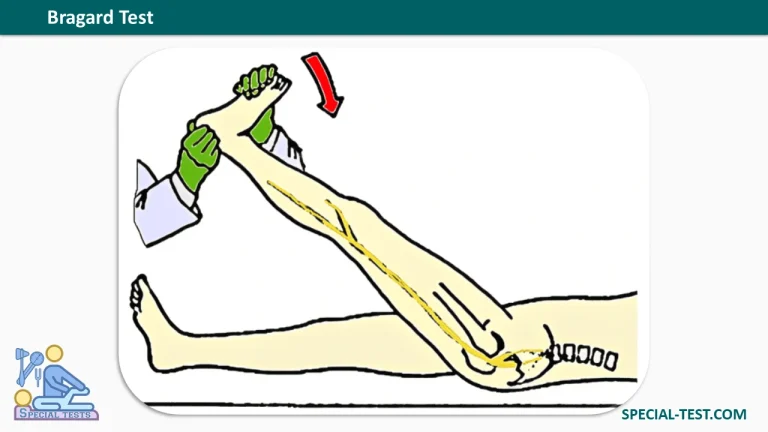
The Bragard Test, also known as Bragard’s Sign, is a clinical orthopedic examination used to assess sciatic nerve irritation and possible lumbar nerve root compression. It is commonly performed in patients presenting with low back pain, sciatica, or radiating leg pain suggestive of lumbar radiculopathy.
The test is a modification of the Straight Leg Raise (SLR) Test, also called the Lasègue Test. By adding passive ankle dorsiflexion during straight leg raising, the examiner increases neural tension to help determine whether the patient’s symptoms are consistent with irritation of the sciatic nerve or lumbosacral nerve roots.
The Bragard Test is particularly useful for distinguishing radicular pain from discomfort caused by hamstring tightness. However, its findings must be interpreted alongside the patient’s medical history, neurological examination, and other clinical investigations.
What Is the Purpose of the Bragard Test?
The primary purpose of the Bragard Test is to evaluate possible lumbar or lumbosacral nerve root irritation, particularly involving the L4, L5, and S1 nerve roots.
It is commonly used to:
- Assess sciatic nerve mechanosensitivity in patients with suspected sciatica.
- Support the clinical evaluation of lumbar radiculopathy.
- Differentiate nerve-related radiating pain from discomfort associated with hamstring stretching.
- Clarify an equivocal or positive Straight Leg Raise Test.
- Identify reproduction of radicular symptoms during passive ankle dorsiflexion.
- Complement other neurological and orthopedic examinations of the lumbar spine.
Although a positive Bragard Sign may indicate neural irritation, it does not independently confirm a lumbar disc herniation or precisely identify the affected nerve root.
How to Perform the Bragard Test
The Bragard Test is performed with the patient lying supine on an examination table. The examiner progressively raises the patient’s leg while maintaining knee extension, followed by passive dorsiflexion of the ankle.
Step-by-Step Bragard Test Procedure
- Patient position: Ask the patient to lie flat on their back (supine position), with both lower limbs relaxed and extended.
- Examiner position: Stand beside the affected lower limb. Support the patient’s heel with one hand and stabilize the anterior aspect of the knee with the other.
- Perform the Straight Leg Raise Test: Slowly elevate the patient’s leg by flexing the hip while keeping the knee extended.
- Identify the onset of symptoms: Continue raising the leg until the patient experiences their familiar radiating leg pain or symptoms consistent with a positive Lasègue Sign.
- Slightly lower the leg: Reduce the hip flexion angle until the patient’s symptoms disappear or substantially decrease.
- Apply ankle dorsiflexion: While maintaining the knee in extension and holding the leg at this position, gently dorsiflex the ankle by moving the foot toward the shin.
- Assess the response: Determine whether ankle dorsiflexion reproduces the patient’s characteristic radiating pain along the distribution of the sciatic nerve.
The examiner should perform the maneuver gradually and avoid forcing the limb through severe pain. The patient’s symptoms, pain distribution, and response to ankle dorsiflexion should be documented.
What Is a Positive Bragard Test?
A positive Bragard Test occurs when passive ankle dorsiflexion reproduces the patient’s familiar radiating leg pain after the symptoms have been reduced by slightly lowering the elevated leg.
This response suggests increased neural mechanosensitivity and may be associated with irritation or compression of the lumbosacral nerve roots.
A positive Bragard Sign is commonly associated with clinical conditions such as lumbar radiculopathy and sciatica, including cases related to lumbar disc herniation.
However, the test is not specific enough to establish the underlying cause of symptoms without additional examination.
Positive vs. Negative Bragard Sign
Positive Bragard Sign:
The patient experiences reproduction of familiar sciatic-type pain, typically radiating from the buttock or posterior thigh toward the lower leg, during passive ankle dorsiflexion.
Negative Bragard Sign:
Passive ankle dorsiflexion does not reproduce the patient’s characteristic radicular symptoms. A negative result reduces suspicion in the appropriate clinical context but does not completely exclude lumbar radiculopathy.
Differentiating Sciatic Nerve Pain From Hamstring Tightness
One of the important applications of the Bragard Test is distinguishing possible nerve root irritation from symptoms caused by stretching of the posterior thigh muscles.
Hamstring tightness: Patients may experience a dull pulling sensation or localized discomfort in the posterior thigh during straight leg raising. This response alone should not be interpreted as a positive Lasègue or Bragard Sign.
Sciatic nerve irritation: Patients with neural involvement may report familiar radiating pain, sometimes accompanied by tingling or other sensory symptoms, that increases when ankle dorsiflexion is applied.
Calf discomfort: An isolated feeling of tension in the calf is nonspecific and may arise from muscular tightness or other conditions. It should not automatically be classified as a positive Bragard Test.
Importantly, the Bragard Test is not a screening or diagnostic test for deep vein thrombosis, and its findings cannot reliably determine whether a patient is exaggerating symptoms.
Bragard Test Sensitivity and Specificity
The diagnostic accuracy of the Bragard Test depends on the technique, patient population, and reference standard used.
A 2018 study by Homayouni and colleagues, published in the Journal of Chiropractic Medicine, evaluated the Modified Bragard Test in patients with suspected lumbosacral radiculopathy, using electrodiagnostic testing as the reference standard.
The study included 506 patients and reported the following diagnostic performance:
| Diagnostic Parameter | Result |
|---|---|
| Sensitivity | 69.3% |
| Specificity | 67.42% |
| Positive Predictive Value | 73.15% |
| Negative Predictive Value | 63.16% |
| Positive Likelihood Ratio | 2.13 |
| Negative Likelihood Ratio | 0.46 |
These values apply to the modified maneuver evaluated in the study, particularly among patients with a negative Straight Leg Raise Test. They should not automatically be applied to every version of the classical Bragard Test.
The investigators concluded that the Modified Bragard Test could improve the clinical assessment of patients with suspected L5 or S1 radiculopathy, particularly during the acute phase of symptoms.
A separate 2020 study involving 864 participants found that using the Straight Leg Raise and Bragard tests in parallel produced a sensitivity of 97.4% for lumbar or lumbosacral radiculopathy. This figure describes the combined testing strategy, not the accuracy of Bragard’s Sign alone.
These findings emphasize that neurodynamic tests are more informative when used together with a comprehensive clinical examination.
What Is the Modified Bragard Test?
The Modified Bragard Test is an alternative examination technique designed primarily for patients whose Straight Leg Raise Test is negative.
In this variation, the examiner raises the patient’s straight leg to approximately 70 degrees of hip flexion. If the patient does not experience radicular pain, the examiner applies passive ankle dorsiflexion while maintaining the position.
The test is considered positive when this additional movement reproduces characteristic radiating pain below the knee.
Unlike the classical Bragard maneuver, which begins by identifying pain during straight leg raising and then lowering the leg, the modified technique specifically investigates patients who do not initially develop radicular symptoms during the SLR maneuver.
This distinction is important when interpreting published diagnostic accuracy results.
Clinical Significance of the Bragard Test
The Bragard Test is a useful component of the physical examination for patients with suspected sciatica and lumbar radiculopathy.
Clinicians commonly interpret the findings alongside muscle strength testing, sensory examination, deep tendon reflexes, and other neurodynamic tests, including the Straight Leg Raise and Slump Tests.
Although ankle dorsiflexion may increase the reproduction of neural symptoms, a positive Bragard Test is not sufficient to diagnose nerve root compression on its own.
Further investigation, including MRI or electrodiagnostic testing, may be indicated depending on the patient’s symptoms, neurological findings, and clinical course.
Frequently Asked Questions (FAQs)
1. What is the Bragard Test used for?
The Bragard Test is used to assess sciatic nerve irritation and possible lumbar nerve root involvement in patients with low back pain, sciatica, or radiating lower-limb symptoms. It complements the Straight Leg Raise Test during the examination of suspected lumbar radiculopathy.
2. What does a positive Bragard Test indicate?
A positive Bragard Test indicates reproduction of characteristic radiating leg pain during passive ankle dorsiflexion. This finding suggests neural mechanosensitivity and may be associated with lumbosacral nerve root irritation or compression, although further clinical evaluation is required.
3. Which nerve roots are assessed by the Bragard Test?
The Bragard Test is used primarily to assess symptoms associated with the lower lumbar and lumbosacral nerve roots, particularly L5 and S1. It may also be relevant to symptoms involving L4, but the test cannot reliably distinguish the exact affected nerve root.
4. What is the difference between the Bragard Test and the Straight Leg Raise Test?
The Straight Leg Raise Test evaluates reproduction of radicular symptoms during passive hip flexion with the knee extended. The Bragard Test adds ankle dorsiflexion to increase neural tension and determine whether familiar radiating pain can be reproduced.
5. What are the sensitivity and specificity of the Bragard Test?
A published study of the Modified Bragard Test reported a sensitivity of 69.3% and specificity of 67.42% in patients evaluated for lumbosacral radiculopathy. These values are specific to that study’s modified technique and patient population.
6. What is the difference between the classical and Modified Bragard Tests?
The classical Bragard Test involves lowering the elevated leg until pain subsides and then applying ankle dorsiflexion. The Modified Bragard Test applies dorsiflexion after an initially negative Straight Leg Raise Test, typically at approximately 70 degrees of hip flexion.
7. Can the Bragard Test diagnose a herniated lumbar disc?
No. The Bragard Test can support suspicion of nerve root irritation associated with a lumbar disc herniation, but it cannot independently confirm the presence, location, or severity of a herniated disc. Diagnosis requires correlation with clinical findings and, when indicated, imaging.
8. Is a negative Bragard Test enough to rule out sciatica?
No. Some patients with sciatica or lumbar radiculopathy may have a negative Bragard Test. Results should be interpreted together with the patient’s history, neurological examination, and other relevant clinical tests.
Medical References
- Orthofixar: Bragard and Modified Bragard Test. Clinical examination technique, interpretation, and modified testing procedure.
- Homayouni K, Jafari SH, Yari H. (2018). Sensitivity and Specificity of Modified Bragard Test in Patients With Lumbosacral Radiculopathy Using Electrodiagnosis as a Reference Standard. Journal of Chiropractic Medicine, 17(1), 36–43. PubMed PMID: 29628807.
- González Espinosa de Los Monteros FJ, et al. (2020). Use of Neurodynamic or Orthopedic Tension Tests for the Diagnosis of Lumbar and Lumbosacral Radiculopathies: Study of the Diagnostic Validity. International Journal of Environmental Research and Public Health, 17(19), 7046. PubMed PMID: 32993094.
- Berthelot JM, et al. (2021). Inadequacies of the Lasègue Test, and How the Slump and Bowstring Tests Are Useful for the Diagnosis of Sciatica. Joint Bone Spine, 88(1), 105030. PubMed PMID: 32561431.