Shoulder Press Test: Purpose, Procedure, Positive Signs, and Cervical Radiculopathy
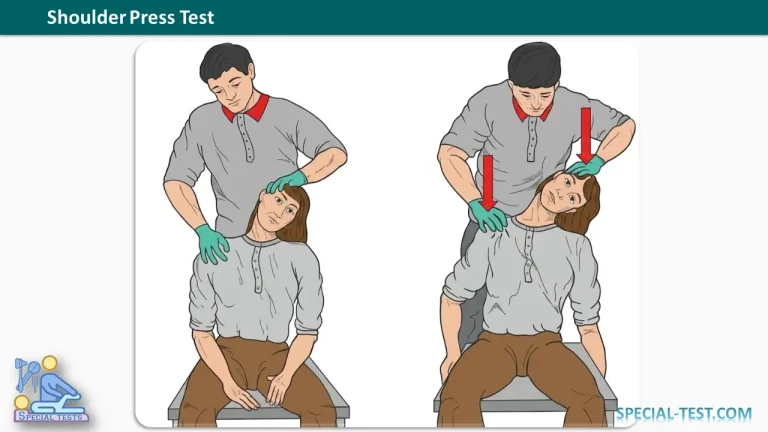
The Shoulder Press Test, also known as the Shoulder Depression Test, is a clinical orthopedic examination used to assess possible cervical nerve root irritation, cervical radiculopathy, and neural tissue sensitivity. The maneuver involves applying downward pressure to the patient’s shoulder while laterally bending the cervical spine toward the opposite side.
This positioning places tension on structures extending between the neck and shoulder, including the brachial plexus and surrounding soft tissues. Reproduction of radiating arm pain or neurological symptoms may suggest neural involvement, whereas localized discomfort can indicate muscular tightness or other musculoskeletal conditions.
The Shoulder Press Test can provide useful information during a cervical spine examination. However, its diagnostic accuracy has not been adequately established, and it should not be used as a standalone test to confirm cervical radiculopathy. PMC+1
What Is the Shoulder Press Test Used For?
The primary purpose of the Shoulder Press Test is to investigate whether symptoms originating in the cervical spine or surrounding neural structures can be reproduced through controlled stretching and positioning.
Clinicians may use this maneuver when evaluating patients experiencing:
- Neck pain radiating into the shoulder or upper extremity.
- Suspected cervical nerve root irritation or compression.
- Tingling, numbness, or burning sensations in the arm.
- Possible brachial plexus irritation.
- Cervical muscle tightness or restricted lateral flexion.
- Symptoms potentially associated with cervical foraminal narrowing.
Cervical radiculopathy occurs when a cervical spinal nerve root becomes irritated or compressed. Common causes include cervical disc herniation, degenerative changes, osteophyte formation, and narrowing of the intervertebral foramina.
Because cervical radiculopathy can produce symptoms similar to peripheral nerve entrapment and shoulder disorders, a comprehensive neurological and musculoskeletal examination is essential. PubMed+1
How to Perform the Shoulder Press Test
The Shoulder Press Test should be performed by a qualified healthcare professional using controlled movements and avoiding excessive force.
Step-by-Step Procedure
- Patient position: The patient sits upright on an examination chair with the head in a neutral position and both shoulders relaxed.
- Examiner position: The examiner stands behind or slightly to the side of the seated patient.
- Shoulder depression: The examiner places one hand over the patient’s shoulder and applies gentle downward pressure.
- Contralateral cervical lateral flexion: While maintaining shoulder depression, the examiner gently bends the patient’s neck toward the opposite shoulder.
- Symptom assessment: The examiner observes whether this position reproduces neck pain, radiating arm symptoms, tingling, numbness, or localized muscular discomfort.
- Bilateral comparison: The maneuver is repeated on the opposite side, provided it is clinically appropriate, to compare symptoms and mobility.
During the examination, the clinician should document the location, intensity, and nature of the patient’s symptoms. Particular attention should be paid to whether discomfort remains localized to the neck or extends into the shoulder, arm, or hand.
The test should be stopped if severe pain, significant neurological symptoms, or unusual dizziness develops.
What Is a Positive Shoulder Press Test?
A positive Shoulder Press Test is generally described as reproduction of the patient’s familiar radiating symptoms, particularly pain, tingling, or other neurological sensations extending from the cervical region into the upper extremity.
Such findings may raise suspicion of cervical nerve root or brachial plexus involvement.
Traditionally, provocation of radicular symptoms during this maneuver has also been interpreted as potentially indicating restricted mobility or adhesions involving the dural sheath or nerve root.
However, a positive test does not establish the presence of dural adhesions, nerve root compression, or a specific anatomical lesion. These possibilities require interpretation alongside clinical history, neurological findings, and appropriate diagnostic investigations.
Increased Pain During the Shoulder Press Test
Increased pain may be associated with several possible underlying mechanisms.
1. Cervical nerve root compression
Mechanical irritation of an already sensitive nerve root may reproduce pain extending into the shoulder or arm. Cervical disc herniation and degenerative spine disorders are potential causes.
2. Cervical foraminal narrowing
Osteophytes and other degenerative changes may narrow the intervertebral foramina through which the cervical nerve roots exit. Such changes can contribute to radicular symptoms.
3. Dural sheath or neural tissue sensitivity
Changes in the mechanical sensitivity or mobility of neural structures may contribute to pain during cervical positioning. Nevertheless, this examination cannot independently identify dural adhesions or structural abnormalities of the dural sheath.
4. Cervical facet joint dysfunction
Restricted facet joint mobility, capsular stiffness, or degenerative facet changes may contribute to pain during cervical lateral bending. These findings are not specific to radiculopathy.
5. Increased cervical muscle tension
Pain localized to the stretched side of the neck may suggest muscular tightness or irritation, particularly involving the upper trapezius, levator scapulae, or sternocleidomastoid muscle.
Unlike radiating neurological symptoms, isolated muscular pain does not necessarily represent a positive neural provocation test.
Decreased Muscular Pain During the Test
A reduction in muscular discomfort on the side opposite the stretch may suggest that cervical positioning changes the mechanical load on shortened or irritated muscles.
Possible explanations include muscle shortening, localized muscular dysfunction, or altered tension within surrounding soft tissues.
However, pain relief during this maneuver is nonspecific and cannot independently confirm a muscle strain or functional impairment.
Clinical Significance of the Shoulder Press Test
The Shoulder Press Test may help distinguish between symptoms suggestive of neurological involvement and symptoms more consistent with local muscular discomfort.
For example, reproduction of familiar radiating pain into the arm raises greater suspicion of neural irritation than isolated stretching discomfort in the upper trapezius.
Nevertheless, the clinician must consider other possible causes, including:
- Cervical disc pathology.
- Degenerative cervical foraminal stenosis.
- Brachial plexus disorders.
- Peripheral nerve entrapment.
- Myofascial neck pain.
- Cervical facet-mediated pain.
A complete cervical spine assessment should also include cervical range of motion, upper-extremity muscle strength, dermatomal sensation, deep tendon reflexes, and other appropriate provocative tests.
A systematic review published in 2026 found that the evidence supporting physical examination tests for cervical radiculopathy remains limited and generally of very low certainty. The Shoulder Press Test itself does not have well-established sensitivity and specificity values, so reliable diagnostic accuracy estimates should not be assigned to it. PubMed+1
Shoulder Press Test vs. Other Cervical Radiculopathy Tests
Although several orthopedic tests assess cervical nerve root symptoms, they use different mechanisms and should not be confused.
| Clinical test | Main purpose | Test response |
|---|---|---|
| Shoulder Press Test | Assess symptoms during shoulder depression and contralateral neck bending | Reproduction of radiating neurological symptoms |
| Spurling Test | Assess possible cervical nerve root compression | Reproduction of familiar radicular arm pain |
| Shoulder Abduction Relief Test | Assess symptom changes with the hand placed on or near the head | Reduction of radicular symptoms |
| Upper Limb Tension Test | Evaluate upper-limb neural mechanosensitivity | Reproduction or modification of familiar neural symptoms |
Among these examinations, Spurling’s Test and combinations of upper-limb neurodynamic tests have been studied more extensively than the Shoulder Press Test. PubMed+2
For a broader cervical spine assessment, see the Complete Spine Examination Guide on OrthoFixar.
Precautions and Limitations
The Shoulder Press Test should be approached cautiously, particularly in patients with significant neurological deficits or suspected cervical instability.
Provocative cervical maneuvers may be inappropriate when there is acute cervical trauma, suspected instability, spinal infection, malignancy, or signs of cervical myelopathy. In these situations, further medical evaluation may be required before applying mechanical stress to the neck.
The Shoulder Press Test also cannot independently determine the precise level of nerve root involvement or distinguish all cervical disorders from peripheral nerve conditions.
Persistent or progressive neurological deficits, especially increasing weakness, gait disturbance, or impaired hand coordination, warrant prompt medical evaluation. NCBI Bookshelf+1
Frequently Asked Questions (FAQ)
1. What does the Shoulder Press Test assess?
The Shoulder Press Test assesses symptom responses to shoulder depression combined with contralateral cervical lateral flexion. It may help identify possible cervical neural irritation, brachial plexus sensitivity, or local muscular discomfort.
2. What indicates a positive Shoulder Press Test?
A positive result generally involves reproduction of familiar radiating pain, tingling, or neurological symptoms extending into the upper extremity. Isolated neck muscle stretching discomfort is not sufficient to confirm neural involvement.
3. Can the Shoulder Press Test diagnose cervical radiculopathy?
No. The test may contribute to clinical assessment, but it cannot independently confirm cervical radiculopathy. Diagnosis requires consideration of the patient’s history, neurological examination, and additional investigations when indicated.
4. What is the difference between the Shoulder Press Test and Spurling’s Test?
The Shoulder Press Test involves downward shoulder pressure and lateral neck bending toward the opposite side. Spurling’s Test typically involves cervical positioning toward the symptomatic side combined with axial compression to reproduce cervical radicular symptoms.
5. What causes pain during the Shoulder Press Test?
Possible causes include cervical nerve root irritation, brachial plexus sensitivity, muscular tightness, and cervical joint dysfunction. The distribution and characteristics of the symptoms help guide clinical interpretation.
6. Is the Shoulder Press Test the same as the Shoulder Abduction Test?
No. The Shoulder Abduction Relief Test evaluates whether placing the affected hand on or near the head reduces radicular symptoms. The Shoulder Press Test uses shoulder depression and contralateral cervical bending to provoke or modify symptoms.
7. What are the sensitivity and specificity of the Shoulder Press Test?
Reliable sensitivity and specificity values have not been established for this specific maneuver. Therefore, its diagnostic performance should not be assumed to match that of other cervical radiculopathy tests.
8. Can the Shoulder Press Test identify a pinched nerve in the neck?
The test may reproduce symptoms consistent with cervical nerve irritation, but it cannot confirm a pinched nerve or identify the precise anatomical cause. Neurological examination and, when appropriate, cervical MRI or electrodiagnostic testing may be necessary.
Conclusion
The Shoulder Press Test is a cervical spine provocative maneuver used to assess possible cervical nerve root irritation, neural tissue sensitivity, and associated musculoskeletal discomfort.
The test is performed with the patient seated while the examiner depresses one shoulder and laterally bends the neck toward the opposite side. Reproduction of familiar radiating arm symptoms may suggest neurological involvement, whereas localized pain may reflect muscular or joint-related conditions.
Although the Shoulder Press Test can contribute to a comprehensive cervical spine examination, its diagnostic accuracy remains uncertain. Findings should always be interpreted alongside the patient’s clinical history, neurological examination, and other validated assessment methods.
References
1. Diagnostic accuracy of physical examination tests for painful cervical radiculopathy: update of a systematic review and meta-analysis. PubMed, 2026. https://pubmed.ncbi.nlm.nih.gov/41680685/
2. Rubinstein SM, et al. A systematic review of the diagnostic accuracy of provocative tests of the neck for diagnosing cervical radiculopathy. European Spine Journal, 2007. https://pubmed.ncbi.nlm.nih.gov/17013656/
3. Value of physical tests in diagnosing cervical radiculopathy: a systematic review. PubMed. https://pubmed.ncbi.nlm.nih.gov/28838857/
4. The value of provocative tests in diagnosis of cervical radiculopathy. PubMed / NCBI. https://pubmed.ncbi.nlm.nih.gov/23961282/
5. Electrodiagnostic Evaluation of Cervical Radiculopathy. NCBI Bookshelf, StatPearls. https://pubmed.ncbi.nlm.nih.gov/33085299/
6. Spurling Test. NCBI Bookshelf, StatPearls. https://www.ncbi.nlm.nih.gov/books/NBK493152/
7. Complete Spine Examination: Cervical, Thoracic & Lumbar Guide. OrthoFixar. https://orthofixar.com/special-test/spine-examination/
8. Test procedures and positive diagnostic criteria of the upper limb tension tests differ: a systematic review of the DiTA database. PubMed Central / NCBI, 2023. https://pmc.ncbi.nlm.nih.gov/articles/PMC10679807/
9. Buckup K. Clinical Tests for the Musculoskeletal System: Examinations—Signs—Phenomena. 3rd edition. Original textbook reference supplied for the traditional test description.