Lhermitte Sign: Test Procedure, Positive Results, Causes & Accuracy
What Is Lhermitte Sign?
Lhermitte Sign, also known as Lhermitte’s phenomenon or the barber chair phenomenon, is a neurological clinical finding characterized by a sudden, electric shock-like sensation that travels down the spine and may radiate into the arms or legs when the cervical spine is flexed.
The sensation is typically brief and may be described as an electrical discharge, tingling, or shooting sensation extending from the neck toward the lower back or extremities.
Lhermitte Sign is commonly associated with pathological conditions affecting the cervical spinal cord, particularly multiple sclerosis (MS) and cervical spondylotic myelopathy.
The phenomenon was initially described by Pierre Marie and Jean Chatelin in 1917 and was later characterized by French neurologist Jean Lhermitte in patients with multiple sclerosis.
It is considered an important clinical clue indicating possible cervical spinal cord involvement, although it is not specific to a single neurological disease. PubMed+1
What Is Lhermitte Sign Used For?
The primary purpose of the Lhermitte Sign test is to identify symptoms suggestive of cervical spinal cord dysfunction, particularly conditions involving demyelination, inflammation, or compression of the spinal cord.
Clinically, the test may help differentiate spinal cord pathology from isolated peripheral nerve root disorders.
However, Lhermitte Sign cannot independently establish this distinction because some patients with radiculopathy or other neurological conditions may experience similar sensations.
The test is particularly useful during the evaluation of patients presenting with:
- Neck pain accompanied by neurological symptoms.
- Electric shock-like sensations radiating down the spine.
- Suspected cervical spinal stenosis or cervical myelopathy.
- Possible multiple sclerosis or another demyelinating disorder.
- Unexplained numbness, tingling, or abnormal sensations in the extremities.
A positive finding should prompt further clinical evaluation rather than being considered a definitive diagnosis.
How to Perform the Lhermitte Sign Test
The Lhermitte Sign is typically assessed by asking the patient to flex the cervical spine while monitoring for characteristic neurological symptoms.
Standard Examination Technique
- Patient positioning: The patient sits comfortably on an examination table or chair with the cervical spine initially in a neutral position.
- Initial assessment: The examiner asks whether the patient has previously experienced electric shock-like sensations during neck movements.
- Cervical flexion: The patient is instructed to gently bend the head forward, bringing the chin toward the chest.
- Symptom observation: The examiner asks whether cervical flexion produces a sudden electric shock-like sensation traveling down the spine or into the extremities.
- Interpretation: The examiner records the presence, distribution, duration, and intensity of the reproduced symptoms.
Alternatively, a clinician may use controlled passive cervical flexion when appropriate.
Important: Forceful cervical flexion should be avoided, especially in patients with suspected cervical instability, recent cervical trauma, or potentially serious spinal cord compression.
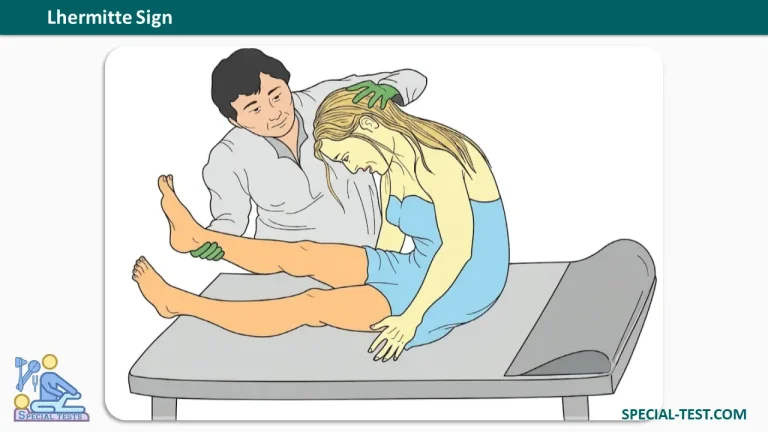
Alternative Technique Described in Musculoskeletal Examination
Some musculoskeletal examination descriptions combine cervical flexion with tension applied through the lower extremity.
In this variation:
- The patient sits with the legs extended on the examination table.
- The examiner supports the patient’s foot and head.
- Cervical flexion is combined with hip flexion while the knee remains extended.
- The examiner observes whether this positioning reproduces neurological symptoms.
This combined maneuver introduces additional neural tension and should not be considered equivalent to the standard neck-flexion assessment of Lhermitte Sign. The standard technique remains the more clearly described method in neurological literature. NCBI Bookshelf+1
What Is a Positive Lhermitte Sign?
A positive Lhermitte Sign occurs when flexion of the cervical spine produces a sudden, transient electric shock-like sensation traveling down the spinal column, sometimes extending into the upper or lower extremities.
Patients may describe the sensation as:
- An electrical current running from the neck down the back.
- A brief shooting sensation extending into both arms.
- Tingling or electrical sensations radiating toward the legs.
- A sudden shock triggered by lowering the chin toward the chest.
Unlike ordinary mechanical neck pain, the characteristic finding is an electric shock-like sensation rather than localized muscular discomfort.
Clinical Interpretation of a Positive Test
A positive result suggests irritation or dysfunction of sensory pathways within the cervical spinal cord, particularly the posterior columns.
These pathways carry sensory information related to vibration and proprioception.
In conditions involving demyelination, neck flexion may mechanically stimulate vulnerable nerve fibers, producing abnormal electrical sensations.
A positive Lhermitte Sign can therefore suggest underlying cervical spinal cord pathology, but additional neurological examination and diagnostic investigations are necessary to determine the exact cause. NCBI Bookshelf+1
Causes of a Positive Lhermitte Sign
Several neurological and spinal conditions may produce a positive Lhermitte Sign.
1. Multiple Sclerosis
Multiple sclerosis (MS) is one of the best-known causes of Lhermitte Sign.
MS produces inflammatory demyelinating lesions within the central nervous system. When lesions involve the cervical spinal cord, particularly the posterior columns, neck flexion may trigger the characteristic electric shock sensation.
Nevertheless, not every patient with multiple sclerosis experiences Lhermitte Sign, and a positive finding alone does not confirm MS.
2. Cervical Spondylotic Myelopathy
Cervical spondylotic myelopathy, also called degenerative cervical myelopathy, occurs when degenerative changes in the cervical spine compress the spinal cord.
Potential contributing abnormalities include intervertebral disc degeneration, osteophyte formation, and narrowing of the spinal canal.
Patients may experience Lhermitte Sign alongside hand clumsiness, gait imbalance, hyperreflexia, or extremity weakness.
3. Cervical Spinal Canal Stenosis
Cervical spinal stenosis involves narrowing of the spinal canal, which may compress or irritate the spinal cord.
In affected patients, neck movement can produce abnormal neurological sensations, including electric shock-like symptoms.
However, the presence of Lhermitte Sign does not necessarily indicate spinal stenosis, as numerous noncompressive neurological conditions can produce the same phenomenon.
4. Vitamin B12 Deficiency
Severe vitamin B12 deficiency may cause subacute combined degeneration of the spinal cord, affecting the posterior and lateral columns.
This neurological complication can produce sensory abnormalities, gait instability, and occasionally a positive Lhermitte Sign.
5. Spinal Cord Tumors
Intramedullary or extramedullary spinal lesions may cause compression or dysfunction of the cervical spinal cord.
Depending on their location, spinal tumors can produce Lhermitte-like symptoms together with progressive neurological deficits.
6. Other Neurological Conditions
Additional reported causes include:
- Cervical spinal cord trauma.
- Transverse myelitis.
- Neuromyelitis optica spectrum disorder.
- Syringomyelia.
- Radiation-induced myelopathy.
- Chemotherapy-associated neurotoxicity.
- Nitrous oxide-related neurological injury.
- Certain cervical radicular disorders.
These associations demonstrate why the finding must be interpreted within the broader clinical presentation. PMC+2
Differential Diagnosis of a Positive Lhermitte Sign
When a patient reports electric shock-like sensations triggered by cervical movement, clinicians should consider both spinal cord and peripheral neurological conditions.
| Condition | Important distinguishing findings |
|---|---|
| Cervical myelopathy | Gait disturbance, hyperreflexia, hand clumsiness, or bilateral neurological symptoms |
| Cervical radiculopathy | Dermatomal arm pain, sensory changes, or myotomal weakness |
| Multiple sclerosis | Neurological symptoms affecting different central nervous system regions |
| Brachial plexopathy | Motor and sensory abnormalities corresponding to brachial plexus involvement |
| Spinal cord tumor | Progressive neurological symptoms or signs of spinal cord compression |
| Vitamin B12 deficiency | Impaired vibration sense, proprioceptive dysfunction, or sensory ataxia |
Amyotrophic lateral sclerosis (ALS) may also be considered in the broader differential diagnosis of progressive neurological dysfunction. However, Lhermitte Sign is not a characteristic finding of ALS, and an isolated positive test should not be interpreted as evidence of this condition.
Lhermitte Sign Test Accuracy: Sensitivity and Specificity
The diagnostic accuracy of Lhermitte Sign has been investigated in a limited number of studies.
Reported sensitivity
3–17%
Reported specificity
97%
Figures from limited diagnostic studies; the specificity estimate relates to compressive myelopathy and should not be generalized to all causes of Lhermitte Sign.
Sensitivity: 3–17%
The reported sensitivity ranges from approximately 3% to 17%, indicating that many patients with relevant spinal cord disorders may not demonstrate the sign.
Consequently, a negative Lhermitte Sign does not exclude cervical myelopathy, multiple sclerosis, or other spinal cord diseases.
Specificity: Approximately 97%
One study reported a specificity of approximately 97% for nonspecific compressive myelopathy.
This suggests that a characteristic positive finding can be clinically meaningful in the appropriate population.
However, the evidence supporting these estimates is limited, and the test should not be used as an independent diagnostic tool. PMC+2
Lhermitte Sign vs. Cervical Radiculopathy
An important clinical consideration is distinguishing cervical spinal cord involvement from cervical nerve root compression.
Lhermitte Sign typically produces an electrical sensation descending along the spine, sometimes involving multiple extremities.
In contrast, cervical radiculopathy commonly causes pain, tingling, or numbness following a particular nerve root distribution, often affecting one upper extremity.
The Spurling Test is commonly used to evaluate suspected cervical radiculopathy, while Lhermitte Sign is more suggestive of spinal cord-related pathology.
Nevertheless, neither finding should be interpreted in isolation. NCBI Bookshelf
Frequently Asked Questions About Lhermitte Sign
1. What does a positive Lhermitte Sign indicate?
A positive Lhermitte Sign indicates a sudden electric shock-like sensation traveling down the spine during cervical flexion. It suggests possible cervical spinal cord dysfunction associated with conditions such as multiple sclerosis, cervical myelopathy, or vitamin B12 deficiency.
2. Is Lhermitte Sign specific to multiple sclerosis?
No. Although Lhermitte Sign is strongly associated with multiple sclerosis in clinical teaching, it can occur in several other neurological conditions, including cervical spinal cord compression, trauma, tumors, and metabolic disorders.
3. How do you test for Lhermitte Sign?
The patient is asked to gently flex the cervical spine by bringing the chin toward the chest. The examiner determines whether this movement reproduces a brief electric shock-like sensation down the spinal column or into the limbs.
4. What is the sensitivity of Lhermitte Sign?
Published reviews report a sensitivity of approximately 3–17%. This relatively low sensitivity means that the absence of Lhermitte Sign cannot reliably rule out spinal cord pathology.
5. What is the specificity of Lhermitte Sign?
A specificity of approximately 97% has been reported for compressive myelopathy in limited research. This estimate does not establish that the sign is 97% specific for all spinal cord disorders.
6. Can cervical spinal stenosis cause Lhermitte Sign?
Yes. Cervical stenosis that affects the spinal cord may produce an electric shock-like sensation during neck movement, particularly when accompanied by degenerative cervical myelopathy.
7. Is Lhermitte Sign the same as the Soto-Hall Test?
No. The Soto-Hall Test is a separate cervical spine examination maneuver traditionally used in the assessment of cervical spine pathology. Lhermitte Sign specifically refers to the characteristic electric shock-like sensation associated with cervical movement, most commonly flexion.
8. Is Lhermitte Sign dangerous?
The sensation itself is often brief and does not necessarily represent an emergency. However, it may indicate an underlying neurological disorder requiring assessment. New or progressive limb weakness, walking difficulty, or bladder or bowel dysfunction warrants prompt medical evaluation. Severe or rapidly developing neurological deficits require emergency assessment.
9. Can Lhermitte Sign occur without neck pain?
Yes. Some individuals experience a distinct electric shock-like sensation without significant localized neck pain. The absence of neck pain does not exclude underlying spinal cord pathology.
10. Can Lhermitte Sign disappear on its own?
Yes. Lhermitte Sign may be intermittent and can resolve, depending on its underlying cause. However, symptom resolution does not necessarily mean that the associated neurological condition has resolved.
Conclusion
Lhermitte Sign is an important neurological examination finding characterized by an electric shock-like sensation that travels down the spine during cervical flexion.
It is particularly associated with multiple sclerosis, cervical spinal cord compression, and other disorders affecting cervical spinal cord sensory pathways.
Although the test has low reported sensitivity, its presence may provide valuable diagnostic information when combined with neurological examination findings, clinical history, and appropriate investigations such as cervical magnetic resonance imaging (MRI).
Understanding how to perform the Lhermitte Sign test, recognize a positive result, and interpret its clinical significance can help healthcare professionals identify patients who may require further assessment for cervical spinal cord pathology.
References
1. Teoli D, Rocha Cabrero F, Smith T, Ghassemzadeh S. Lhermitte Sign. StatPearls. StatPearls Publishing. NCBI Bookshelf. https://www.ncbi.nlm.nih.gov/books/NBK493237/
2. Khare S, Seth D. Lhermitte’s Sign: The Current Status. Annals of Indian Academy of Neurology. 2015;18(2):154–156. https://pmc.ncbi.nlm.nih.gov/articles/PMC4445188/
3. Lhermitte’s Sign—A Neuropathic Pain and Its Neuroanatomy. PubMed Central. https://pmc.ncbi.nlm.nih.gov/articles/PMC11477464/
4. Kempster PA, Rollinson RD. The Lhermitte Phenomenon: Variant Forms and Their Significance. Journal of Clinical Neuroscience. 2008. https://pubmed.ncbi.nlm.nih.gov/18280165/
5. A Clinical Review of Hand Manifestations of Cervical Myelopathy, Cervical Radiculopathy, Radial, Ulnar, and Median Nerve Neuropathies. PubMed Central. https://pmc.ncbi.nlm.nih.gov/articles/PMC10982913/
6. Provocative Tests in Cervical Spine Examination: Historical Basis and Scientific Analyses. PubMed. https://pubmed.ncbi.nlm.nih.gov/16883381/
7. Spurling Test. StatPearls. NCBI Bookshelf. https://www.ncbi.nlm.nih.gov/books/NBK493152/
8. A Pragmatic Neurological Screen for Patients With Suspected Cord Compressive Myelopathy. PubMed. https://pubmed.ncbi.nlm.nih.gov/17636158/