Lasègue Test (Straight Leg Raise Test): Procedure, Positive Signs, Accuracy & Clinical Significance
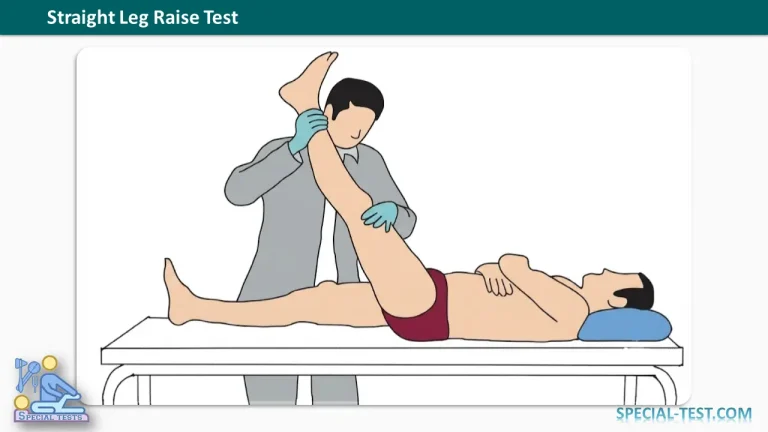
The Lasègue Test, also known as the Straight Leg Raise Test (SLR Test), is a commonly performed orthopedic and neurological examination used to assess lumbosacral nerve root irritation, lumbar radiculopathy, and sciatica. It is particularly useful when evaluating patients who experience lower back pain radiating into the buttock or lower limb.
The test involves passively raising the patient’s straight leg while monitoring for reproduction of radicular symptoms. Although the Lasègue Test is widely used to investigate suspected lumbar disc herniation, it should always be interpreted alongside the patient’s medical history, neurological examination, and other clinical findings.
What Is the Purpose of the Lasègue Test?
The primary purpose of the Lasègue Test is to evaluate possible irritation or compression of the lumbosacral nerve roots, particularly L5 and S1, which contribute to the sciatic nerve.
Healthcare professionals commonly perform this examination in patients presenting with:
- Lumbar radiculopathy: Pain, tingling, or numbness associated with irritation or dysfunction of a lumbar or sacral nerve root.
- Sciatica: Radiating pain that typically extends from the lower back or buttock into the leg.
- Lumbar disc herniation: Displacement of intervertebral disc material that may irritate adjacent nerve roots.
- Low back pain with leg symptoms: Particularly when symptoms suggest neural involvement rather than isolated muscular pain.
During the test, hip flexion with the knee extended increases mechanical loading on the sciatic nerve and associated lumbosacral nerve roots. Reproduction of the patient’s characteristic radiating pain may indicate increased neural mechanosensitivity.
However, a positive Lasègue Test does not independently establish the presence of a herniated disc or confirm the exact anatomical location of nerve root compression.
How to Perform the Lasègue Test
The Straight Leg Raise Test procedure is straightforward but requires appropriate positioning and careful interpretation.
Step-by-Step Procedure
- Patient positioning: Ask the patient to lie comfortably in a supine position (face upward) on an examination table, with both legs extended.
- Examiner positioning: Stand beside the patient and support the tested leg near the heel or ankle while maintaining knee extension.
- Passive leg elevation: Slowly raise the patient’s leg by flexing the hip while keeping the knee straight and the hip approximately neutral.
- Observe symptom reproduction: Ask the patient to report any pain, tingling, or radiating symptoms, including their location and whether they resemble the patient’s usual complaint.
- Record the hip flexion angle: Note the approximate angle at which symptoms begin, particularly within the commonly assessed range of 30–70 degrees.
- Compare both sides: Repeat the examination on the opposite leg to identify differences in symptom reproduction and available movement.
The examiner should stop raising the leg when the patient’s characteristic symptoms appear or discomfort becomes excessive. The movement must be controlled and should never be forced.
Additional Testing: Bragard Sign
The Bragard Test is a modification of the Straight Leg Raise Test that can help distinguish neural symptoms from muscular tightness.
After raising the leg to the point where symptoms appear, the examiner slightly lowers it until the discomfort decreases. The ankle is then passively dorsiflexed.
Reproduction or aggravation of the patient’s familiar radiating pain with ankle dorsiflexion supports the possibility of neural mechanosensitivity.
This maneuver is an additional clinical finding rather than definitive proof of nerve root compression.
What Is a Positive Lasègue Test?
A positive Lasègue Test occurs when passive straight leg elevation reproduces the patient’s characteristic radicular leg pain, typically extending below the knee along a distribution consistent with lumbosacral nerve root irritation.
The finding is commonly associated with symptoms appearing between 30 and 70 degrees of hip flexion.
Examples of symptoms that support a positive finding include:
- Sharp or shooting pain extending from the buttock down the leg.
- Reproduction of familiar sciatic pain below the knee.
- Radiating symptoms that may follow an L5 or S1 nerve root distribution.
- A reduction in symptoms when the leg is lowered or the knee is flexed.
What Is Considered a Negative Lasègue Test?
The test is generally considered negative when passive leg elevation does not reproduce the patient’s characteristic radicular symptoms.
Importantly, isolated lower back pain, posterior thigh tightness, or hamstring stretching discomfort does not constitute a true positive Lasègue sign.
Pain occurring only at higher hip flexion angles may reflect hamstring tightness or other musculoskeletal limitations rather than lumbosacral nerve root irritation.
A negative result does not completely exclude lumbar disc herniation or radiculopathy.
Lasègue Test Sensitivity and Specificity
The diagnostic accuracy of the Lasègue Test varies considerably depending on the patient population, diagnostic criteria, and reference standard used.
An influential systematic review published by Devillé and colleagues in 2000 reported the following pooled diagnostic values for lumbar disc herniation in surgical populations:
- Sensitivity: 91%
- Specificity: 26%
These results suggested that the Straight Leg Raise Test was relatively sensitive but insufficiently specific for diagnosing lumbar disc herniation.
However, the estimates were derived from selected surgical populations and cannot automatically be generalized to all patients with low back pain.
A more recent 2026 systematic review and meta-analysis reported that pooled sensitivity and specificity for the Straight Leg Raise Test were generally below 80%. The investigators concluded that the test and its crossed variation provide limited diagnostic accuracy for lumbosacral radicular pain when used independently.
Clinical Interpretation
Sensitivity refers to the ability of a test to correctly identify patients who have the condition being investigated.
Specificity refers to its ability to correctly identify patients who do not have that condition.
The Lasègue Test remains a useful component of the physical examination, but its results should not be treated as a stand-alone diagnosis.
Crossed Straight Leg Raise Test
The Crossed Straight Leg Raise Test, also known as the Crossed Lasègue Test, is a related examination that may help identify lumbar nerve root irritation.
During this maneuver, the examiner raises the patient’s unaffected leg while keeping the knee extended.
A positive crossed Lasègue Test occurs when raising the unaffected leg reproduces the patient’s characteristic radicular pain in the opposite, symptomatic leg.
This finding can be associated with lumbar disc herniation and nerve root compression.
Compared with the standard Straight Leg Raise Test, the crossed maneuver generally has higher specificity but lower sensitivity.
Therefore, a positive crossed SLR finding may provide additional diagnostic information, although a negative result cannot reliably exclude radiculopathy.
Clinical Significance of the Lasègue Test
The Lasègue Test is an important component of the examination of patients with suspected lumbar radiculopathy.
It is commonly combined with other assessments, including muscle strength testing, sensory examination, deep tendon reflexes, gait assessment, and evaluation of the distribution of lower limb pain.
Additional examination techniques, such as the Slump Test, Bragard Test, or Crossed Straight Leg Raise Test, may provide further clinical information.
Magnetic resonance imaging (MRI) may be appropriate in selected patients, particularly when symptoms are persistent, neurological deficits are progressive, or serious pathology is suspected. However, routine imaging is not recommended for every patient presenting with uncomplicated low back pain or sciatica.
The overall clinical picture, rather than the Straight Leg Raise Test alone, should guide diagnostic and treatment decisions.
Frequently Asked Questions (FAQs)
1. What is the Lasègue Test used for?
The Lasègue Test is used to assess possible lumbosacral nerve root irritation in patients with lower back pain, sciatica, or radiating leg symptoms. It is frequently included in examinations for suspected lumbar disc herniation and lumbar radiculopathy.
2. What does a positive Lasègue Test indicate?
A positive Lasègue Test indicates reproduction of characteristic radicular leg pain during passive straight leg elevation. This may suggest irritation of a lumbosacral nerve root, but additional examination is necessary to establish the underlying diagnosis.
3. At what angle is the Straight Leg Raise Test positive?
A positive Straight Leg Raise Test commonly reproduces radicular symptoms between 30 and 70 degrees of hip flexion. The location and nature of the pain are more important than the angle alone.
4. Which nerve roots are assessed by the Lasègue Test?
The test primarily evaluates symptoms associated with the lower lumbar and sacral nerve roots, especially L5 and S1. However, it does not independently identify the exact affected nerve root.
5. Is the Lasègue Test the same as the Straight Leg Raise Test?
Yes. The terms Lasègue Test, Lasègue Sign, and Straight Leg Raise Test are commonly used to describe the same clinical maneuver. The name Lazarević Sign is also encountered in medical literature.
6. Can hamstring tightness cause a positive Lasègue Test?
Hamstring tightness can cause posterior thigh discomfort during leg elevation, but this alone is not considered a true positive Lasègue Test. A clinically meaningful positive result typically reproduces familiar radiating nerve-related pain, often below the knee.
7. How accurate is the Straight Leg Raise Test?
Accuracy varies between studies and patient populations. Older research reported sensitivity of 91% and specificity of 26% for lumbar disc herniation in surgical populations. More recent evidence indicates that diagnostic performance is generally limited, emphasizing the need to combine the test with other clinical findings.
8. What is the difference between the Lasègue Test and the Crossed Lasègue Test?
The standard Lasègue Test involves raising the symptomatic leg and observing whether characteristic radicular pain occurs on that side.
In the Crossed Lasègue Test, the examiner raises the opposite leg. Reproduction of radicular pain in the symptomatic leg represents a positive crossed finding.
The crossed version is generally more specific but less sensitive.
Conclusion
The Lasègue Test (Straight Leg Raise Test) is a valuable clinical examination for assessing suspected sciatica and lumbosacral nerve root irritation. A positive finding involves reproduction of characteristic radiating leg pain during passive hip flexion with the knee extended, typically within a range of 30–70 degrees.
Although commonly used in orthopedic, neurological, and physical therapy examinations, the test has important diagnostic limitations. Its findings are most useful when interpreted together with the patient’s history, neurological examination, and other relevant assessments.
References
- Camino Willhuber GO, Piuzzi NS. Straight Leg Raise Test. StatPearls. NCBI Bookshelf. https://www.ncbi.nlm.nih.gov/books/NBK539717/
- Das JM, Dua A, Nadi M. Straight Leg Raise Test (Lasegue Sign). StatPearls. NCBI Bookshelf. https://www.ncbi.nlm.nih.gov/books/NBK545299/
- Devillé WL, van der Windt DA, Dzaferagić A, et al. The Test of Lasègue: Systematic Review of the Accuracy in Diagnosing Herniated Discs. Spine. 2000;25(9):1140–1147. PubMed
- Nee RJ, Boyd BS, Sierra-Silvestre E, Coppieters MW. Diagnostic Accuracy of the Straight Leg Raise Test for Lumbosacral Radicular Pain: A Systematic Review With Meta-analysis. Musculoskeletal Science and Practice. 2026;86:103666. PubMed
- Nee RJ, Coppieters MW, Boyd BS. Reliability of the Straight Leg Raise Test for Suspected Lumbar Radicular Pain: A Systematic Review With Meta-analysis. Musculoskeletal Science and Practice. 2022;59:102529. PubMed
- Khorami AK, Oliveira CB, Maher CG, et al. Recommendations for Diagnosis and Treatment of Lumbosacral Radicular Pain: A Systematic Review of Clinical Practice Guidelines. Journal of Clinical Medicine. 2021;10(11):2482. PubMed
- Orthofixar. Lasegue Test | Straight Leg Raise Test. https://orthofixar.com/special-test/lasegue-test/