Valsalva Maneuver Test: Purpose, Procedure, Positive Sign & Diagnostic Accuracy
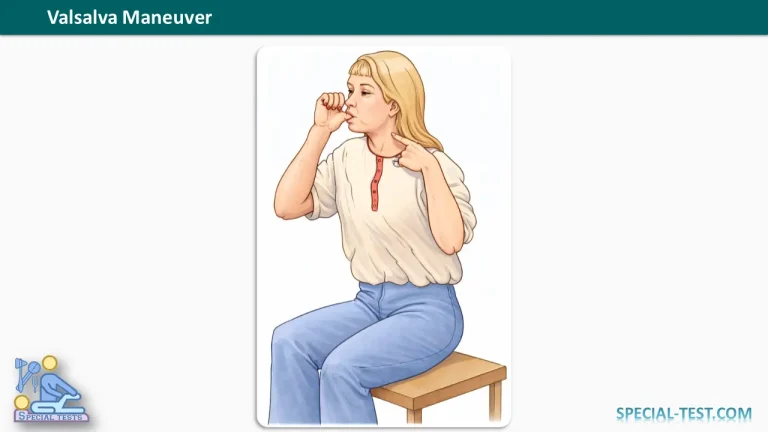
The Valsalva Maneuver is a clinical technique involving forceful exhalation against a closed airway. It produces a temporary increase in intrathoracic and intra-abdominal pressure, resulting in physiological changes that affect the cardiovascular and nervous systems.
In orthopedic and neurological examinations, the Valsalva Maneuver test is used to investigate possible spinal nerve root irritation or compression, particularly in patients experiencing low back pain, sciatica, or lumbar radiculopathy.
The maneuver also has important applications in cardiology, including the assessment of autonomic nervous system function, evaluation of certain heart conditions, and management of selected cardiac arrhythmias.
What Is the Valsalva Maneuver Test Used For?
The primary purpose of the Valsalva Maneuver for the lumbar spine is to provoke or aggravate symptoms associated with spinal nerve root compression.
During the maneuver, increased pressure within the thoracic and abdominal cavities may produce changes in intraspinal pressure and aggravate symptoms caused by irritated or compressed nerve roots.
The test can provide additional clinical information when evaluating conditions such as:
- Lumbar disc herniation: A protruding or extruded intervertebral disc may irritate or compress a spinal nerve root.
- Lumbar radiculopathy: Nerve root irritation or compression may cause radiating pain, tingling, numbness, or weakness.
- Spinal stenosis: Narrowing of the spinal canal or neural foramina may contribute to nerve compression.
- Degenerative spinal changes: Osteophytes and other degenerative structures may reduce the available space around spinal nerves.
- Spinal space-occupying lesions: Less commonly, tumors or other lesions may contribute to neurological symptoms.
However, a positive Valsalva test cannot independently identify the specific cause of nerve compression.
According to research on lumbar disc herniation, coughing, sneezing, and straining can aggravate radicular symptoms, making symptom provocation an important component of the clinical assessment. [1, 2]
How to Perform the Valsalva Maneuver Test
The Valsalva Maneuver is relatively simple to perform and generally requires no specialized equipment when used as part of a musculoskeletal examination.
Patient position: The patient sits upright in a comfortable position, preferably with appropriate support if dizziness is a concern.
Examiner position: The examiner stands close to the patient, within arm’s reach, to provide assistance if dizziness or faintness occurs.
Step-by-Step Procedure
- Ask the patient to sit upright and relax.
- Instruct the patient to take a deep breath.
- Ask the patient to close the glottis and bear down as though attempting to have a bowel movement.
- The patient maintains the straining effort briefly without releasing air.
- Ask whether the maneuver reproduces or increases pain, tingling, or other radiating neurological symptoms.
- Instruct the patient to release the strain and resume normal breathing.
Alternative technique: The patient may be instructed to attempt to blow forcefully against a closed airway. Some orthopedic descriptions use the thumb-in-mouth technique, although this is not essential for performing the test.
For standardized cardiovascular autonomic testing, the maneuver is commonly performed by maintaining an expiratory pressure of approximately 40 mmHg for 15 seconds using a manometer. This standardized cardiovascular protocol should not be confused with the brief symptom-provocation maneuver used during lumbar spine examination. [3, 4]
What Is a Positive Valsalva Maneuver Test?
A positive Valsalva Maneuver test in a lumbar spine examination occurs when straining reproduces or increases the patient’s characteristic symptoms, particularly pain radiating from the lower back into the buttock or lower extremity.
Positive findings may include:
- Increased radiating pain along a suspected nerve root distribution.
- Reproduction of sciatica-like symptoms during straining.
- Increased tingling or paresthesia in the affected lower extremity.
- Aggravation of previously reported neurological symptoms.
These findings may support the suspicion of lumbar radiculopathy or an underlying disc-related disorder.
Clinical Interpretation
Radicular pain commonly follows a distribution associated with an affected spinal nerve root, although symptoms do not always correspond precisely to a single dermatome.
For example, L5 nerve root irritation may produce pain radiating along the lateral leg toward the dorsum of the foot, while S1 irritation may cause symptoms extending through the posterior leg toward the lateral foot.
It is important to distinguish between radiating neurological symptoms and isolated low back pain. Straining may also aggravate discogenic back pain without definite nerve root compression.
Therefore, a positive Valsalva test does not confirm a herniated disc, spinal tumor, or other space-occupying lesion. Findings must be interpreted alongside the patient’s medical history and neurological examination. [1, 2]
Valsalva Maneuver Test Accuracy: Sensitivity and Specificity
The diagnostic accuracy of the Valsalva Maneuver depends on the clinical condition being investigated and the specific testing technique.
A frequently cited study reported the following findings:
| Diagnostic measure | Reported result |
|---|---|
| Sensitivity | 73.3% |
| Specificity | 95.2% |
| Positive predictive value | 97.1% |
| Negative predictive value | 62.5% |
Important distinction: These figures were obtained from a study of Cecin’s Sign (X Sign), a modified examination technique combining lumbar spine flexion with the Valsalva Maneuver. They should not be interpreted as validated accuracy estimates for the standard Valsalva Maneuver alone.
The study included 45 patients with MRI-confirmed symptomatic lumbar disc herniation and 21 patients with mechanical low back pain and normal MRI findings.
Although the findings were promising, the sample was relatively small and selected. Larger studies are needed before these accuracy values can be generalized to routine clinical practice. [5]
In addition, systematic reviews indicate that individual physical examination tests often have limited diagnostic accuracy for lumbar radiculopathy. Consequently, clinicians should avoid relying on the Valsalva Maneuver as a standalone diagnostic test. [6]
Other Clinical Applications of the Valsalva Maneuver
Beyond orthopedic examination, the Valsalva Maneuver has several established medical applications.
1. Assessment of Autonomic Nervous System Function
The maneuver produces characteristic changes in heart rate and blood pressure. These responses can be measured to evaluate autonomic cardiovascular regulation and baroreflex function.
2. Management of Supraventricular Tachycardia
The Valsalva Maneuver is a vagal maneuver used in selected patients with hemodynamically stable supraventricular tachycardia (SVT).
A modified technique involving repositioning and passive leg elevation after straining can improve conversion to normal sinus rhythm. In the REVERT trial, conversion occurred in approximately 43% of patients receiving the modified technique compared with 17% using the standard technique. [7]
3. Evaluation of Heart Failure
Clinicians may assess abnormal blood pressure responses during the maneuver to obtain information about cardiac function and autonomic regulation.
4. Differentiation of Cardiac Murmurs
Changes in cardiac preload during the maneuver can alter the intensity of certain heart murmurs, helping clinicians distinguish between cardiovascular conditions.
Precautions and Contraindications
Although the Valsalva Maneuver is generally well tolerated, it can temporarily affect venous return, cardiac output, and blood pressure.
Possible adverse effects include dizziness, lightheadedness, fainting, and, rarely, cardiac rhythm disturbances.
Additional caution or avoidance may be necessary in patients with certain cardiovascular disorders, retinopathy, or recent ophthalmic procedures.
The test should be performed under appropriate clinical supervision when significant medical risk factors are present. It should be stopped if the patient develops marked dizziness, chest pain, or other concerning symptoms. [3]
Frequently Asked Questions (FAQs)
1. What is the main purpose of the Valsalva Maneuver test?
In orthopedic examinations, the Valsalva Maneuver helps identify symptom aggravation associated with possible spinal nerve root irritation or compression. It is also used in cardiovascular and autonomic nervous system assessments.
2. What does a positive Valsalva test indicate?
A positive test occurs when straining reproduces or aggravates the patient’s characteristic symptoms. Radiating pain or paresthesia may support suspected radiculopathy, but the result does not establish a definitive diagnosis.
3. Can the Valsalva Maneuver detect a herniated disc?
The maneuver may reproduce symptoms associated with a lumbar disc herniation, but it cannot directly visualize or confirm a herniated disc. MRI may be required when clinically indicated.
4. What are the sensitivity and specificity of the Valsalva Maneuver?
A modified test known as Cecin’s Sign demonstrated 73.3% sensitivity and 95.2% specificity in a small study of lumbar disc herniation. These results should not be attributed to the standard Valsalva Maneuver alone.
5. Is the Valsalva Maneuver safe?
The maneuver is generally safe for appropriately selected patients. However, it may cause dizziness, fainting, or cardiovascular changes, making medical supervision important for patients with relevant risk factors.
6. What is the difference between the Valsalva Maneuver and the Straight Leg Raise test?
The Valsalva Maneuver increases internal pressure through straining, while the Straight Leg Raise test mechanically stresses neural structures by elevating the extended lower limb. Both can contribute information during lumbar radiculopathy assessment, but neither should be used alone to establish a diagnosis.
7. Can a negative Valsalva test rule out lumbar radiculopathy?
No. A negative result does not exclude lumbar nerve root compression, disc herniation, or other spinal pathology. Clinical history, neurological findings, and further investigations when indicated remain essential.
8. When should further investigation be considered?
Further assessment is indicated when radicular symptoms persist, worsen, or are associated with neurological deficits. New bladder or bowel dysfunction, saddle anesthesia, or rapidly progressive leg weakness requires urgent medical evaluation.
Conclusion
The Valsalva Maneuver test is a useful supplementary clinical technique for evaluating patients with suspected lumbar nerve root irritation, disc-related pain, or radiculopathy.
A positive result may reproduce characteristic radiating neurological symptoms during straining, providing additional diagnostic information.
However, the maneuver has important limitations. Its findings should be interpreted alongside the clinical history, physical examination, and appropriate imaging or electrodiagnostic investigations when necessary.
The Valsalva Maneuver also remains an important tool in cardiovascular medicine, particularly for autonomic function assessment and selected supraventricular tachycardias.
References
- World Federation of Neurosurgical Societies Spine Committee. Lumbar Disc Herniation: Epidemiology, Clinical and Radiologic Diagnosis—WFNS Spine Committee Recommendations. PubMed Central, 2024. Read on NCBI.
- Lumbar Disc Herniation. StatPearls. NCBI Bookshelf. Read on NCBI.
- Srivastav S, Jamil RT, Dua A, Zeltser R. Valsalva Maneuver. StatPearls. NCBI Bookshelf, updated 2025. Read on NCBI.
- Pstras L, Thomaseth K, Waniewski J, et al. The Valsalva Manoeuvre: Physiology and Clinical Examples. Acta Physiologica. 2016;217(2):103–119. Read on PubMed.
- Cecin HA. Cecin’s Sign (“X” Sign): Improving the Diagnosis of Radicular Compression by Herniated Lumbar Disks. Revista Brasileira de Reumatologia. 2010;50(1):44–55. Read on PubMed.
- Accuracy of Clinical Neurological Examination in Diagnosing Lumbo-Sacral Radiculopathy: A Systematic Literature Review. Read on PubMed.
- Appelboam A, Reuben A, Mann C, et al. Postural Modification to the Standard Valsalva Manoeuvre for Emergency Treatment of Supraventricular Tachycardias (REVERT): A Randomised Controlled Trial. The Lancet. 2015;386:1747–1753. Read on PubMed.
- Orthofixar. Valsalva Maneuver: Complete Guide to Test, Technique, and Indications. Read on Orthofixar.