Spurling’s Test: Procedure, Positive Sign, Sensitivity & Specificity
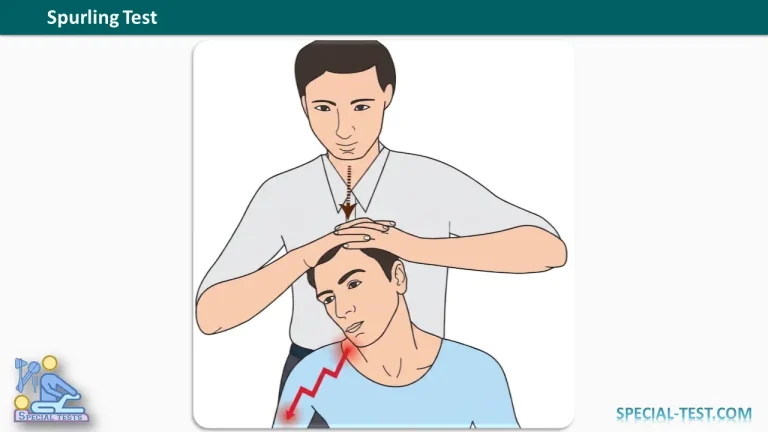
Spurling’s Test, also known as the Foraminal Compression Test, Cervical Compression Test, or Neck Compression Test, is a clinical examination used to assess suspected cervical radiculopathy caused by irritation or compression of a cervical nerve root.
The test involves positioning the cervical spine into extension, lateral flexion, or rotation toward the symptomatic side, followed by controlled axial compression. A positive Spurling’s Test reproduces the patient’s familiar radiating symptoms into the shoulder or upper extremity.
Spurling’s Test is commonly used by orthopedic surgeons, physical therapists, neurologists, and other healthcare professionals as part of a comprehensive cervical spine examination.
What Is Spurling’s Test Used For?
The primary purpose of Spurling’s Test is to evaluate possible cervical nerve root compression in patients presenting with neck pain accompanied by radiating upper extremity symptoms.
Cervical radiculopathy develops when a spinal nerve root becomes irritated or compressed as it exits the cervical spine through the intervertebral foramen.
Common underlying conditions include:
- Cervical disc herniation
- Cervical spondylosis
- Foraminal stenosis
- Degenerative disc disease
- Osteophyte formation
Patients with cervical radiculopathy may experience neck pain, radiating arm pain, tingling, numbness, sensory disturbances, muscle weakness, or changes in deep tendon reflexes.
Spurling’s Test helps determine whether cervical spine positioning and compression reproduce symptoms consistent with nerve root irritation. However, the test cannot independently establish the diagnosis or identify the exact affected nerve root.
How to Perform Spurling’s Test
Spurling’s Test should be performed by a trained healthcare professional following appropriate screening for cervical spine instability and other contraindications.
Patient Position
The patient sits upright on an examination table or chair with the cervical spine initially in a neutral position.
Examiner Position
The examiner stands behind the seated patient and supports the patient’s head while monitoring symptoms.
Spurling’s Test Procedure
- Position the patient: Ask the patient to sit comfortably with the shoulders relaxed and the head facing forward.
- Position the cervical spine: Gently side-bend the patient’s head toward the symptomatic side. Depending on the test variation, slight ipsilateral rotation and cervical extension may also be introduced.
- Apply axial compression: If clinically appropriate and well tolerated, the examiner applies controlled downward axial pressure through the top of the patient’s head. Some historical protocols describe approximately 7 kg of force, but this is not a universal target or a requirement for safe testing.
- Monitor symptoms: Ask whether the maneuver reproduces familiar pain, tingling, or other symptoms radiating toward the shoulder, arm, or hand.
- Interpret the response: Record the location and nature of the symptoms and discontinue compression immediately if the patient’s typical radicular symptoms appear or any concerning symptoms develop.
Different variations of Spurling’s Test have been described in the literature, and the exact cervical positioning can influence diagnostic accuracy.
What Is a Positive Spurling’s Test?
A positive Spurling’s Test occurs when the maneuver reproduces the patient’s familiar radicular pain or paresthesia radiating into the ipsilateral shoulder or upper extremity.
For example, a patient with suspected right-sided cervical radiculopathy may develop familiar pain radiating down the right arm when the neck is positioned toward the right and gentle axial compression is applied.
A positive result supports the possibility of cervical nerve root irritation or compression, particularly when it corresponds with the patient’s clinical history and neurological examination.
Important: Localized neck pain or muscular discomfort alone is not considered a positive result for cervical radiculopathy.
What Is a Negative Spurling’s Test?
A negative Spurling’s Test occurs when the examination does not reproduce the patient’s characteristic radicular symptoms.
However, a negative test does not exclude cervical radiculopathy because the procedure has limited sensitivity.
Further neurological assessment may still be necessary when the patient’s symptoms suggest cervical nerve root involvement.
Spurling’s Test Sensitivity and Specificity
The diagnostic accuracy of Spurling’s Test varies according to the examination technique, patient population, and reference standard used.
In a diagnostic study by Wainner and colleagues, the Spurling A variation demonstrated:
- Sensitivity: 50%
- Specificity: 86%
The Spurling B variation demonstrated 50% sensitivity and 74% specificity in the same study.
A 2025 systematic review and meta-analysis involving eight studies reported pooled sensitivity of approximately 53% and pooled specificity of 92%.
A subsequent 2026 systematic review found that sensitivity and specificity continued to vary substantially across studies, emphasizing the importance of interpreting results in the appropriate clinical context.
Clinical Interpretation
Sensitivity describes how effectively a test identifies patients who have a particular condition. Relatively low sensitivity means that some patients with cervical radiculopathy may have a negative Spurling’s Test.
Specificity describes how effectively a test identifies patients who do not have the condition. High specificity means that a positive result can help increase clinical suspicion of cervical radiculopathy.
Therefore, Spurling’s Test is generally more useful for supporting a suspected diagnosis when positive than for excluding cervical radiculopathy when negative.
Nevertheless, neither result should be interpreted in isolation.
Clinical Significance of Spurling’s Test
Spurling’s Test is a valuable component of the orthopedic and neurological assessment of patients with suspected cervical radiculopathy.
Its diagnostic usefulness improves when the examination is combined with other clinical findings, including:
- Upper Limb Tension Test (ULTT)
- Cervical Distraction Test
- Shoulder Abduction Relief Test (Bakody Sign)
- Cervical range-of-motion assessment
- Upper extremity muscle strength, sensation, and reflex testing
A comprehensive clinical examination can also help distinguish cervical radiculopathy from peripheral nerve entrapment, brachial plexus disorders, and other causes of upper extremity pain.
Magnetic resonance imaging (MRI) or electrodiagnostic studies may be considered when symptoms persist, neurological deficits progress, or the diagnosis remains uncertain.
Contraindications and Precautions
Spurling’s Test should not be performed when cervical compression could place the patient at risk.
Important contraindications or reasons to avoid testing include:
- Suspected cervical spine fracture or instability
- Acute cervical trauma
- Signs of cervical myelopathy
- Suspected spinal infection
- Suspected spinal malignancy
- Other serious cervical spine pathology
Patients with progressive neurological weakness, gait abnormalities, or signs of spinal cord dysfunction require appropriate medical evaluation rather than provocative cervical compression testing.
The procedure should never involve sudden, aggressive, or uncontrolled pressure.
Frequently Asked Questions About Spurling’s Test
1. What does a positive Spurling’s Test indicate?
A positive Spurling’s Test suggests possible cervical nerve root irritation or compression when the maneuver reproduces familiar radiating arm pain or neurological symptoms. It supports the clinical diagnosis of cervical radiculopathy but does not confirm it independently.
2. How accurate is Spurling’s Test?
Spurling’s Test generally demonstrates higher specificity than sensitivity. The Spurling A variation showed 50% sensitivity and 86% specificity in one study, while a 2025 meta-analysis reported pooled sensitivity of 53% and specificity of 92%. Accuracy varies between studies and test variations.
3. What is the difference between Spurling A and Spurling B?
Spurling A typically involves cervical lateral flexion toward the symptomatic side followed by axial compression. Spurling B incorporates additional cervical extension and rotation or lateral flexion before compression. These variations can produce different diagnostic accuracy estimates.
4. Can Spurling’s Test diagnose a cervical disc herniation?
No. A positive test may suggest nerve root irritation associated with a cervical disc herniation, but it cannot determine the precise anatomical cause. MRI may be appropriate when imaging is clinically indicated.
5. Is Spurling’s Test positive if only neck pain occurs?
No. Isolated neck pain without familiar radicular symptoms is not generally considered a positive Spurling’s Test for cervical radiculopathy. Reproduction of characteristic radiating upper extremity symptoms is more clinically meaningful.
6. Can a negative Spurling’s Test rule out cervical radiculopathy?
No. Because Spurling’s Test has limited sensitivity, a negative result cannot reliably exclude cervical radiculopathy. Additional clinical examination and appropriate investigations may be necessary.
7. Is Spurling’s Test safe?
Spurling’s Test is an established clinical maneuver when performed appropriately by a trained clinician after screening for contraindications. It should be avoided in patients with suspected cervical instability, acute trauma, myelopathy, or other serious cervical spine conditions. Patients should not attempt forceful cervical compression on themselves.
Conclusion
Spurling’s Test is an important orthopedic special test for evaluating suspected cervical radiculopathy and cervical nerve root irritation. It is performed using carefully controlled cervical positioning and axial compression to assess whether the patient’s familiar radiating upper extremity symptoms can be reproduced.
Because Spurling’s Test generally demonstrates high specificity but limited sensitivity, a positive result can strengthen suspicion of cervical radiculopathy, while a negative result does not reliably exclude the condition.
For the most accurate clinical interpretation, Spurling’s Test should always be combined with patient history, neurological examination, and other appropriate cervical spine assessment techniques.
References
- Spurling Test. StatPearls. National Center for Biotechnology Information (NCBI Bookshelf). https://www.ncbi.nlm.nih.gov/books/NBK493152/
- Wainner RS, et al. Reliability and diagnostic accuracy of the clinical examination and patient self-report measures for cervical radiculopathy. Spine. 2003;28(1):52–62. https://pubmed.ncbi.nlm.nih.gov/12544957/
- van der Heijden GJMG, et al. Accuracy of spinal orthopaedic tests: a systematic review. BMC Musculoskeletal Disorders. 2006. https://pmc.ncbi.nlm.nih.gov/articles/PMC1635718/
- Lin LH, et al. Diagnostic Performance of Spurling’s Test for the Assessment of Subacute and Chronic Cervical Radiculopathy: A Systematic Review and Meta-analysis. American Journal of Physical Medicine & Rehabilitation. 2025. https://pubmed.ncbi.nlm.nih.gov/39938056/
- Thoomes EJ, et al. Diagnostic accuracy of physical examination tests for painful cervical radiculopathy: update of a systematic review and meta-analysis. BMC Musculoskeletal Disorders. 2026. https://pubmed.ncbi.nlm.nih.gov/41680685/
- Spurling Test: How to Diagnose Cervical Radiculopathy Accurately. Orthofixar. https://orthofixar.com/special-test/spurling-test/
- Childress MA, Becker BA. Nonoperative Management of Cervical Radiculopathy. American Family Physician. 2016. https://pubmed.ncbi.nlm.nih.gov/27175952/