Shoulder Posterior Drawer Test: Technique and Positive Findings
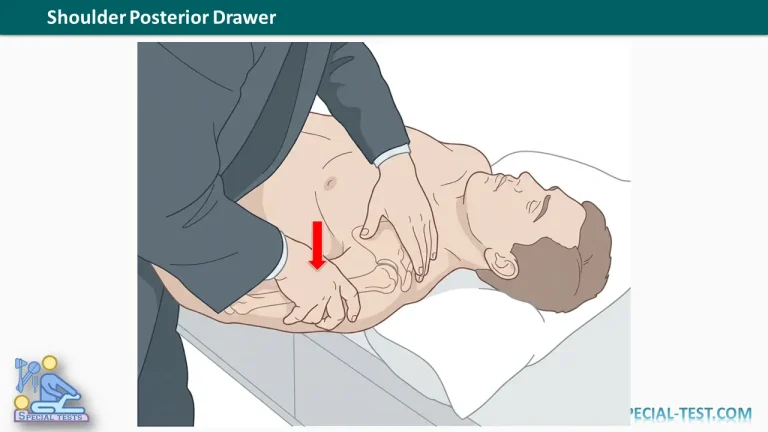
The shoulder posterior drawer test is a clinical examination maneuver used to assess posterior glenohumeral instability by evaluating the posterior translation of the humeral head relative to the glenoid.
It is commonly performed during an orthopedic shoulder examination when posterior shoulder instability or excessive glenohumeral joint translation is suspected.
What Is the Shoulder Posterior Drawer Test Used For?
The posterior drawer test is used to assess posterior glenohumeral instability by determining whether the humeral head demonstrates excessive posterior translation relative to the glenoid.
Posterior shoulder instability may be associated with capsulolabral injuries, previous shoulder trauma, repetitive loading, or generalized ligamentous laxity.
The test should be interpreted alongside the patient’s symptoms, medical history, and other physical examination findings.
How to Perform the Shoulder Posterior Drawer Test
Patient position: Position the patient comfortably, commonly in the supine position, with the shoulder and arm relaxed. The exact arm position may vary according to the examination technique.
Examiner technique:
- Stabilize the scapula with one hand to minimize scapular movement during the examination.
- Place the other hand over the proximal humerus to control the humeral head.
- Gently apply a posteriorly directed force to the humeral head relative to the glenoid.
- Assess the amount of posterior translation, the quality of the endpoint, and whether the maneuver reproduces the patient’s symptoms.
- Compare the findings with those of the contralateral shoulder.
Apply the maneuver carefully and avoid excessive force, particularly when acute injury or dislocation is suspected.
What Is a Positive Shoulder Posterior Drawer Test?
The test may be considered positive when there is increased posterior translation of the humeral head compared with the contralateral shoulder, particularly when accompanied by symptoms of instability, apprehension, or a soft endpoint.
However, increased translation alone does not establish symptomatic shoulder instability. Some individuals have physiological glenohumeral laxity without clinical symptoms.
Interpret the result in conjunction with the patient’s history and other examination maneuvers, such as the posterior stress test, jerk test, and Kim test.
Clinical Significance
The posterior drawer test is one component of the clinical assessment of posterior shoulder instability. No single physical examination maneuver should be used in isolation to establish the diagnosis.
Depending on the clinical presentation, further assessment may include radiographs, MRI, or MR arthrography to evaluate associated bone and soft-tissue abnormalities.
Frequently Asked Questions (FAQ)
1. What does the shoulder posterior drawer test assess?
It assesses posterior translation of the humeral head relative to the glenoid and helps clinicians evaluate posterior glenohumeral instability.
2. What is a positive posterior drawer test of the shoulder?
A positive finding may include excessive posterior translation compared with the opposite shoulder, particularly if it reproduces the patient’s symptoms or is associated with an abnormal endpoint.
3. Does increased posterior translation always indicate shoulder instability?
No. Increased translation can reflect normal physiological laxity. Clinical instability is more likely when abnormal translation is associated with symptoms, such as a sensation of slipping, apprehension, or recurrent subluxation.
4. What is the difference between the posterior drawer test and the posterior stress test?
The posterior drawer test primarily assesses the amount of posterior translation of the humeral head. The posterior stress test applies a posteriorly directed force in a provocative arm position and assesses whether pain or a sensation of instability is reproduced. The maneuvers are related but are not identical.
5. Which other tests can help assess posterior shoulder instability?
Other commonly used maneuvers include the jerk test, Kim test, and posterior load-and-shift test. These tests assess different aspects of posterior or posteroinferior instability and should be interpreted together with the history and overall examination.
6. Is imaging required after a positive posterior drawer test?
Not in every case. Imaging decisions depend on the clinical history, examination findings, suspected injury, and whether structural damage is a concern. Radiographs may be used to evaluate bone abnormalities, while MRI or MR arthrography may help assess labral and capsular pathology.
References
- Doehrmann R, Frush TJ. Posterior Shoulder Instability. StatPearls. NCBI Bookshelf. Read the clinical review.
- Provencher MT, et al. Evaluation and Management of Posterior Shoulder Instability. Sports Health. Read the peer-reviewed review.
- Gerber C, Ganz R. Clinical assessment of instability of the shoulder, with special reference to anterior and posterior drawer tests. The Journal of Bone and Joint Surgery. British Volume. 1984;66(4):551–556. View the PubMed record.
- Campbell’s Operative Orthopaedics. Refer to the relevant edition and chapter on shoulder instability for textbook-based examination guidance.
- Instability and Laxity. Musculoskeletal Key. Access the chapter.