Posterior Stress Test of the Shoulder: Purpose, Procedure, and Positive Results
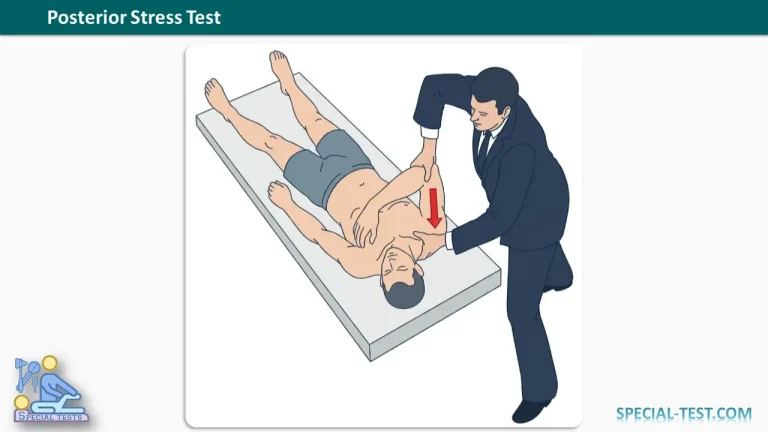
The Posterior Stress Test of the shoulder, also known as the Posterior Apprehension Test, is a clinical orthopedic examination maneuver used to assess posterior glenohumeral instability. This test helps clinicians evaluate whether the head of the humerus moves abnormally backward within the glenoid cavity, potentially causing shoulder pain, subluxation, or a feeling of instability.
Posterior shoulder instability can occur after traumatic injuries, repetitive microtrauma, or underlying capsulolabral abnormalities. It may be overlooked because symptoms can resemble other shoulder conditions, particularly in athletes who repeatedly perform pushing movements or activities involving shoulder flexion and internal rotation. A thorough history and physical examination are essential for identifying this condition.
What Is the Posterior Stress Test Used For?
The Posterior Stress Test is primarily used to assess posterior instability of the glenohumeral joint. During the examination, the clinician places the shoulder in a position that challenges its posterior stabilizing structures and applies a controlled force directed backward.
The test may help identify symptoms associated with posterior translation of the humeral head, including pain, apprehension, and a sensation that the shoulder is slipping out of its normal position.
Posterior shoulder instability may be associated with several conditions, including:
- Posterior glenohumeral subluxation: Partial displacement of the humeral head toward the back of the glenoid.
- Posterior shoulder dislocation: Complete displacement of the humeral head posteriorly.
- Posterior capsulolabral injury: Damage involving the posterior joint capsule or glenoid labrum.
- Repetitive microtrauma: Repeated loading of the shoulder during athletic or occupational activities.
- Shoulder ligamentous laxity: Increased movement of the joint that may contribute to instability.
The Posterior Stress Test is one component of the clinical assessment and should not be used alone to establish a definitive diagnosis.
How to Perform the Posterior Stress Test
The Posterior Stress Test should be performed by a qualified healthcare professional who understands shoulder anatomy and instability assessment.
Patient Position
- The patient lies in the supine position, with the back resting on the examination table.
- The affected shoulder and arm should be relaxed and accessible for examination.
- The clinician ensures that the patient understands the procedure before applying any stress to the joint.
Test Procedure
- The examiner positions the patient’s shoulder in approximately 90 degrees of flexion, with the arm adducted across the body and internally rotated.
- The examiner stabilizes the shoulder girdle as needed to control unwanted movement of the scapula.
- A controlled, posteriorly directed force is applied through the patient’s elbow, pushing the humeral head backward relative to the glenoid.
- The examiner observes the patient’s response, paying attention to pain, apprehension, resistance, or a sensation of instability.
- The maneuver is stopped if significant pain, marked apprehension, or suspected dislocation occurs.
The exact positioning and force application may vary according to the clinical technique being used. The examiner should avoid excessive force and compare findings with the opposite shoulder when appropriate.
What Is a Positive Posterior Stress Test?
The Posterior Stress Test is considered positive when the maneuver reproduces symptoms consistent with posterior shoulder instability.
Positive findings may include:
- Pain: The patient experiences familiar posterior shoulder pain during the maneuver.
- Apprehension: The patient feels that the shoulder may slip out of place or become dislocated.
- A sensation of instability: The patient describes abnormal movement or a feeling that the shoulder is giving way.
- Posterior translation or subluxation: The examiner detects excessive posterior movement of the humeral head relative to the glenoid.
A positive test supports the suspicion of posterior glenohumeral instability, particularly when the findings are consistent with the patient’s history and other examination results. Pain alone, however, is not specific to instability and may occur with other shoulder disorders.
What Does a Negative Posterior Stress Test Mean?
A negative result means that the maneuver does not reproduce the characteristic symptoms or demonstrate clear signs of posterior instability during the examination.
However, a negative test does not completely exclude posterior shoulder instability. Some patients have intermittent symptoms, subtle instability, or injuries that are not adequately reproduced by a single examination maneuver.
If the patient’s history strongly suggests posterior instability, the clinician may perform additional tests, such as the jerk test, Kim test, posterior drawer test, or load-and-shift test.
Clinical Importance of the Posterior Stress Test
Posterior shoulder instability may cause discomfort during activities that place the arm in a forward-flexed, adducted, and internally rotated position. Examples include pushing heavy objects, performing bench presses, blocking during contact sports, and certain throwing or weightlifting movements.
Accurate assessment is important because posterior instability can be mistaken for rotator cuff pathology, nonspecific shoulder pain, or other forms of glenohumeral instability.
A systematic review published in Sports Health found that evidence supporting individual clinical tests for posterior shoulder instability was limited. Therefore, clinicians should interpret the Posterior Stress Test alongside the patient’s symptoms, injury mechanism, physical examination findings, and, when indicated, imaging studies.
Differential Diagnosis and Additional Assessment
When the Posterior Stress Test is positive, further assessment may be required to determine the underlying cause of symptoms.
Possible differential diagnoses include:
- Posterior glenoid labral tears.
- Rotator cuff injuries.
- Multidirectional shoulder instability.
- Glenohumeral ligament or capsular abnormalities.
- Traumatic posterior shoulder dislocation.
Radiographs may be indicated when dislocation, fracture, or bony abnormalities are suspected. Magnetic resonance imaging or magnetic resonance arthrography may be considered when a labral or other soft-tissue injury requires further investigation.
The choice of investigations depends on the clinical presentation and the findings of the initial assessment. The test itself does not determine the specific injured structure or establish the severity of an injury.
Limitations and Safety Considerations
The Posterior Stress Test is a clinical examination maneuver rather than a stand-alone diagnostic investigation. Its interpretation depends on the examiner’s technique, the patient’s symptoms, and the overall clinical context.
The test should be performed cautiously in patients with severe pain, recent trauma, suspected dislocation, or a known unstable shoulder. Repeated or forceful posterior loading should be avoided when it could worsen the injury.
A qualified clinician should determine whether the maneuver is appropriate and whether additional assessment is necessary.
Frequently Asked Questions (FAQ)
1. What is the Posterior Stress Test of the shoulder used for?
The Posterior Stress Test is used to assess posterior glenohumeral instability by applying a controlled posterior force to the shoulder and evaluating for pain, apprehension, or abnormal movement of the humeral head.
2. How do you perform the Posterior Stress Test?
The patient lies supine. The examiner positions the shoulder in flexion, adduction, and internal rotation, then applies a controlled posteriorly directed force through the elbow while observing the patient’s symptoms and joint response.
3. What is a positive Posterior Stress Test?
A positive result occurs when the maneuver reproduces the patient’s familiar shoulder pain or apprehension, produces a sensation of instability, or reveals abnormal posterior translation of the humeral head.
4. What does a positive Posterior Stress Test indicate?
It suggests posterior shoulder instability or abnormal posterior movement of the humeral head. Additional clinical assessment may be required to identify the underlying injury.
5. Is the Posterior Stress Test reliable?
The test can contribute useful clinical information, but evidence for individual shoulder instability tests is limited. It should be interpreted alongside the patient’s history and other examination findings rather than used as the sole diagnostic criterion. (2)
6. Which tests can be performed alongside the Posterior Stress Test?
Other examination maneuvers include the jerk test, Kim test, posterior drawer test, and load-and-shift test. The clinician selects appropriate tests based on the patient’s symptoms and suspected pathology.
References
- Tannenbaum E, Sekiya JK. Evaluation and Management of Posterior Shoulder Instability. Sports Health. 2011;3(3):253–263.
- Dhir J, et al. Evidence-Based Review of Clinical Diagnostic Tests and Predictive Clinical Tests That Evaluate Response to Conservative Rehabilitation for Posterior Glenohumeral Instability. Sports Health. 2018;10(2):141–145.
- Shoulder Posterior Stress Test — Orthofixar.
- Posterior Shoulder Instability — NCBI Bookshelf.