Shoulder Anterior Drawer Test: Procedure, Positive Findings & Accuracy
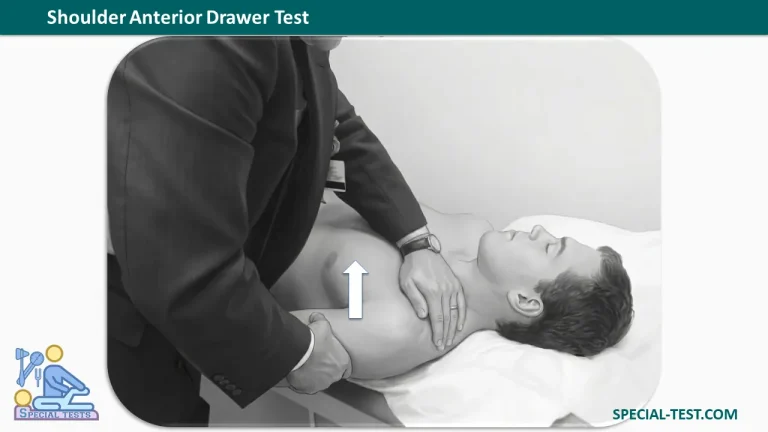
The Shoulder Anterior Drawer Test, also known as the Gerber–Ganz Anterior Drawer Test, is a clinical examination used to assess anterior glenohumeral instability. It evaluates the anterior translation of the humeral head relative to the glenoid cavity and helps identify patients with suspected shoulder instability.
The test is particularly useful in patients with a history of shoulder dislocation, recurrent subluxation, or a sensation that the shoulder may slip out of position during certain movements.
The Shoulder Anterior Drawer Test has a reported sensitivity of 53% and specificity of 85% for diagnosing traumatic anterior shoulder instability when reproduction of instability symptoms is considered a positive finding.
What Is the Purpose of the Shoulder Anterior Drawer Test?
The primary purpose of the Shoulder Anterior Drawer Test is to evaluate anterior instability of the glenohumeral joint.
The shoulder is a highly mobile joint that depends on several stabilizing structures, including the glenoid labrum, joint capsule, glenohumeral ligaments, and surrounding muscles.
Damage or excessive laxity of these structures may allow abnormal anterior translation of the humeral head.
The test helps clinicians assess the degree of anterior shoulder laxity and determine whether the movement reproduces symptoms of instability.
It may be particularly relevant in patients with traumatic anterior shoulder dislocations, recurrent shoulder instability, or instability associated with repetitive overhead activities.
However, joint laxity and symptomatic instability are not the same condition. Increased translation of the humeral head may be present in individuals without shoulder symptoms and does not necessarily indicate pathological instability.
How to Perform the Shoulder Anterior Drawer Test
The Shoulder Anterior Drawer Test is typically performed with the patient lying supine on an examination table.
Step-by-step procedure:
- Patient positioning: Position the patient supine, with the affected shoulder slightly beyond the edge of the examination table to allow adequate movement.
- Shoulder positioning: Place the shoulder in approximately 80–120 degrees of abduction, 0–20 degrees of flexion, and 0–30 degrees of external rotation. The shoulder should remain relaxed and comfortable.
- Scapular stabilization: The examiner stabilizes the scapula using one hand, positioning the thumb near the coracoid process and the fingers along the scapular spine.
- Humeral head stabilization: With the opposite hand, the examiner grasps the proximal humerus while maintaining control of the patient’s arm.
- Anterior translation: Apply a controlled anteriorly directed force to the proximal humerus, translating the humeral head forward relative to the stabilized glenoid.
- Assessment: Observe the amount of anterior humeral head translation and determine whether the maneuver reproduces the patient’s familiar symptoms of instability.
- Contralateral comparison: Repeat the examination on the opposite shoulder to assess differences in translation and symptom reproduction.
The maneuver should be performed gently by a trained healthcare professional to minimize discomfort and avoid provoking an actual shoulder dislocation.
The original Gerber–Ganz technique emphasizes proper scapular stabilization to distinguish true glenohumeral translation from movement of the entire shoulder girdle.
What Is a Positive Shoulder Anterior Drawer Test?
A positive Shoulder Anterior Drawer Test occurs when anterior translation of the humeral head reproduces the patient’s characteristic sensation of shoulder instability or apprehension.
The patient may describe a feeling that the shoulder is slipping forward, becoming unstable, or approaching dislocation.
Increased anterior translation compared with the opposite shoulder can support the clinical assessment, but excessive movement alone does not necessarily indicate pathological instability.
An audible or palpable click may sometimes accompany anterior translation. Although clicking can be associated with labral abnormalities or movement of the humeral head over the glenoid rim, it is not diagnostic of a specific injury.
Importantly, pain alone should not be interpreted as a positive test for anterior shoulder instability.
Research by Farber and colleagues demonstrated that reproduction of instability symptoms provides greater diagnostic value than pain during anterior drawer testing.
Shoulder Anterior Drawer Test Grading
The degree of anterior humeral head translation can be classified using a grading system ranging from Grade 0 to Grade 3.
Grade 0: Minimal Translation
There is minimal or no appreciable anterior translation of the humeral head relative to the glenoid.
Grade 1+: Translation to the Glenoid Rim
The humeral head translates anteriorly toward the glenoid rim but does not pass beyond it.
Grade 2+: Translation Beyond the Glenoid Rim With Spontaneous Reduction
The humeral head moves beyond the glenoid rim but returns spontaneously to its normal position when the applied force is released.
Grade 3+: Translation Beyond the Glenoid Rim Without Spontaneous Reduction
The humeral head translates beyond the glenoid rim and remains displaced rather than spontaneously returning to its original position.
Clinical Note: The grading system describes the magnitude of glenohumeral translation rather than independently establishing a diagnosis of pathological instability.
Some individuals, particularly those with generalized ligamentous laxity, may demonstrate increased translation without associated symptoms.
Therefore, the grading findings must be interpreted alongside the patient’s medical history, clinical symptoms, and other shoulder examination results.
Shoulder Anterior Drawer Test Sensitivity and Specificity
The diagnostic accuracy of the Shoulder Anterior Drawer Test has been investigated in clinical research.
A study published by Farber et al. in 2006 evaluated the apprehension test, relocation test, and anterior drawer test for diagnosing traumatic anterior shoulder instability.
The study included 363 patients undergoing shoulder examination and subsequent arthroscopy, including 46 patients with confirmed traumatic anterior shoulder instability.
When reproduction of instability symptoms was used as the criterion for a positive anterior drawer test, the researchers reported the following results:
| Diagnostic Parameter | Result |
|---|---|
| Sensitivity | 53% |
| Specificity | 85% |
| Positive Likelihood Ratio (LR+) | 3.6 |
| Negative Likelihood Ratio (LR−) | Approximately 0.56 |
The anterior drawer test could be successfully performed during the clinical examination in approximately 87% of patients.
These results suggest that the test has moderate specificity but relatively low sensitivity.
Sensitivity of 53% indicates that the test identified approximately 53% of patients who had traumatic anterior shoulder instability in the study population.
Specificity of 85% indicates that approximately 85% of patients without the condition received a negative result.
The positive likelihood ratio of 3.6 indicates that a positive finding increases the probability of anterior shoulder instability.
However, because sensitivity is relatively low, a negative Shoulder Anterior Drawer Test cannot reliably exclude anterior shoulder instability.
Clinical Significance of the Shoulder Anterior Drawer Test
The Shoulder Anterior Drawer Test is an important component of the clinical evaluation of patients with suspected anterior glenohumeral instability.
However, it should not be used as the sole diagnostic assessment.
A comprehensive shoulder examination should incorporate the patient’s history of traumatic dislocation, episodes of subluxation, activity-related instability, and findings from other physical examination maneuvers.
Common complementary tests include the anterior apprehension test, Jobe relocation test, anterior release test, and load-and-shift test.
Although the anterior drawer and load-and-shift tests are similar, the load-and-shift test involves centering or loading the humeral head within the glenoid before applying translational force. The anterior drawer test does not require this initial loading maneuver.
Combining multiple clinical tests with the patient’s history improves the overall evaluation of suspected anterior shoulder instability.
A 2017 review of anterior shoulder instability examination techniques emphasized the importance of combining clinical history with several provocative shoulder tests rather than relying on a single maneuver.
Reliability of the Shoulder Anterior Drawer Test
A 2025 study by Aldon-Villegas and colleagues investigated the reliability of anterior and posterior shoulder drawer tests in 105 participants with symptoms of shoulder instability.
The researchers reported excellent intra-rater reliability and good inter-rater reliability for the anterior drawer test.
Using the Hawkins grading scale, the anterior drawer test demonstrated an inter-rater weighted kappa of 0.76.
These findings suggest that clinicians can achieve reasonably consistent anterior drawer test assessments when standardized examination and grading methods are used.
However, reliability describes the consistency of examination findings and should not be confused with diagnostic sensitivity or specificity.
Conclusion
The Shoulder Anterior Drawer Test is a useful clinical examination for assessing anterior glenohumeral laxity and suspected shoulder instability.
The procedure involves stabilizing the scapula and applying an anteriorly directed force to the proximal humerus while assessing translation and the reproduction of instability symptoms.
A positive test is most clinically meaningful when the maneuver reproduces the patient’s characteristic sensation of anterior shoulder instability.
With a reported sensitivity of 53% and specificity of 85%, the test can support the diagnosis of traumatic anterior shoulder instability, but a negative finding does not exclude the condition.
The results should always be interpreted in combination with clinical history, other shoulder instability tests, and imaging studies when clinically indicated.
Frequently Asked Questions (FAQ)
1. What does the Shoulder Anterior Drawer Test assess?
The Shoulder Anterior Drawer Test assesses anterior translation of the humeral head relative to the glenoid cavity. It helps clinicians evaluate anterior glenohumeral laxity and identify symptoms associated with anterior shoulder instability.
2. What is considered a positive Shoulder Anterior Drawer Test?
A positive result occurs when anterior translation of the humeral head reproduces the patient’s characteristic sensation of instability or apprehension. Increased translation compared with the opposite shoulder may support the assessment, but excessive laxity without symptoms does not necessarily indicate pathological instability.
3. What is the sensitivity and specificity of the Shoulder Anterior Drawer Test?
The Shoulder Anterior Drawer Test has a reported sensitivity of 53% and specificity of 85% for traumatic anterior shoulder instability when reproduction of instability symptoms is used to define a positive result. These values were reported by Farber et al. in 2006.
4. What is the difference between the Shoulder Anterior Drawer Test and the Load-and-Shift Test?
Both tests assess glenohumeral translation. However, the load-and-shift test involves applying an initial axial force to center the humeral head within the glenoid before translating it anteriorly or posteriorly. The anterior drawer test evaluates anterior translation without requiring this initial loading step.
5. Does a positive Shoulder Anterior Drawer Test confirm a labral tear?
No. A positive test suggests possible anterior shoulder instability but cannot independently confirm a labral tear. Additional clinical examination and appropriate imaging may be necessary to identify associated structural injuries, such as a Bankart lesion.
6. Can the Shoulder Anterior Drawer Test be positive in healthy individuals?
Increased anterior humeral head translation can occur in asymptomatic individuals, particularly those with generalized joint laxity. Therefore, increased translation alone does not establish pathological instability. Reproduction of characteristic symptoms is an important part of clinical interpretation.
7. Can a negative Shoulder Anterior Drawer Test rule out shoulder instability?
No. Because the test has a reported sensitivity of only 53%, a negative result cannot reliably exclude anterior shoulder instability. Additional examination maneuvers and clinical history are necessary for a comprehensive assessment.
Medical References
- Orthofixar — Shoulder Anterior Drawer Test. Orthofixar. Shoulder Anterior Drawer Test: Sensitivity, Specificity & How to Perform. Read on Orthofixar
- Tzannes A, Murrell GAC. (2002). Clinical examination of the unstable shoulder. Sports Medicine. 2002;32(7):447–457. DOI: 10.2165/00007256-200232070-00004. PubMed – PMID: 12015806
- Farber AJ, Castillo R, Clough M, Bahk M, McFarland EG. (2006). Clinical assessment of three common tests for traumatic anterior shoulder instability. Journal of Bone and Joint Surgery American Volume. 2006;88(7):1467–1474. DOI: 10.2106/JBJS.E.00594. PubMed – PMID: 16818971
- Gerber C, Ganz R. (1984). Clinical assessment of instability of the shoulder. With special reference to anterior and posterior drawer tests. Journal of Bone and Joint Surgery British Volume. 1984;66(4):551–556. DOI: 10.1302/0301-620X.66B4.6746691. PubMed – PMID: 6746691
- Clinical Evaluation and Physical Exam Findings in Patients with Anterior Shoulder Instability. (2017). A review describing clinical examination maneuvers and their diagnostic performance in anterior shoulder instability. PubMed – PMID: 29043566
- Aldon-Villegas R, et al. (2025). Intra- and inter-rater reliability of anterior and posterior drawer tests for the assessment of people with shoulder instability. Clinical Rehabilitation. 2025;39(7):914–922. DOI: 10.1177/02692155251339380. PubMed – PMID: 40340595