Crank Test for Shoulder Labral Tears: Procedure, Positive Signs & Accuracy
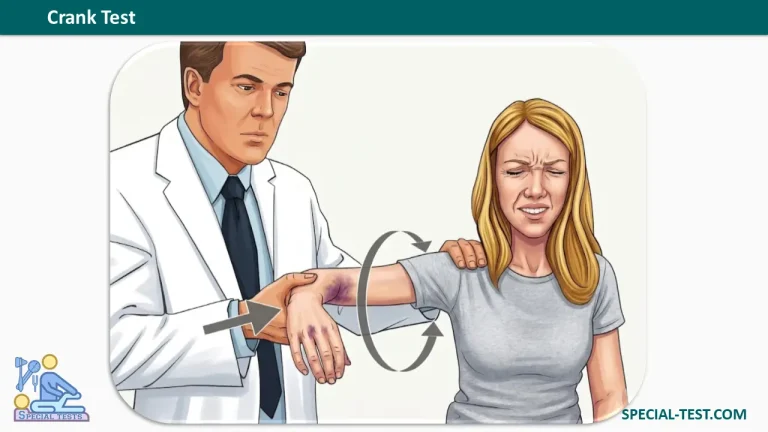
The Crank Test, also known as the Shoulder Crank Test, is an orthopedic physical examination maneuver used to assess injuries of the glenoid labrum, particularly SLAP lesions (Superior Labrum Anterior to Posterior tears). It is commonly performed by orthopedic surgeons, sports medicine physicians, and physical therapists when evaluating patients with shoulder pain, clicking, catching, or suspected labral pathology.
The test involves applying an axial compressive force through the humerus while rotating the shoulder internally and externally. This maneuver creates mechanical stress across the glenoid labrum, potentially reproducing symptoms associated with a labral tear.
Originally described by Liu and colleagues in 1996, the Crank Test remains a recognized component of the clinical examination for suspected shoulder labral injuries.
What Is the Crank Test Used For?
The Crank Test is primarily used to identify possible glenoid labral tears and SLAP lesions of the shoulder.
The glenoid labrum is a fibrocartilaginous structure surrounding the glenoid cavity of the scapula. It helps deepen the shoulder socket and contributes to glenohumeral joint stability.
Injury to this structure can cause shoulder pain, mechanical clicking, catching sensations, and reduced function, particularly during overhead activities.
A SLAP lesion involves damage to the superior portion of the labrum, extending from anterior to posterior around the attachment of the long head of the biceps tendon.
These injuries may occur following:
- A fall onto an outstretched hand.
- Repetitive overhead movements, particularly throwing activities.
- Sudden traction or pulling forces applied to the arm.
- Shoulder dislocation or instability.
- Traumatic loading of the shoulder during sports or physical activities.
The Crank Test helps clinicians determine whether the patient’s symptoms may originate from the glenoid labrum. However, it should be interpreted alongside the medical history, other physical examination findings, and imaging when appropriate.
How to Perform the Crank Test
The Crank Test procedure involves positioning the shoulder in elevation while applying axial compression and controlled internal and external rotation.
Step-by-Step Crank Test Procedure
- Patient positioning: Position the patient either standing or lying supine. The shoulder should be relaxed throughout the examination.
- Shoulder elevation: Elevate the patient’s arm to approximately 160 degrees in the scapular plane, with the elbow slightly flexed. The original examination technique describes this highly elevated position.
- Examiner hand placement: Stabilize the patient’s arm by holding the wrist with one hand while using the other hand to apply a compressive force along the humerus toward the glenoid cavity.
- Apply axial compression: Gently direct the humeral head into the glenoid while maintaining shoulder elevation. This axial load creates compression across the glenohumeral joint.
- Perform shoulder rotation: While maintaining the compressive force, passively rotate the humerus internally and externally through the available range of motion.
- Observe the response: Assess whether the maneuver reproduces deep shoulder pain, clicking, catching, or other mechanical symptoms.
The purpose of the maneuver is to produce mechanical shear stress across the labrum, potentially reproducing symptoms caused by labral pathology.
The test should be performed carefully by a trained healthcare professional, avoiding excessive force or movement beyond the patient’s comfortable range.
What Is a Positive Crank Test?
A positive Crank Test occurs when the maneuver reproduces pain or clicking within the glenohumeral joint.
Positive findings may include:
- Deep shoulder pain during internal or external rotation.
- Painful clicking within the shoulder joint.
- A catching or clunking sensation during movement.
- Reproduction of the patient’s familiar shoulder symptoms.
These findings may raise suspicion for a glenoid labral injury, including a SLAP lesion.
However, a positive Crank Test does not definitively confirm a labral tear. Other shoulder disorders, including rotator cuff pathology and subacromial impingement, may produce similar symptoms and contribute to false-positive results.
Painless clicking alone should also be interpreted cautiously because joint sounds are not necessarily evidence of structural injury.
What Does a Negative Crank Test Mean?
A negative Crank Test occurs when passive shoulder rotation under axial compression does not reproduce relevant shoulder pain or mechanical symptoms.
Although a negative result may reduce clinical suspicion of labral pathology, it does not reliably exclude a SLAP lesion.
Some patients with confirmed labral tears may have negative examination findings, particularly when symptoms are intermittent or difficult to reproduce during physical examination.
For this reason, clinicians should avoid using the Crank Test as the sole method of excluding a shoulder labral injury.
Crank Test Sensitivity and Specificity
The diagnostic accuracy of the Crank Test varies significantly between clinical studies.
Original Study: Liu et al. (1996)
In a prospective study involving 62 patients with persistent shoulder pain, Liu and colleagues compared Crank Test findings with shoulder arthroscopy.
The researchers reported:
Sensitivity: 91%
Specificity: 93%
The study also reported a positive predictive value of 94% and a negative predictive value of 90%.
These results suggested that the Crank Test could be useful in detecting glenoid labral tears within the selected study population.
However, the participants represented a specific group of patients, and these findings should not be assumed to apply to every patient presenting with shoulder pain.
Subsequent Research: Stetson and Templin (2002)
A later prospective study involving 65 patients reported substantially different findings.
The researchers found:
Sensitivity: 46%
Specificity: 56%
The study concluded that the Crank Test was not sufficiently sensitive as an isolated clinical indicator of labral tears. False-positive findings were also observed in patients with other shoulder conditions.
What Does the Evidence Suggest?
Systematic reviews have demonstrated considerable variability in the reported diagnostic accuracy of physical examination tests for SLAP lesions.
A systematic review published in 2008 concluded that no individual clinical test demonstrated consistently sufficient sensitivity and specificity to establish the diagnosis of a SLAP lesion independently.
More recent research also supports evaluating combinations of shoulder examination maneuvers rather than relying on a single test result.
Consequently, the Crank Test should be considered a supportive clinical examination maneuver rather than a definitive diagnostic test.
Clinical Significance of the Shoulder Crank Test
The Crank Test remains relevant in orthopedic and sports medicine examinations because it can reproduce symptoms associated with mechanical loading of the glenoid labrum.
Its clinical value is greatest when the findings are considered together with the patient’s history and additional shoulder examination maneuvers.
Other commonly used tests for suspected labral pathology include the O’Brien Active Compression Test, Speed’s Test, Anterior Slide Test, and Biceps Load Test.
The presence of multiple compatible findings may strengthen suspicion of labral pathology, although combinations of physical examination tests still have limitations.
When a clinically important labral tear remains suspected, further evaluation with appropriate imaging, including MRI or MR arthrography in selected circumstances, may be considered.
The choice of additional investigations depends on the patient’s symptoms, examination findings, clinical circumstances, and whether imaging would influence management.
Conclusion
The Crank Test is a clinical examination maneuver used to assess suspected shoulder labral tears and SLAP lesions. It is performed by elevating the patient’s arm, applying axial compression through the humerus, and rotating the shoulder internally and externally.
A positive result is indicated by reproduction of pain or clicking within the glenohumeral joint.
Although early research reported sensitivity of 91% and specificity of 93%, later studies demonstrated substantially lower diagnostic accuracy.
Therefore, the Crank Test should be incorporated into a comprehensive shoulder examination and should not be used alone to confirm or exclude labral pathology.
Frequently Asked Questions (FAQ)
1. What is the Crank Test used for?
The Crank Test is used to evaluate suspected injuries of the shoulder’s glenoid labrum, particularly SLAP lesions. It reproduces mechanical stress across the labrum to determine whether the maneuver provokes shoulder pain or clicking.
2. How do you perform the Crank Test?
The examiner elevates the patient’s shoulder to approximately 160 degrees in the scapular plane, applies an axial compressive force along the humerus toward the glenoid, and passively rotates the shoulder internally and externally while observing for pain or clicking.
3. What indicates a positive Crank Test?
A positive Crank Test is indicated by pain or clicking within the glenohumeral joint during the maneuver. A positive finding may suggest a labral injury but does not confirm the diagnosis.
4. What is the sensitivity and specificity of the Crank Test?
The original 1996 study reported 91% sensitivity and 93% specificity. However, a subsequent 2002 study reported 46% sensitivity and 56% specificity. These differences demonstrate that the accuracy of the Crank Test varies across patient populations and clinical studies.
5. Can the Crank Test diagnose a SLAP tear?
No. The Crank Test can raise suspicion of a SLAP tear, but it cannot independently establish the diagnosis. Clinical history, additional examination findings, and appropriate imaging may be necessary.
6. Is the Crank Test painful?
The test may reproduce pain in patients with shoulder pathology, particularly when compression and rotation stress injured structures. It should be performed gently, and excessive force should be avoided.
7. What is the difference between the Crank Test and O’Brien Test?
The Crank Test uses passive shoulder rotation combined with axial compression to stress the labrum. The O’Brien Test uses resisted shoulder positioning to provoke symptoms associated with labral and other shoulder disorders. Both may contribute to the assessment of suspected SLAP lesions, but neither is independently definitive.
8. Does a negative Crank Test rule out a shoulder labral tear?
No. A negative Crank Test does not reliably exclude a labral tear because the test has demonstrated limited sensitivity in several studies. Further clinical assessment may be appropriate when suspicion remains high.
Medical References
- Orthofixar – Crank Test: Procedure, Accuracy, and Positive Findings.
- Liu SH, Henry MH, Nuccion SL. A prospective evaluation of a new physical examination in predicting glenoid labral tears. American Journal of Sports Medicine. 1996;24(6):721–725. PubMed PMID: 8947391.
- Stetson WB, Templin K. The crank test, the O’Brien test, and routine magnetic resonance imaging scans in the diagnosis of labral tears. American Journal of Sports Medicine. 2002;30(6):806–809. PubMed PMID: 12435645.
- Diagnostic accuracy of clinical tests for superior labral anterior posterior lesions: a systematic review. PubMed PMID: 18515961.
- Physical Examination Maneuvers for SLAP Lesions: A Systematic Review and Meta-analysis of Individual and Combinations of Maneuvers. PubMed PMID: 35997579.