Kim Test for Shoulder: How to Perform, Positive Sign & Accuracy
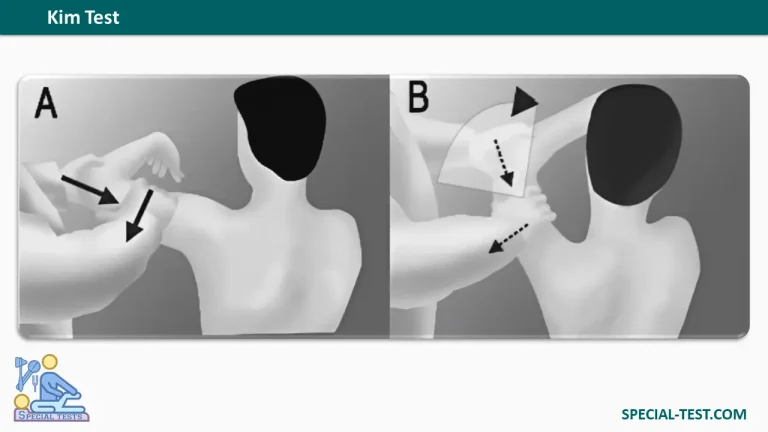
The Kim Test is an orthopedic physical examination maneuver used to detect posteroinferior labral lesions of the shoulder joint. It is particularly useful when evaluating patients with posterior shoulder pain, suspected posterior shoulder instability, or injuries involving the posterior and inferior portions of the glenoid labrum.
Originally described by Kim and colleagues in 2005, the test is a modification of the Jerk Test and is designed to identify labral injuries that may be difficult to detect during routine shoulder examination.
The Kim Test has demonstrated a sensitivity of 80% and specificity of 94% in its original clinical study, making it a valuable component of the physical examination for suspected posteroinferior labral tears.
What Is the Kim Test Used For?
The primary purpose of the Kim Test for the shoulder is to identify injuries involving the posteroinferior glenoid labrum.
The glenoid labrum is a ring of fibrocartilaginous tissue surrounding the shoulder socket. It increases the depth of the glenoid cavity and contributes to the stability of the glenohumeral joint.
Damage to the posteroinferior labrum can occur following traumatic shoulder injuries, repetitive loading, or activities that place excessive stress on the posterior shoulder structures.
The Kim Test is particularly relevant when evaluating:
- Suspected posteroinferior labral tears.
- Posterior shoulder pain associated with instability.
- Shoulder injuries in overhead or contact-sport athletes.
- Patients experiencing pain during activities that load the posterior shoulder.
- Suspected Kim lesions involving concealed damage to the posteroinferior labrum.
A Kim lesion is a specific type of incomplete and concealed avulsion of the posteroinferior labrum. Although the superficial labral tissue may appear intact, the deeper attachment is disrupted, potentially contributing to posterior shoulder instability.
Importantly, the Kim Test evaluates suspected posteroinferior labral pathology and is not exclusively diagnostic of a Kim lesion.
How to Perform the Kim Test
The Kim Test is performed with the patient seated and the examiner positioned beside the affected shoulder.
Step 1: Patient Position
Ask the patient to sit upright in a chair. The shoulder should be relaxed, and the examiner should have adequate access to the affected arm.
A chair with a firm backrest may help stabilize the scapula during the examination.
Step 2: Shoulder Abduction
Position the patient’s shoulder in 90 degrees of abduction.
The examiner holds the patient’s elbow with one hand and grasps the lateral aspect of the proximal humerus with the other hand.
Step 3: Apply Axial Compression
Apply a firm axial loading force through the elbow toward the glenohumeral joint.
This force compresses the humeral head against the glenoid cavity.
Step 4: Diagonal Arm Elevation
While maintaining axial compression, elevate the patient’s arm approximately 45 degrees diagonally upward.
Step 5: Apply Posteroinferior Force
Simultaneously apply a downward and backward force to the proximal humerus, producing a posteroinferiorly directed stress on the shoulder.
Step 6: Assess the Patient’s Response
Observe whether the maneuver reproduces sudden posterior shoulder pain. Note any associated clicking, clunking, or sensation of instability.
The examination should be performed in a controlled manner by a qualified healthcare professional, avoiding unnecessary force.
What Is a Positive Kim Test?
A positive Kim Test is characterized primarily by the sudden onset of posterior shoulder pain during the maneuver.
The patient may also experience a click, clunk, or sensation of abnormal shoulder movement.
However, a clearly audible or palpable clunk is not essential for a clinically positive response.
A positive test suggests a possible posteroinferior labral lesion, particularly when the patient’s symptoms and clinical history are consistent with posterior shoulder pathology.
What Does a Negative Kim Test Mean?
A negative Kim Test occurs when the maneuver does not reproduce the characteristic posterior shoulder pain.
Although a negative result reduces the likelihood of a posteroinferior labral lesion, it does not completely exclude an injury.
Clinical interpretation should consider the patient’s history, other shoulder examination findings, and imaging when appropriate.
Kim Test Sensitivity and Specificity
The original study by Kim et al., published in The American Journal of Sports Medicine in 2005, evaluated the Kim Test in 172 painful shoulders, using arthroscopic examination as the reference standard.
The investigators reported the following diagnostic performance:
| Diagnostic Measure | Result |
|---|---|
| Sensitivity | 80% |
| Specificity | 94% |
| Positive Predictive Value | 73% |
| Negative Predictive Value | 96% |
A sensitivity of 80% indicates that the test correctly identified approximately 80% of shoulders with posteroinferior labral lesions in the study.
A specificity of 94% indicates that the test correctly identified approximately 94% of shoulders without these lesions.
These figures reflect the original study population and should not be interpreted as guaranteed accuracy in every clinical setting.
A systematic review of shoulder labral examination tests also emphasized that diagnostic performance may vary between patient populations and that further validation is important.
Kim Test vs. Jerk Test
Both the Kim Test and Jerk Test are used to evaluate suspected posterior shoulder labral pathology, but their diagnostic strengths differ.
The Kim Test appears more sensitive for detecting lesions predominantly involving the inferior portion of the posterior labrum.
In contrast, the Jerk Test appears more sensitive for lesions predominantly located in the posterior labrum.
In the original study, the Jerk Test demonstrated 73% sensitivity and 98% specificity.
When the Kim Test and Jerk Test were combined, the sensitivity for detecting posteroinferior labral lesions increased to 97%.
These findings suggest that performing both maneuvers may provide additional diagnostic information during the examination of patients with suspected posterior shoulder labral injuries.
Clinical Significance of the Kim Test
The Kim Test is a useful clinical examination maneuver for assessing posteroinferior shoulder labral injuries, particularly in patients presenting with posterior shoulder pain or symptoms of instability.
However, it should not be used as the sole basis for establishing a definitive diagnosis.
A comprehensive assessment may include a detailed history, evaluation of shoulder stability, additional provocative maneuvers, and appropriate imaging studies.
MRI or MR arthrography may help investigate suspected labral pathology, although concealed injuries such as Kim lesions can sometimes be difficult to identify.
Arthroscopic evaluation may be necessary to confirm certain lesions.
The Kim Test therefore provides valuable clinical information when interpreted alongside the complete orthopedic examination.
Frequently Asked Questions (FAQ)
1. What is the Kim Test for the shoulder?
The Kim Test is a physical examination maneuver used to detect posteroinferior glenoid labral lesions. It involves applying axial compression and posteroinferior stress to the shoulder while elevating the arm.
2. What indicates a positive Kim Test?
A positive Kim Test is indicated by the sudden onset of posterior shoulder pain during the maneuver. Clicking or clunking may accompany the pain but is not always present.
3. What is the sensitivity and specificity of the Kim Test?
The original study reported a sensitivity of 80% and specificity of 94% for identifying posteroinferior labral lesions.
4. What is the difference between the Kim Test and the Jerk Test?
The Kim Test is more sensitive for predominantly inferior posterior labral lesions, whereas the Jerk Test is more sensitive for predominantly posterior labral lesions. Using both tests may improve diagnostic sensitivity.
5. What is a Kim lesion in the shoulder?
A Kim lesion is an incomplete, concealed avulsion of the posteroinferior glenoid labrum. The superficial labral tissue may remain intact while the deeper attachment is damaged, potentially causing posterior shoulder instability.
6. Can a negative Kim Test rule out a labral tear?
No. Although a negative Kim Test decreases the likelihood of a posteroinferior labral lesion, the test is not perfectly sensitive. Additional clinical examination and imaging may be necessary.
7. Is the Kim Test painful?
The maneuver may reproduce posterior shoulder pain in patients with posteroinferior labral pathology. It should be performed carefully by a trained healthcare professional.
References
- Kim SH, Park JS, Jeong WK, Shin SK. The Kim test: a novel test for posteroinferior labral lesion of the shoulder—a comparison to the jerk test. American Journal of Sports Medicine. 2005;33(8):1188–1192. PubMed PMID: 16000664.
- Orthofixar. Kim Test for Posteroinferior Labral Lesion: Procedure, Positive Result, and Diagnostic Accuracy. Orthofixar Clinical Examination Guide.
- Kim SH, Ha KI, Yoo JC, Noh KC. Kim’s lesion: an incomplete and concealed avulsion of the posteroinferior labrum in posterior or multidirectional posteroinferior instability of the shoulder. Arthroscopy. 2004;20(7):712–720. PubMed PMID: 15346113.
- Munro W, Healy R. The validity and accuracy of clinical tests used to detect labral pathology of the shoulder—a systematic review. Manual Therapy. 2009;14(2):119–130. PubMed PMID: 18996735.