Rowe Test for Anterior Shoulder Instability: Procedure, Positive Signs & Clinical Interpretation
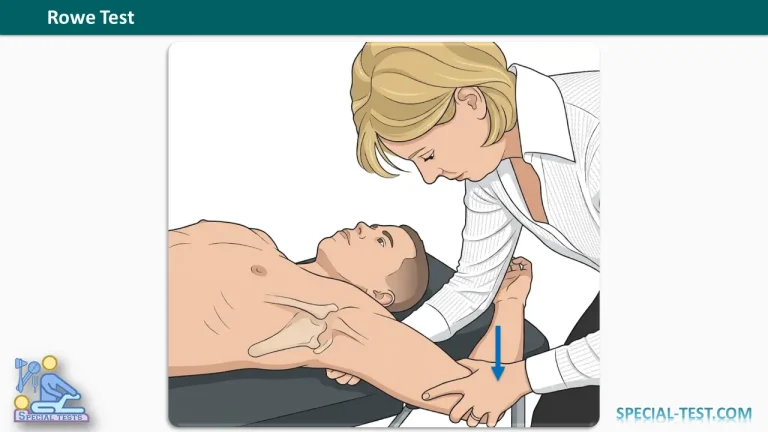
The Rowe Test is an orthopedic physical examination maneuver used to assess anterior shoulder instability. It helps clinicians identify abnormal movement or a sensation of instability in the glenohumeral joint, particularly in patients with a history of shoulder dislocation, subluxation, or recurrent episodes of shoulder apprehension.
During the Rowe shoulder test, the examiner applies gentle anteriorly directed pressure to the humeral head while positioning the patient’s arm to reproduce symptoms associated with anterior instability.
A positive Rowe Test is characterized primarily by apprehension or a feeling that the shoulder may dislocate. Pain, clicking, or grinding may also occur, although these findings are not specific to shoulder instability.
What Is the Rowe Test Used For?
The Rowe Test is used to evaluate anterior glenohumeral instability, a condition in which the head of the humerus moves excessively toward the front of the shoulder joint.
Anterior shoulder instability is the most common direction of glenohumeral instability. It may develop following traumatic shoulder dislocation, repetitive overhead activities, or injury to the structures responsible for maintaining joint stability.
The Rowe Test may be useful when evaluating patients with:
- Previous anterior shoulder dislocation.
- Recurrent shoulder subluxation.
- Apprehension during shoulder abduction and external rotation.
- A sensation that the shoulder may slip out of place.
- Suspected anterior capsulolabral injury.
- Recurrent instability symptoms during sports or overhead activities.
The test is typically included as part of a comprehensive shoulder examination rather than used as an isolated diagnostic procedure.
How to Perform the Rowe Test
The Rowe Test is performed with the patient lying supine on an examination table.
Step-by-Step Procedure
- Patient position: Ask the patient to lie comfortably in the supine position (face upward) on an examination table.
- Arm positioning: Instruct the patient to place the hand of the affected shoulder behind the head. This position places the shoulder in abduction and external rotation.
- Examiner position: The examiner stands beside the affected shoulder and places a clenched fist beneath or against the posterior aspect of the humeral head.
- Apply anterior pressure: Using the clenched fist as a fulcrum, the examiner applies gentle upward pressure against the posterior humeral head, producing an anteriorly directed force.
- Extend the shoulder slightly: While maintaining controlled pressure, the examiner gently moves the patient’s arm into slight extension to increase stress on the anterior stabilizing structures of the shoulder.
- Observe the response: The examiner evaluates the patient for apprehension, pain, protective muscle contraction, or mechanical symptoms such as clicking or grinding.
The maneuver should be performed slowly and carefully, particularly in patients with a history of recurrent shoulder dislocations. Excessive force should be avoided because provocative instability tests can potentially reproduce subluxation or dislocation.
What Is a Positive Rowe Test?
A positive Rowe Test suggests possible anterior shoulder instability when the maneuver reproduces apprehension or the sensation that the shoulder is about to dislocate.
The principal positive findings include:
- Apprehension: The patient expresses fear or anxiety that the shoulder may dislocate.
- Protective muscle guarding: The patient contracts the surrounding shoulder muscles or resists further movement.
- Anterior shoulder pain: Discomfort may occur during the maneuver, although pain alone is not sufficient to confirm instability.
- Mechanical symptoms: A clunk, click, or grinding sensation may suggest associated labral pathology or abnormal translation of the humeral head.
A clunk or grinding sensation may raise suspicion of an anterior glenoid labral injury, including a Bankart lesion, but it does not establish a definitive diagnosis.
Clinical research emphasizes that apprehension is generally more informative than isolated pain when interpreting provocative tests for anterior shoulder instability.
Clinical Significance of the Rowe Test
The Rowe shoulder test challenges the anterior stabilizing structures of the glenohumeral joint.
These structures include the glenoid labrum, joint capsule, glenohumeral ligaments, and surrounding musculature.
When the shoulder is abducted and externally rotated, the anterior capsuloligamentous structures are placed under tension. Applying an anteriorly directed force to the humeral head may reproduce instability symptoms in patients with deficient joint stabilization.
An important associated injury is the Bankart lesion, which involves detachment of the anteroinferior glenoid labrum and may occur following an anterior shoulder dislocation.
Patients with anterior instability may also have capsular laxity, glenoid bone loss, or other associated injuries.
The Rowe Test helps identify clinical symptoms consistent with instability, but additional examination and appropriate imaging may be necessary to determine the underlying structural pathology.
Rowe Test vs. Shoulder Apprehension Test
The Rowe Test and the anterior shoulder apprehension test are both provocative maneuvers used in the assessment of anterior shoulder instability.
The Rowe Test, in its supine variation, uses a clenched fist beneath the posterior humeral head while the arm is positioned behind the head and gently extended.
The traditional shoulder apprehension test typically involves placing the shoulder in approximately 90 degrees of abduction with the elbow flexed to 90 degrees, followed by progressive external rotation.
Both maneuvers aim to reproduce symptoms of anterior instability, particularly the patient’s fear of shoulder dislocation.
The apprehension test is more extensively evaluated in published diagnostic accuracy studies. Its reported sensitivity and specificity should not automatically be applied to the Rowe Test because the maneuvers and research populations are not identical.
Limitations of the Rowe Test
Although the Rowe Test may provide useful clinical information, several limitations should be considered.
First, shoulder pain during testing is not always caused by instability. Rotator cuff pathology, impingement, capsular irritation, and other shoulder disorders may produce discomfort during provocative movements.
Second, a negative Rowe Test does not definitively exclude anterior shoulder instability, especially when symptoms are intermittent.
Third, an audible click or clunk does not confirm a labral tear without further clinical evaluation.
The Rowe Test should therefore be interpreted alongside the patient’s clinical history, range of motion, previous dislocation episodes, and findings from other instability tests.
Common complementary examinations include the anterior apprehension test, Jobe relocation test, anterior drawer test, and anterior load-and-shift test.
When clinically indicated, radiographs or magnetic resonance imaging may help identify associated bone or soft-tissue injuries.
Frequently Asked Questions (FAQ)
1. What is the Rowe Test?
The Rowe Test is an orthopedic examination maneuver used to assess anterior shoulder instability. It involves applying anteriorly directed pressure to the humeral head while the shoulder is placed in a provocative position.
2. What does a positive Rowe Test indicate?
A positive Rowe Test suggests anterior shoulder instability when the patient experiences apprehension or feels that the shoulder may dislocate. Pain and protective muscle guarding may also occur.
3. How is the Rowe Test performed?
The patient lies supine with the affected hand positioned behind the head. The examiner places a clenched fist against the posterior humeral head, applies gentle anteriorly directed pressure, and slightly extends the arm while observing the patient’s response.
4. Can the Rowe Test detect a labral tear?
The Rowe Test may produce clicking, clunking, or grinding in patients with associated labral pathology. However, these symptoms are not specific enough to diagnose a labral tear. Further clinical assessment and imaging may be necessary.
5. Is the Rowe Test the same as the apprehension test?
No. Although both tests assess anterior shoulder instability, their techniques differ. The Rowe Test described here uses a clenched fist as a posterior fulcrum, whereas the conventional apprehension test typically uses progressive shoulder abduction and external rotation.
6. What is the difference between the Rowe Test and Rowe Score?
The Rowe Test is a provocative physical examination maneuver used to assess shoulder instability. The Rowe Score is a clinical outcome measure used to evaluate shoulder stability, motion, and function, particularly after treatment for shoulder instability.
7. Can a negative Rowe Test rule out anterior shoulder instability?
No. A negative Rowe Test does not completely exclude shoulder instability. Clinicians should consider the patient’s symptoms, injury history, and findings from other physical examination tests when making a diagnosis.
8. Is the Rowe Test painful?
The maneuver may reproduce pain or discomfort in patients with shoulder pathology. However, apprehension or fear of dislocation is more suggestive of instability than pain alone. The test should be performed carefully by a trained healthcare professional.
References
- Valencia Mora M, Ibán MÁR, Heredia JD, et al. Physical Exam and Evaluation of the Unstable Shoulder. Open Orthop J. 2017;11:946-956. doi:10.2174/1874325001711010946. PMID: 29114336. PubMed Central
- Lizzio VA, Meta F, Fidai M, Makhni EC. Clinical Evaluation and Physical Exam Findings in Patients with Anterior Shoulder Instability. Curr Rev Musculoskelet Med. 2017;10(4):434-441. PMID: 29043566. PubMed
- Farber AJ, Castillo R, Clough M, Bahk M, McFarland EG. Clinical Assessment of Three Common Tests for Traumatic Anterior Shoulder Instability. J Bone Joint Surg Am. 2006;88(7):1467-1474. PMID: 16818971. PubMed
- Orthofixar. Shoulder Apprehension Test: Procedure, Positive Signs & Accuracy. Orthofixar
- Orthofixar. Anterior Shoulder Instability: Pathoanatomy and Treatment Guide. Orthofixar