Roos Test (Elevated Arm Stress Test): Procedure, Positive Signs, and Accuracy
What Is the Roos Test?
The Roos Test, also known as the Elevated Arm Stress Test (EAST) or Hands-Up Test, is a provocative physical examination maneuver used to evaluate patients with suspected Thoracic Outlet Syndrome (TOS).
Thoracic outlet syndrome occurs when nerves or blood vessels become compressed as they travel from the neck toward the upper extremity through the thoracic outlet. This compression can cause pain, numbness, tingling, weakness, and other neurological or vascular symptoms.
The Roos Test primarily evaluates symptoms associated with compression or irritation of the brachial plexus, a network of nerves responsible for motor and sensory function in the upper extremity.
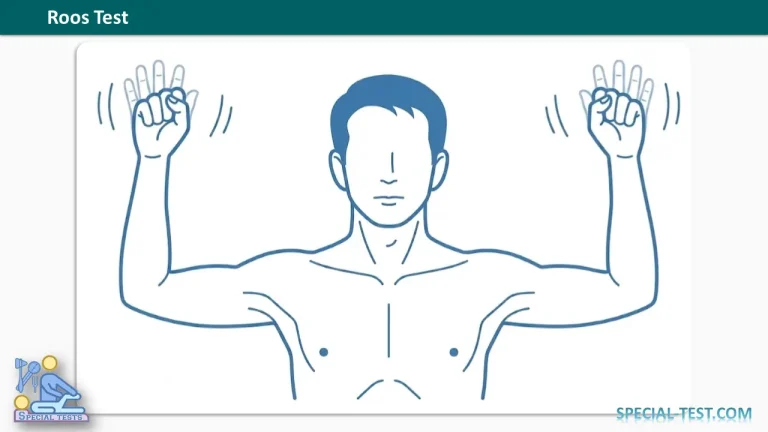
By positioning the shoulders in abduction and external rotation while repeatedly opening and closing the hands, the maneuver attempts to reproduce symptoms associated with neurogenic thoracic outlet syndrome.
Although commonly included in the physical examination of patients with suspected TOS, the Roos Test cannot independently confirm or exclude the diagnosis.
What Is the Roos Test Used For?
The primary purpose of the Roos Test is to help assess patients with suspected neurogenic thoracic outlet syndrome (NTOS).
It may be particularly useful when patients experience symptoms that worsen during overhead activities, including:
- Shoulder, neck, or upper-extremity pain.
- Numbness or tingling in the fingers.
- Hand weakness or reduced endurance.
- A sensation of heaviness in the affected arm.
- Symptoms triggered by prolonged arm elevation.
Thoracic outlet syndrome is generally classified into three types:
1. Neurogenic Thoracic Outlet Syndrome: Involves irritation or compression of the brachial plexus and is the most common form of TOS.
2. Venous Thoracic Outlet Syndrome: Involves compression of the venous structures, potentially causing arm swelling, discoloration, or venous thrombosis.
3. Arterial Thoracic Outlet Syndrome: Involves compression of the subclavian artery and may cause vascular symptoms, including coldness, pallor, or reduced blood flow.
Although the Roos Test primarily provokes neurological symptoms, clinicians may also observe vascular changes during the maneuver.
How to Perform the Roos Test
The Roos Test is generally performed with the patient seated and should be supervised by a qualified healthcare professional.
Step-by-Step Procedure
- Patient Position: Ask the patient to sit upright in a chair, maintaining a comfortable and neutral spinal posture.
- Shoulder Position: Position both shoulders at approximately 90 degrees of abduction and external rotation, creating a goalpost or surrender position.
- Elbow Position: Flex both elbows to 90 degrees while maintaining the elevated position of the upper extremities.
- Hand Movements: Instruct the patient to slowly and repeatedly open and close both hands, making a fist and then extending the fingers.
- Test Duration: Ask the patient to continue the movement for up to 3 minutes, provided the maneuver can be performed safely.
- Symptom Monitoring: Observe the patient’s ability to maintain the position and ask whether any pain, numbness, tingling, heaviness, fatigue, or weakness develops.
During the examination, the clinician should document the location, type, and timing of symptoms, particularly whether they reproduce the patient’s usual complaints.
The radial pulse may also be assessed when vascular compression is suspected. However, a reduction or disappearance of the pulse during arm elevation is not sufficient to diagnose thoracic outlet syndrome.
The examination should be discontinued if the patient develops significant pain, concerning vascular symptoms, or cannot safely maintain the position.
What Is a Positive Roos Test?
A positive Roos Test occurs when the maneuver reproduces symptoms suggestive of thoracic outlet syndrome or the patient cannot complete the required position and movement because of these symptoms.
Possible positive findings include:
- Reproduction of the patient’s typical arm or shoulder pain.
- Numbness or tingling in the hand or fingers.
- A feeling of heaviness in the affected upper extremity.
- Reduced hand motor function or grip endurance.
- Inability to maintain the elevated arm position for 3 minutes because of symptoms.
A positive finding raises clinical suspicion of thoracic outlet syndrome, especially when the reproduced symptoms are consistent with the patient’s history.
However, muscle fatigue during prolonged arm elevation can also occur in otherwise healthy individuals. Therefore, isolated fatigue or discomfort should not automatically be interpreted as pathological nerve compression.
Clinical Interpretation: A positive Roos Test supports further evaluation for TOS but does not establish a definitive diagnosis.
Roos Test Sensitivity and Specificity
The diagnostic accuracy of the Roos Test varies considerably across clinical studies.
Reported accuracy ranges include:
| Diagnostic Parameter | Reported Value |
|---|---|
| Sensitivity | 52–84% |
| Specificity | 30–100% |
| Standard Test Duration | 3 minutes |
| Primary Clinical Application | Suspected neurogenic TOS |
These broad sensitivity and specificity ranges reflect differences in study populations, examination methods, and definitions of a positive test. They should not be interpreted as a single validated estimate of accuracy.
False-Positive Results
One major limitation of the Roos Test is its relatively high false-positive rate.
A study by Nord et al., published in Electromyography and Clinical Neurophysiology in 2008, reported positive Roos Test results in:
- 47% of healthy participants.
- 77% of patients with carpal tunnel syndrome.
These findings suggest that the Roos Test may reproduce symptoms in patients who do not have thoracic outlet syndrome.
Another study by Plewa and Delinger found that the Elevated Arm Stress Test produced changes in radial pulse quality in 62% of healthy volunteers.
Therefore, changes in radial pulse or reproduction of nonspecific symptoms should be interpreted cautiously.
What Does Recent Research Say?
A 2022 study investigating the diagnostic value of the Elevated Arm Stress Test found that test duration had moderate test-retest reliability but limited ability to distinguish patients with neurogenic thoracic outlet syndrome from symptomatic controls.
A separate study of a standardized Elevated Arm Stress Test similarly reported limited diagnostic discrimination.
Nevertheless, the 2024 International Neurogenic Thoracic Outlet Syndrome (INTOS) Workgroup consensus recommendations included the Elevated Arm Stress Test among the provocative maneuvers used during clinical assessment.
Together, these findings suggest that the Roos Test remains a useful component of a comprehensive examination, but it should not be used as an isolated diagnostic test.
Clinical Significance and Limitations
The Roos Test is commonly performed during the physical examination of patients presenting with unexplained upper-extremity pain, paresthesia, or weakness.
Its main clinical advantage is that it provides a simple, noninvasive method of attempting to reproduce symptoms during sustained arm elevation.
However, several limitations must be considered:
- The test can produce positive findings in healthy individuals.
- Symptoms may overlap with carpal tunnel syndrome, cervical radiculopathy, and other neurological conditions.
- Test results depend partly on patient tolerance, muscle endurance, and the interpretation of symptoms.
- A positive result cannot reliably distinguish neurogenic from vascular thoracic outlet syndrome.
- A negative result does not completely exclude TOS.
When thoracic outlet syndrome is suspected, clinicians should combine the Roos Test with a detailed history, neurological and vascular examination, and other appropriate clinical assessments.
Additional diagnostic investigations may include cervical or chest radiographs, electrodiagnostic studies, vascular duplex ultrasonography, or MRI, depending on the suspected condition.
Conclusion
The Roos Test (Elevated Arm Stress Test) is a commonly used provocative examination for suspected thoracic outlet syndrome, particularly the neurogenic type.
It involves maintaining the shoulders at 90 degrees of abduction and the elbows at 90 degrees of flexion while repeatedly opening and closing the hands for up to 3 minutes.
A positive test may reproduce pain, paresthesia, heaviness, weakness, or an inability to maintain the position.
Although the test is easy to perform and may provide useful clinical information, its variable sensitivity, specificity, and high false-positive rates limit its diagnostic value when performed alone.
For reliable clinical decision-making, Roos Test findings should always be interpreted alongside the patient’s symptoms, physical examination, and other diagnostic investigations when indicated.
Frequently Asked Questions (FAQs)
1. What does the Roos Test diagnose?
The Roos Test is used to assess patients with suspected thoracic outlet syndrome, particularly neurogenic TOS. A positive result may support clinical suspicion but cannot confirm the diagnosis independently.
2. How long should the Roos Test be performed?
The standard Roos Test lasts up to 3 minutes. During this period, the patient maintains both arms in an elevated position while repeatedly opening and closing the hands. The test may be stopped earlier if significant symptoms develop.
3. What indicates a positive Roos Test?
A positive Roos Test may involve reproduction of characteristic pain, numbness, tingling, heaviness, or weakness in the upper extremity. Inability to maintain the test position because of symptoms may also be considered a positive finding.
4. What is the sensitivity and specificity of the Roos Test?
Reported sensitivity ranges from 52% to 84%, while specificity ranges from 30% to 100%. These figures vary substantially across studies, and the test has important limitations due to false-positive findings.
5. Can the Roos Test be positive in healthy individuals?
Yes. A study published in 2008 found positive Roos Test findings in 47% of healthy participants. This emphasizes the importance of interpreting the results alongside the complete clinical examination.
6. Is the Roos Test the same as the Elevated Arm Stress Test?
Yes. The Roos Test is commonly referred to as the Elevated Arm Stress Test (EAST) or Hands-Up Test. These names generally describe the same provocative examination maneuver.
7. Can a negative Roos Test rule out thoracic outlet syndrome?
No. A negative Roos Test does not reliably exclude thoracic outlet syndrome because the test has imperfect sensitivity. Further clinical assessment may be required when symptoms and examination findings suggest TOS.
8. Is the Roos Test reliable for diagnosing thoracic outlet syndrome?
The Roos Test can provide useful information during a comprehensive physical examination, but research demonstrates variable diagnostic accuracy and relatively high false-positive rates. Consequently, it should be combined with other clinical findings rather than used as a standalone diagnostic tool.
Medical References
- Orthofixar. Roos Test | Elevated Arm Stress Test.
- Nord KM, et al. False positive rate of thoracic outlet syndrome diagnostic maneuvers. Electromyogr Clin Neurophysiol. 2008;48(2):67–74. PMID: 18435210.
- Plewa MC, Delinger M. The false-positive rate of thoracic outlet syndrome shoulder maneuvers in healthy subjects. Acad Emerg Med. 1998;5(4):337–342. PMID: 9562199.
- Pesser N, et al. Reliability and validity of the elevated arm stress test in the diagnosis of neurogenic thoracic outlet syndrome. J Vasc Surg. 2022;76(3):814–820. PMID: 35550394.
- Diagnostic Accuracy of Clinical Tests for Neurogenic and Vascular Thoracic Outlet Syndrome: A Systematic Review. PMID: 30871714.
- Chim H, Hagan RR. Consensus Recommendations for Neurogenic Thoracic Outlet Syndrome from the INTOS Workgroup. Plast Reconstr Surg Glob Open. 2024;12(8). PMID: 39206209.