Lift-Off Test for Subscapularis Tear: Procedure and Accuracy
What Is the Lift-Off Test?
The Lift-Off Test, also known as the Gerber Lift-Off Test, is a clinical shoulder examination used to assess the integrity and function of the subscapularis muscle and tendon. It is particularly useful for identifying a subscapularis tendon rupture, including an isolated full-thickness tear.
The test was originally described by Gerber and Krushell in 1991 as a physical examination maneuver for diagnosing isolated subscapularis tendon injuries.
The subscapularis is one of the four rotator cuff muscles. It originates from the anterior surface of the scapula and inserts onto the lesser tuberosity of the humerus. Its primary functions include internal rotation of the shoulder and stabilization of the glenohumeral joint.
In patients with subscapularis tendon injuries, weakness or inability to perform active internal rotation behind the back may produce a positive Lift-Off Test.
Because the test has relatively high specificity but variable and often low sensitivity, it is particularly useful for supporting the diagnosis of a significant subscapularis tear rather than excluding an injury.
How to Perform the Lift-Off Test
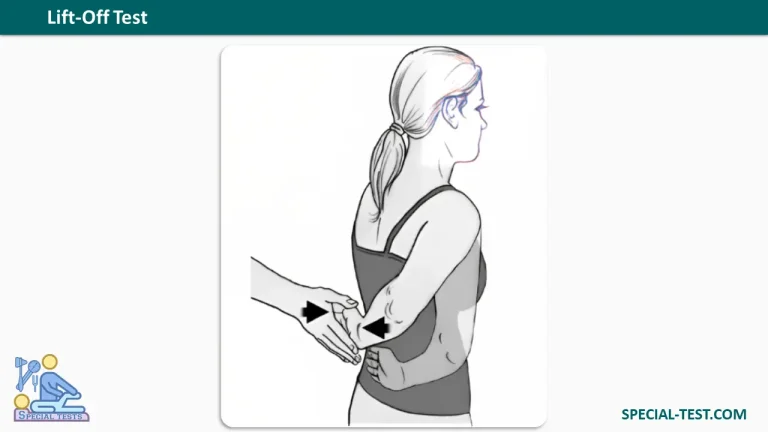
The Lift-Off Test is performed with the patient standing or sitting comfortably. The examiner evaluates the patient’s ability to actively internally rotate the shoulder against gravity and resistance.
Step-by-step procedure:
- Patient position: Ask the patient to stand or sit upright with the affected shoulder relaxed.
- Arm position: Position the shoulder in internal rotation and extension, with the elbow flexed.
- Hand placement: Instruct the patient to place the dorsum (back) of the hand against the lower back, preferably at the mid-lumbar region.
- Active movement: Ask the patient to lift the hand away from the back while maintaining the position of the elbow and shoulder.
- Resistance testing: If the patient can lift the hand successfully, apply gentle, progressively increasing resistance against the dorsum of the hand to assess subscapularis strength.
- Observation: Evaluate the patient’s ability to maintain the movement without compensatory shoulder or elbow motion.
The examiner should compare findings with the opposite shoulder whenever appropriate.
The patient must have sufficient shoulder internal rotation to reach the lower back. If significant pain or restricted mobility prevents this position, alternative clinical tests should be considered.
What Is a Positive Lift-Off Test?
A positive Lift-Off Test occurs when the patient is unable to actively lift the dorsum of the hand away from the lower back or cannot maintain the position against resistance.
This finding suggests weakness or dysfunction of the subscapularis muscle, potentially caused by a substantial subscapularis tendon tear.
Additional findings that may indicate an abnormal test include:
- Inability to separate the hand from the lumbar spine.
- Marked weakness during resisted internal rotation.
- Compensatory movement of the elbow or shoulder instead of true internal rotation.
- Inability to maintain the hand away from the back against the examiner’s resistance.
A positive result increases suspicion of a significant subscapularis injury, particularly when accompanied by shoulder weakness and other positive rotator cuff examination findings.
However, pain and restricted shoulder mobility can interfere with test performance, so the findings should always be interpreted within the complete clinical examination.
What Is a Negative Lift-Off Test?
A negative Lift-Off Test occurs when the patient successfully lifts the dorsum of the hand away from the lower back and maintains the position against appropriate resistance.
This indicates preserved active internal rotation strength in the tested position.
However, a negative result does not definitively exclude a subscapularis tendon tear.
Patients with partial-thickness injuries or smaller tears may still perform the maneuver successfully. Therefore, additional clinical tests or imaging may be necessary when clinical suspicion remains high.
Lift-Off Test Sensitivity and Specificity
The diagnostic accuracy of the Lift-Off Test varies depending on the study population, severity of tendon injury, and examination technique.
In a 2006 study by Barth and colleagues involving 68 patients undergoing shoulder arthroscopy, the reported diagnostic performance was:
- Sensitivity: 17.6%
- Specificity: 100%
Sensitivity of 17.6% indicates that the test identified only a relatively small proportion of patients with subscapularis tears in that study. Consequently, many patients with an existing tear had a negative test result.
Specificity of 100% indicates that none of the patients without a subscapularis tear in that study had a positive result.
These findings demonstrate that a positive Lift-Off Test can provide strong evidence of subscapularis tendon pathology, whereas a negative result cannot reliably rule it out.
The same study reported that a positive Lift-Off Test was not observed until at least 75% of the subscapularis tendon was torn, suggesting greater clinical usefulness for substantial tendon injuries in that population.
A later systematic review and meta-analysis published in 2022 found that commonly used subscapularis clinical tests, including the Lift-Off Test, generally demonstrated high specificity but limited sensitivity. The authors concluded that no individual clinical test was sufficiently reliable to diagnose subscapularis tears in isolation.
Therefore, the 17.6% sensitivity and 100% specificity should be interpreted as study-specific results, rather than fixed diagnostic values for every patient population.
Clinical Importance and Limitations
The Lift-Off Test is an important component of the clinical assessment of suspected rotator cuff injuries, particularly when subscapularis dysfunction is suspected.
Its main clinical advantages include simplicity, minimal equipment requirements, and the ability to assess active internal rotation strength.
However, several limitations must be considered.
First, patients with shoulder stiffness, pain, or restricted internal rotation may be unable to assume the required position. Second, smaller subscapularis tears may not produce sufficient weakness to generate a positive result. Finally, compensatory activation of other shoulder muscles may influence the examination findings.
When the Lift-Off Test cannot be performed or produces inconclusive results, additional subscapularis examination maneuvers may be useful, including:
- Belly-Press Test: Assesses subscapularis function through resisted internal rotation with the hand against the abdomen.
- Bear-Hug Test: Evaluates subscapularis strength by resisting the examiner’s attempt to lift the patient’s hand from the opposite shoulder.
- Internal Rotation Lag Sign: Assesses the patient’s ability to maintain an internally rotated shoulder position.
Combining examination findings with the patient’s clinical history and, when indicated, ultrasound or magnetic resonance imaging (MRI) can improve diagnostic evaluation.
Frequently Asked Questions (FAQ)
1. What is the Lift-Off Test used for?
The Lift-Off Test is primarily used to evaluate the subscapularis tendon and identify possible subscapularis tendon tears, particularly substantial or full-thickness injuries.
2. How do you perform the Lift-Off Test?
The patient places the dorsum of the hand against the lower back and attempts to lift the hand away from the spine. The examiner observes active movement and may apply resistance to assess internal rotation strength.
3. What does a positive Lift-Off Test indicate?
A positive Lift-Off Test indicates an inability to lift the hand away from the lower back or significant weakness against resistance. This suggests subscapularis dysfunction and raises suspicion of a tendon tear.
4. What are the sensitivity and specificity of the Lift-Off Test?
A study published by Barth and colleagues in 2006 reported a sensitivity of 17.6% and specificity of 100%. Diagnostic accuracy varies among studies, so these percentages should not be considered universal.
5. Can a negative Lift-Off Test rule out a subscapularis tear?
No. Because the test may have low sensitivity, a negative result cannot reliably exclude a partial-thickness or even a full-thickness subscapularis tear.
6. Which muscle is assessed by the Lift-Off Test?
The test primarily assesses the subscapularis muscle, an important rotator cuff muscle responsible for internal rotation and dynamic stabilization of the shoulder joint.
7. What is the difference between the Lift-Off Test and Belly-Press Test?
Both evaluate subscapularis function. The Lift-Off Test requires the patient to move the hand away from the lower back, whereas the Belly-Press Test assesses internal rotation strength with the hand positioned against the abdomen. The Belly-Press Test is particularly useful when restricted shoulder mobility prevents the Lift-Off Test.
8. Is the Lift-Off Test reliable for diagnosing subscapularis tears?
The Lift-Off Test is useful because of its generally high specificity. However, its sensitivity varies considerably, and it should be combined with other clinical findings and appropriate imaging when necessary.
References
- Gerber C, Krushell RJ. Isolated rupture of the tendon of the subscapularis muscle. Clinical features in 16 cases. J Bone Joint Surg Br. 1991.
- Barth JR, Burkhart SS, De Beer JF. The bear-hug test: a new and sensitive test for diagnosing a subscapularis tear. Arthroscopy. 2006.
- Diagnostic Accuracy of Clinical Tests for Subscapularis Tears: A Systematic Review and Meta-analysis. PubMed.
- Yoon JP, et al. Diagnostic value of four clinical tests for the evaluation of subscapularis integrity. J Shoulder Elbow Surg. 2013.
- Greis PE, et al. Validation of the lift-off test and analysis of subscapularis activity during maximal internal rotation. Am J Sports Med. 1996.
- Orthofixar. Gerber Lift-Off Test: Procedure, Interpretation, and Diagnostic Accuracy.