Scapular Assistance Test (SAT): Procedure, Positive Findings, Clinical Significance & Accuracy
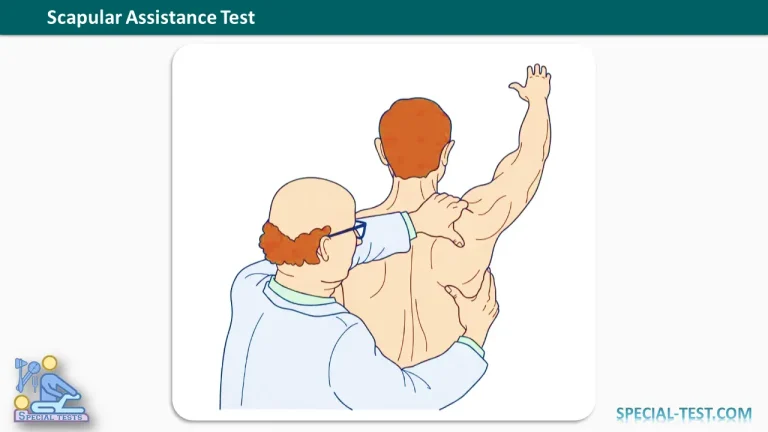
The Scapular Assistance Test (SAT) is a clinical shoulder examination used to evaluate the contribution of scapular movement to shoulder pain, particularly during arm elevation. It is commonly performed in patients with suspected scapular dyskinesis, rotator cuff-related shoulder pain, or subacromial pain syndrome.
The test involves manually assisting the scapula into upward rotation and posterior tilt while the patient actively raises the arm. A reduction in pain or improvement in shoulder range of motion suggests that modifying scapular mechanics may positively influence the patient’s symptoms.
What Is the Scapular Assistance Test Used For?
The Scapular Assistance Test is a corrective clinical maneuver designed to determine whether altered scapular movement contributes to shoulder pain during arm elevation.
Normal shoulder movement requires coordinated activity between the scapula, clavicle, and humerus. The serratus anterior and trapezius muscles are particularly important in producing scapular upward rotation and posterior tilt, helping maintain appropriate shoulder mechanics during overhead activities.
Alterations in these movements may be associated with shoulder pain and movement dysfunction.
The SAT is commonly used to:
- Assess the influence of scapular movement on shoulder pain.
- Identify changes in symptoms during assisted scapular upward rotation.
- Evaluate painful shoulder elevation in patients with subacromial pain syndrome.
- Determine whether modifying scapular position improves shoulder range of motion.
- Help guide further assessment and rehabilitation planning.
A biomechanical study by Seitz and colleagues demonstrated that manual scapular assistance increased scapular posterior tilt and acromiohumeral distance at certain arm positions. However, these findings do not establish that a positive SAT confirms mechanical impingement.
How to Perform the Scapular Assistance Test
The Scapular Assistance Test is performed with the patient standing or sitting while the examiner stands behind the affected shoulder.
Step 1: Patient Position
Ask the patient to stand upright with the arms relaxed at the sides. Observe the resting position of the scapula and any visible asymmetry.
Step 2: Assess Active Shoulder Elevation
Instruct the patient to actively elevate the affected arm in the sagittal or scapular plane. Identify the presence of a painful arc, limitations in movement, or abnormal scapular motion.
Step 3: Examiner Hand Placement
The examiner places one hand over the superior aspect of the scapula near the superior angle or clavicle. The other hand contacts the inferior angle or inferomedial border of the scapula.
Step 4: Apply Scapular Assistance
Ask the patient to raise the arm again. During elevation, the examiner gently assists scapular upward rotation by guiding the inferior angle upward and laterally around the thorax.
In the modified Scapular Assistance Test, the examiner also facilitates posterior tilt of the scapula through the hand positioned over the superior shoulder.
These movements simulate aspects of the normal mechanical contribution of the serratus anterior and lower trapezius muscles.
Step 5: Evaluate the Response
Compare shoulder pain, the painful arc, and active range of motion with and without scapular assistance.
The examiner should use controlled manual pressure without forcing the shoulder beyond the patient’s comfortable range.
What Is a Positive Scapular Assistance Test?
A positive Scapular Assistance Test occurs when manual assistance of the scapula reduces shoulder pain during arm elevation.
Positive findings may include:
- Reduction or disappearance of pain during the painful arc.
- Improved comfort during active shoulder elevation.
- Increased pain-free shoulder range of motion.
- Improved tolerance of overhead movement.
A positive result suggests that changing scapular motion influences the patient’s shoulder symptoms.
However, it does not independently confirm scapular dyskinesis, serratus anterior weakness, lower trapezius weakness, or subacromial impingement.
A 2020 study found that patients with positive SAT findings demonstrated greater scapular anterior tilt, but did not have significantly different serratus anterior or lower trapezius strength compared with patients with negative findings.
What Is a Negative Scapular Assistance Test?
A negative SAT occurs when manual scapular assistance does not meaningfully reduce pain or improve shoulder elevation.
This finding suggests that the particular movement correction applied during testing did not improve the patient’s symptoms.
However, a negative result does not exclude rotator cuff pathology, subacromial pain syndrome, or scapular movement dysfunction.
Additional clinical examination is necessary to determine the underlying cause of shoulder pain.
Scapular Assistance Test Accuracy and Reliability
The clinical reliability of the Scapular Assistance Test has been evaluated in several studies.
In a study published in the Journal of Orthopaedic & Sports Physical Therapy, Rabin and colleagues examined the intertester reliability of the modified SAT in 46 patients with shoulder disorders.
The researchers reported:
| Measurement | Scapular Plane | Sagittal Plane |
|---|---|---|
| Kappa coefficient | 0.53 | 0.62 |
| Agreement between examiners | 77% | 91% |
These results suggested moderate to substantial agreement depending on the testing plane.
Another study involving 110 shoulder patients reported a Cohen’s kappa coefficient of 0.68 for the modified SAT without additional handheld weights.
Nevertheless, systematic reviews have identified limitations in the reliability and diagnostic validity of clinical scapular assessment tests.
Important: The frequently reported sensitivity of 81.7% and specificity of 80.8% belong to a 2018 study of the Scapular Retraction Test for evaluating full-thickness rotator cuff tears. These values should not be attributed to the Scapular Assistance Test.
There is insufficient evidence to assign those diagnostic accuracy values to the SAT.
Scapular Assistance Test vs. Scapular Retraction Test
Although their names are similar, the Scapular Assistance Test and Scapular Retraction Test evaluate different aspects of shoulder function.
| Feature | Scapular Assistance Test (SAT) | Scapular Retraction Test (SRT) |
|---|---|---|
| Primary purpose | Assess influence of scapular motion on symptoms | Assess effect of scapular stabilization on shoulder strength or symptoms |
| Main maneuver | Assisted upward rotation and posterior tilt | Scapular retraction and stabilization |
| Clinical assessment | Pain and range of motion during elevation | Shoulder strength and symptom changes during examination |
| Interpretation | Symptom improvement with assisted movement | Change in strength or symptoms with stabilization |
The SAT is primarily a symptom-modification test, whereas the SRT involves scapular stabilization, often during resisted shoulder testing.
The two tests should not be considered interchangeable.
Clinical Significance of the Scapular Assistance Test
The Scapular Assistance Test can provide useful information during the evaluation of patients with shoulder pain, particularly when symptoms are reproduced by arm elevation.
A positive test may encourage the clinician to examine scapular motor control, shoulder mobility, muscle performance, and movement coordination more closely.
However, more recent evidence suggests that SAT results do not consistently identify specific scapular impairments.
A 2024 cross-sectional study involving 70 patients with shoulder pain found no significant association between a positive modified SAT and the presence of scapular dyskinesis.
Therefore, the SAT should be interpreted alongside patient history, shoulder range of motion, strength testing, and other relevant clinical findings rather than used as a standalone diagnostic test.
Frequently Asked Questions (FAQ)
1. What does the Scapular Assistance Test assess?
The Scapular Assistance Test assesses whether manually improving scapular upward rotation and posterior tilt changes shoulder pain during active arm elevation. It is primarily used as a symptom-modification test during a shoulder examination.
2. What indicates a positive Scapular Assistance Test?
A positive SAT is indicated by a reduction in shoulder pain during arm elevation when the examiner manually assists scapular movement. An improvement in pain-free range of motion may also be observed.
3. What muscles are involved in the Scapular Assistance Test?
The test simulates aspects of the action of the serratus anterior and lower trapezius muscles, which contribute to scapular upward rotation and stabilization. However, the test cannot independently determine whether these muscles are weak.
4. Is the Scapular Assistance Test used to diagnose shoulder impingement?
The SAT may be used during the evaluation of patients with subacromial pain syndrome, but it cannot independently diagnose shoulder impingement. Its primary purpose is to assess whether assisted scapular motion changes the patient’s symptoms.
5. What is the difference between the Scapular Assistance Test and Scapular Retraction Test?
The Scapular Assistance Test involves assisting upward rotation and posterior tilt while the patient elevates the arm. The Scapular Retraction Test involves stabilizing the scapula in retraction to evaluate changes in shoulder strength or symptoms.
6. How accurate is the Scapular Assistance Test?
Research has reported moderate to substantial intertester agreement in individual studies of the modified SAT. However, evidence supporting its diagnostic accuracy for identifying specific shoulder disorders remains insufficient. The sensitivity of 81.7% and specificity of 80.8% are associated with the Scapular Retraction Test, not the SAT.
7. Can a positive Scapular Assistance Test indicate scapular dyskinesis?
A positive SAT may indicate that changing scapular mechanics influences shoulder symptoms, but it does not confirm scapular dyskinesis. Research has shown that positive SAT findings may occur in patients both with and without observable scapular dyskinesis.
8. Why is the Scapular Assistance Test important in physical therapy?
The SAT helps physical therapists understand how modifying scapular movement affects shoulder pain and function. Its findings may contribute to individualized rehabilitation planning, including exercises targeting scapular control and shoulder movement, but treatment decisions should also consider the complete clinical assessment.
References
- Rabin A, Irrgang JJ, Fitzgerald GK, Eubanks A. The intertester reliability of the Scapular Assistance Test. J Orthop Sports Phys Ther. 2006;36(9):653–660. PubMed.
- Khazzam M, et al. Diagnostic Accuracy of the Scapular Retraction Test in Assessing the Status of the Rotator Cuff. Orthop J Sports Med. 2018. PubMed.
- Seitz AL, et al. The scapular assistance test results in changes in scapular position and subacromial space but not rotator cuff strength in subacromial impingement. PubMed.
- Ribeiro LP, et al. Comparison of scapular kinematics and muscle strength between those with a positive and a negative Scapular Assistance Test. Clin Biomech. 2020. PubMed.
- Soliño S, et al. Prevalence of positive modified scapular assistance test in patients with shoulder pain with and without scapular dyskinesis: a cross-sectional study. J Hand Ther. 2024. PubMed.
- Wright AA, et al. Diagnostic accuracy of scapular physical examination tests for shoulder disorders: a systematic review. Br J Sports Med. 2013. PubMed.
- OrthoFixar. Scapular Assistance Test: Procedure, Accuracy, and Positive Findings.
- OrthoFixar. Scapular Retraction Test.