Jerk Test for Posterior Shoulder Instability: Procedure, Positive Sign & Accuracy
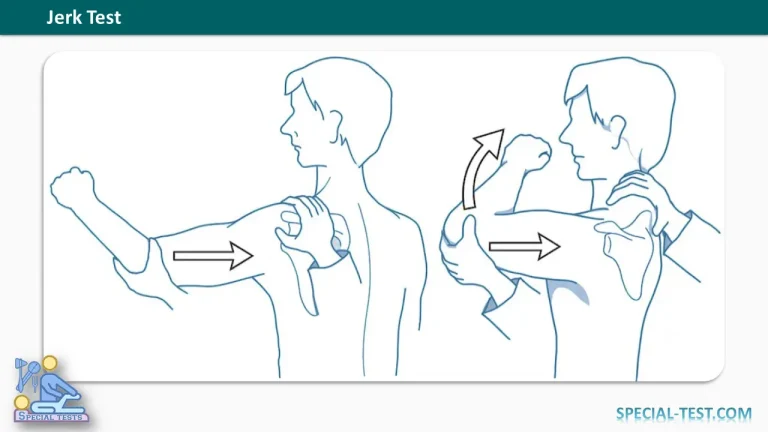
The Jerk Test, also known as the Shoulder Jerk Test or Jahnke Test, is a clinical orthopedic examination used to assess posterior shoulder instability and identify potential posteroinferior labral tears of the glenohumeral joint.
This shoulder examination test evaluates whether the humeral head translates abnormally toward the posterior aspect of the glenoid during specific movements. A positive Jerk Test may produce a sudden clunk, jerk, or posterior shoulder pain, suggesting posterior instability or associated labral pathology.
The Jerk Test is particularly useful when evaluating patients with recurrent shoulder pain, suspected posterior subluxation, or symptoms associated with repetitive loading of the shoulder joint. It is commonly performed alongside other clinical examinations, including the Kim Test, to improve diagnostic assessment.
What Is the Jerk Test Used For?
The primary purpose of the Jerk Test is to evaluate posterior glenohumeral instability, a condition characterized by abnormal posterior translation of the humeral head relative to the glenoid.
The test is also used to identify posteroinferior glenoid labral lesions, which may contribute to shoulder pain, mechanical symptoms, and recurrent instability.
Posterior shoulder instability is less common than anterior instability and may occur following traumatic injuries, repetitive microtrauma, or excessive loading of the shoulder.
Patients with posterior shoulder instability may experience:
- Posterior shoulder pain during physical activity.
- Pain while pushing, lifting, or performing weight-bearing exercises.
- Recurrent clicking, catching, or clunking sensations.
- A feeling that the shoulder is slipping out of position.
- Discomfort during movements involving shoulder flexion, adduction, and internal rotation.
Athletes participating in contact sports, weightlifting, and activities involving repetitive shoulder loading may be particularly susceptible to posterior shoulder instability.
The Jerk Test helps reproduce mechanical symptoms associated with posterior translation of the humeral head. However, the findings should always be interpreted alongside the patient’s medical history and other clinical examination results.
How to Perform the Jerk Test
The Jerk Test procedure is performed with the patient sitting upright, although some examination descriptions also allow the patient to stand.
The examiner should carefully control the shoulder throughout the maneuver to assess abnormal posterior movement of the humeral head.
Step-by-Step Procedure
- Patient Position: Ask the patient to sit upright with the back straight and the affected shoulder relaxed.
- Arm Position: Position the shoulder at approximately 90 degrees of forward flexion, with the elbow flexed to 90 degrees. Internally rotate the shoulder.
- Shoulder Stabilization: Place one hand over the patient’s shoulder girdle to stabilize the scapula and clavicle.
- Apply Axial Compression: With the other hand supporting the elbow, apply an axial load along the longitudinal axis of the humerus toward the glenoid.
- Horizontal Adduction: While maintaining axial compression, gradually move the arm across the patient’s chest into horizontal adduction. This maneuver produces posteriorly directed stress on the humeral head.
- Observe for Subluxation: Assess whether the humeral head translates posteriorly, producing a palpable or audible clunk.
- Return Movement: Gradually move the arm back toward horizontal abduction while maintaining controlled pressure. A sudden jerk or clunk may occur as the humeral head relocates into the glenoid.
The examiner should observe for pain, mechanical clicking, abnormal translation, and apprehension throughout the procedure.
Clinical Note: Some descriptions of the Jerk Test begin with the shoulder abducted to 90 degrees rather than forward-flexed. Both techniques use axial compression and horizontal adduction to provoke posterior translation of the humeral head.
The maneuver should be performed gently by a trained healthcare professional, particularly in patients with suspected shoulder instability.
What Is a Positive Jerk Test?
A positive Jerk Test is characterized by reproduction of the patient’s posterior shoulder pain, a sudden mechanical jerk, or a palpable or audible clunk during the examination.
The characteristic clunk occurs when the humeral head subluxates posteriorly and subsequently relocates into the glenoid during the return movement.
The clinical interpretation depends on the symptoms produced.
Painful Jerk Test
A painful response, particularly when accompanied by a mechanical clunk, may suggest a posteroinferior labral lesion associated with posterior shoulder instability.
Posterior shoulder pain without a distinct clunk may also be clinically significant, particularly when it reproduces the patient’s familiar symptoms.
Painless Jerk Test
A mechanical jerk or clunk without pain may indicate posterior translation or instability without necessarily demonstrating a symptomatic labral lesion.
A study by Kim and colleagues in 2004 examined the relationship between painful and painless Jerk Test findings and nonoperative treatment outcomes.
The investigators reported that patients with a painful Jerk Test had a higher rate of unsuccessful nonoperative treatment than those with a painless Jerk Test.
However, the study involved a selected patient population, and these findings should not be used alone to determine whether surgical treatment is necessary.
Jerk Test Sensitivity and Specificity
The diagnostic accuracy of the Jerk Test for posteroinferior labral tears was evaluated by Kim and colleagues in a study published in The American Journal of Sports Medicine in 2005.
The study included 172 painful shoulders and compared Jerk Test findings with the Kim Test, using arthroscopic examination as the reference standard.
The researchers reported the following diagnostic values:
| Diagnostic Parameter | Jerk Test Accuracy |
|---|---|
| Sensitivity | 73% |
| Specificity | 98% |
| Positive Predictive Value | 88% |
| Negative Predictive Value | 95% |
What Does 73% Sensitivity Mean?
A sensitivity of 73% indicates that the Jerk Test correctly identified approximately 73% of the shoulders with posteroinferior labral lesions in the study population.
This means that some patients with labral tears may have a negative test result.
Therefore, a negative Jerk Test does not reliably exclude posteroinferior labral pathology.
What Does 98% Specificity Mean?
A specificity of 98% indicates that the Jerk Test correctly identified approximately 98% of shoulders without posteroinferior labral lesions in the study population.
This high specificity suggests that a positive result may provide useful evidence supporting the presence of a posteroinferior labral tear.
Important: These sensitivity and specificity values apply specifically to the detection of posteroinferior labral lesions, rather than posterior shoulder instability in general.
Furthermore, a systematic review published in Sports Health in 2018 found limited evidence supporting the use of individual clinical tests, including the Jerk Test, as standalone diagnostic tools for posterior glenohumeral instability.
Jerk Test vs. Kim Test
Both the Jerk Test and Kim Test are used in the clinical assessment of posterior shoulder pathology, particularly posteroinferior labral injuries.
However, the tests emphasize slightly different regions of the posterior labrum.
The Jerk Test is generally more sensitive for predominantly posterior labral lesions, whereas the Kim Test may be more sensitive for predominantly inferior labral lesions.
In the 2005 study by Kim and colleagues:
| Clinical Test | Sensitivity | Specificity |
|---|---|---|
| Jerk Test | 73% | 98% |
| Kim Test | 80% | 94% |
When the two tests were combined, sensitivity for detecting posteroinferior labral lesions increased to 97% in the study population.
These findings suggest that using both tests during a comprehensive shoulder examination may improve the detection of posteroinferior labral pathology compared with relying on either test individually.
Clinical Significance of the Jerk Test
The Jerk Test is an important component of the physical examination for suspected posterior shoulder instability.
Its primary clinical value lies in reproducing posterior shoulder symptoms and identifying abnormal movement of the humeral head.
A positive test may increase suspicion of posterior instability or a posteroinferior labral tear, especially when the patient’s symptoms and injury history are consistent with these conditions.
Nevertheless, the Jerk Test should not be considered a definitive diagnostic examination.
A comprehensive assessment may include additional tests such as the Kim Test, posterior drawer test, and posterior load-and-shift test.
When clinically indicated, imaging studies such as magnetic resonance imaging (MRI) or magnetic resonance arthrography may help evaluate associated labral and capsular injuries.
Computed tomography (CT) may also be useful when significant glenoid bone abnormalities are suspected.
Treatment decisions depend on the underlying pathology, symptom severity, activity demands, and response to conservative management.
The Jerk Test is best interpreted as part of a complete clinical assessment rather than as an isolated diagnostic finding.
Frequently Asked Questions (FAQs)
1. What is the Jerk Test used for?
The Jerk Test is primarily used to assess posterior shoulder instability and identify possible posteroinferior labral lesions. It evaluates abnormal posterior translation of the humeral head during axial compression and horizontal adduction.
2. How do you perform the Jerk Test?
The patient sits upright with the shoulder positioned at approximately 90 degrees of flexion and internally rotated. The examiner stabilizes the shoulder, applies an axial load through the humerus, and gradually moves the arm across the chest into horizontal adduction. A sudden jerk, clunk, or reproduction of posterior shoulder pain may indicate a positive result.
3. What indicates a positive Jerk Test?
A positive Jerk Test is indicated by posterior shoulder pain, a palpable or audible clunk, or a sudden jerk during the examination. A mechanical clunk may occur when the humeral head moves posteriorly and subsequently relocates into the glenoid.
4. What is the sensitivity and specificity of the Jerk Test?
According to Kim et al. (2005), the Jerk Test has a sensitivity of 73% and specificity of 98% for detecting posteroinferior labral lesions. These values should not be interpreted as the test’s accuracy for all forms of posterior shoulder instability.
5. What is the difference between the Jerk Test and Kim Test?
The Jerk Test is generally more sensitive for predominantly posterior labral lesions, while the Kim Test is more sensitive for predominantly inferior labral lesions. Combining both tests may improve the identification of posteroinferior labral injuries.
6. Can a positive Jerk Test confirm a posterior labral tear?
A positive Jerk Test raises suspicion of a posterior or posteroinferior labral tear but does not independently confirm the diagnosis. Further clinical examination and appropriate imaging may be necessary.
7. What does a negative Jerk Test mean?
A negative Jerk Test means that the examination did not reproduce the expected pain or mechanical signs. However, a negative result does not completely exclude posterior shoulder instability or a posteroinferior labral lesion.
8. Is a painful Jerk Test clinically significant?
Yes. A painful Jerk Test may suggest symptomatic posteroinferior labral pathology. Research has also associated painful Jerk Test findings with poorer outcomes following nonoperative rehabilitation in selected patients with posteroinferior shoulder instability. However, pain alone does not determine the need for surgery.
References
- 1. Orthofixar – Jerk Test (Jahnke Test) Jerk Test for Posterior Shoulder Instability and Posteroinferior Labral Lesions. Read on Orthofixar
- 2. Kim SH, Park JS, Jeong WK, Shin SK. (2005). The Kim Test: A Novel Test for Posteroinferior Labral Lesion of the Shoulder—A Comparison to the Jerk Test. American Journal of Sports Medicine. 33(8):1188–1192. DOI: 10.1177/0363546504272687 View on PubMed
- 3. Kim SH, Park JC, Park JS, Oh I. (2004). Painful Jerk Test: A Predictor of Success in Nonoperative Treatment of Posteroinferior Instability of the Shoulder. American Journal of Sports Medicine. 32(8):1849–1855. DOI: 10.1177/0363546504265263 View on PubMed
- 4. Dhir J, Willis M, Watson L, Somerville L, Sadi J. (2018). Evidence-Based Review of Clinical Diagnostic Tests and Predictive Clinical Tests That Evaluate Response to Conservative Rehabilitation for Posterior Glenohumeral Instability: A Systematic Review. Sports Health. 10(2):141–145. DOI: 10.1177/1941738117752306. View on PubMed
- 5. Tannenbaum E, Sekiya JK. (2011). Evaluation and Management of Posterior Shoulder Instability. Sports Health. 3(3):253–263. DOI: 10.1177/1941738111400562 View on PubMed