Hawkins-Kennedy Test: Purpose, Procedure, Positive Result & Accuracy
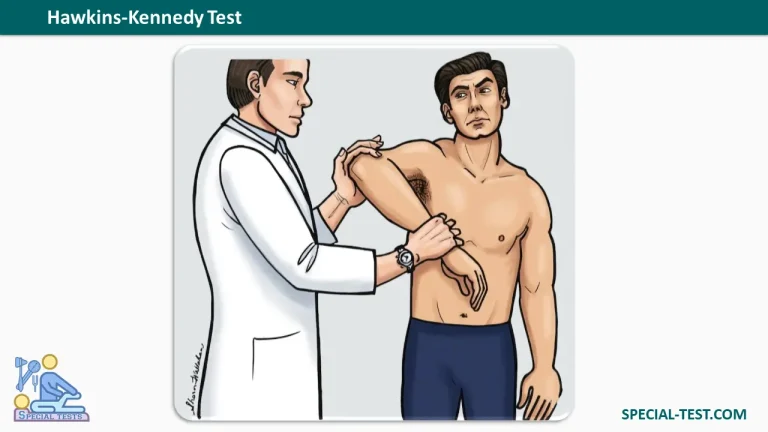
The Hawkins-Kennedy Test, also known as the Hawkins Impingement Test, is a commonly used orthopedic physical examination maneuver for assessing subacromial impingement syndrome and rotator cuff-related shoulder pain. It is particularly useful when evaluating patients who experience shoulder discomfort during overhead activities, arm elevation, or internal rotation.
The test involves positioning the shoulder and elbow at 90 degrees of flexion, followed by passive internal rotation of the shoulder. Reproduction of the patient’s characteristic shoulder pain indicates a positive result.
Although the Hawkins-Kennedy test is an important component of the shoulder examination, its findings should be interpreted alongside the patient’s medical history, symptoms, and other orthopedic special tests.
What Is the Hawkins-Kennedy Test Used For?
The Hawkins-Kennedy Test is primarily used to assess subacromial impingement syndrome, a condition associated with pain involving structures within the subacromial region of the shoulder.
The test helps clinicians evaluate conditions such as:
- Subacromial impingement syndrome: Pain associated with structures beneath the coracoacromial arch.
- Rotator cuff tendinopathy: Pain and dysfunction involving rotator cuff tendons, particularly the supraspinatus.
- Subacromial bursitis: Irritation of the subacromial bursa, which helps reduce friction between shoulder structures.
- Rotator cuff pathology: Including some partial-thickness or full-thickness tendon tears that may produce pain during the maneuver.
The test is frequently performed by orthopedic surgeons, sports medicine physicians, and physical therapists when examining patients with suspected rotator cuff-related shoulder pain.
However, a positive test does not independently establish any of these diagnoses.
How to Perform the Hawkins-Kennedy Test
The Hawkins-Kennedy test is performed with the patient sitting or standing while the examiner passively moves the affected shoulder.
Step-by-Step Procedure
- Patient position: Ask the patient to sit or stand comfortably with the shoulder relaxed.
- Shoulder flexion: Passively elevate the patient’s arm forward until the shoulder reaches approximately 90 degrees of forward flexion.
- Elbow flexion: Flex the patient’s elbow to 90 degrees.
- Arm stabilization: Support the elbow and control the forearm or wrist while maintaining the shoulder position.
- Internal rotation: Passively rotate the shoulder internally by moving the forearm downward in a controlled manner.
- Assess the response: Observe the patient’s reaction and ask whether the maneuver reproduces their familiar shoulder pain.
Important: Internal rotation should be performed carefully and should not be forced beyond the patient’s tolerated range of motion.
The examiner should distinguish pain caused by the maneuver from simple stretching discomfort or restricted shoulder mobility.
What Is a Positive Hawkins-Kennedy Test?
A positive Hawkins-Kennedy test occurs when passive internal rotation of the shoulder reproduces the patient’s characteristic shoulder pain, usually in the anterior or lateral shoulder region.
Traditionally, this response is associated with compression or mechanical irritation of structures within the subacromial space.
During the maneuver, internal rotation changes the relationship between the greater tuberosity of the humerus and the coracoacromial arch. This positioning may increase contact or compression involving the supraspinatus tendon and surrounding tissues.
A positive response may be associated with:
- Supraspinatus tendinopathy.
- Subacromial bursitis.
- Rotator cuff-related shoulder pain.
- Symptomatic subacromial impingement.
Nevertheless, shoulder pain reproduced during the Hawkins-Kennedy test is not specific to a single anatomical structure. Other shoulder disorders can produce similar symptoms.
Therefore, the result should be considered suggestive rather than diagnostic.
What Does a Negative Hawkins-Kennedy Test Mean?
A negative Hawkins-Kennedy test occurs when internal rotation does not reproduce the patient’s typical shoulder pain.
A negative result may reduce the likelihood of subacromial impingement syndrome, particularly when other findings are also negative.
However, a negative test does not completely exclude rotator cuff disease or other shoulder pathology. Its diagnostic value depends on the patient’s symptoms, examination findings, and the clinical setting.
Hawkins-Kennedy Test Sensitivity and Specificity
The diagnostic accuracy of the Hawkins-Kennedy test has been investigated in several clinical studies and systematic reviews.
Sensitivity
Sensitivity describes how frequently a diagnostic test correctly identifies patients who have the condition being evaluated.
A systematic review and meta-analysis by Hegedus and colleagues, published in the British Journal of Sports Medicine in 2012, reported a pooled Hawkins-Kennedy test sensitivity of 79% for subacromial impingement.
An earlier study by Caliş and colleagues reported a sensitivity of approximately 92.1%, demonstrating that results can differ substantially between patient populations and study methods.
Specificity
Specificity describes how frequently a test correctly identifies individuals who do not have the target condition.
The 2012 Hegedus meta-analysis reported a pooled specificity of 59%.
A later systematic review by Gismervik and colleagues in 2017 reported a sensitivity of 58% and specificity of 67%.
Diagnostic Accuracy Summary
| Study | Sensitivity | Specificity |
|---|---|---|
| Hegedus et al. (2012) | 79% | 59% |
| Gismervik et al. (2017) | 58% | 67% |
| Caliş et al. (2000) | 92.1% | Not specified in the PubMed abstract |
These findings indicate that the Hawkins-Kennedy test has limited diagnostic accuracy when used alone.
Its generally modest specificity means that a positive result can also occur in patients without the specific condition being investigated.
The clinical usefulness of a negative result likewise varies according to the study and the patient’s underlying probability of disease.
Clinical Significance of the Hawkins-Kennedy Test
The Hawkins-Kennedy test is most useful as part of a comprehensive shoulder assessment rather than as an isolated diagnostic procedure.
Clinicians commonly combine it with other examinations, including:
- Neer Impingement Test: Evaluates shoulder pain during passive forward elevation.
- Painful Arc Test: Assesses pain produced during active shoulder abduction.
- Empty Can (Jobe) Test: Assesses supraspinatus-related pain and weakness.
- Infraspinatus Strength Test: Evaluates external rotation strength and possible rotator cuff dysfunction.
Research by Park and colleagues demonstrated that combining the Hawkins-Kennedy test with the painful arc sign and infraspinatus muscle test improved diagnostic prediction for subacromial impingement compared with relying on individual findings.
Additional diagnostic investigations, including ultrasound or magnetic resonance imaging (MRI), may be considered when clinically indicated, particularly in patients with significant weakness, traumatic injuries, or persistent symptoms.
Limitations of the Hawkins-Kennedy Test
Despite its widespread clinical use, the Hawkins-Kennedy shoulder test has several limitations.
First, it cannot reliably distinguish between subacromial bursitis, rotator cuff tendinopathy, and rotator cuff tears.
Second, pain during internal rotation may occur in patients with other shoulder conditions, contributing to false-positive results.
Third, differences in examination technique, patient characteristics, and diagnostic reference standards can influence its reported sensitivity and specificity.
For these reasons, the Hawkins-Kennedy test should not be used as the sole basis for diagnosing shoulder impingement syndrome.
Conclusion
The Hawkins-Kennedy test is a practical and widely used orthopedic examination maneuver for assessing subacromial impingement and rotator cuff-related shoulder pain.
It is performed by flexing the shoulder and elbow to 90 degrees and then passively internally rotating the shoulder. Reproduction of the patient’s characteristic pain constitutes a positive result.
Although some individual studies have reported high sensitivity, systematic reviews show that the test has limited specificity and cannot independently confirm a diagnosis.
Combining the Hawkins-Kennedy test with other shoulder examination findings provides a more informative clinical assessment.
Frequently Asked Questions (FAQ)
1. What is the Hawkins-Kennedy test used for?
The Hawkins-Kennedy test is primarily used to assess subacromial impingement syndrome and rotator cuff-related shoulder pain. It helps identify pain reproduced by passive internal rotation of the shoulder.
2. How do you perform the Hawkins-Kennedy test?
The examiner flexes the patient’s shoulder to 90 degrees, bends the elbow to 90 degrees, and then passively internally rotates the shoulder. The examiner assesses whether this movement reproduces the patient’s characteristic shoulder pain.
3. What indicates a positive Hawkins-Kennedy test?
A positive Hawkins-Kennedy test is indicated by reproduction of the patient’s familiar shoulder pain during passive internal rotation. This may suggest subacromial or rotator cuff-related pathology but does not establish a definitive diagnosis.
4. What is the sensitivity and specificity of the Hawkins-Kennedy test?
According to the 2012 meta-analysis by Hegedus and colleagues, the Hawkins-Kennedy test has a pooled sensitivity of approximately 79% and specificity of 59%. Other studies have reported different values depending on patient populations and research methods.
5. What structures are affected during the Hawkins-Kennedy test?
The maneuver changes the position of the greater tuberosity beneath the coracoacromial arch and may increase compression or contact involving the supraspinatus tendon and surrounding subacromial tissues.
6. Can the Hawkins-Kennedy test diagnose a rotator cuff tear?
No. Although patients with rotator cuff tears may experience pain during the test, the Hawkins-Kennedy maneuver cannot reliably distinguish a tendon tear from tendinopathy, bursitis, or other causes of shoulder pain.
7. What is the difference between the Neer test and the Hawkins-Kennedy test?
The Neer test involves passive forward elevation of the shoulder, whereas the Hawkins-Kennedy test involves passive internal rotation with the shoulder and elbow flexed to 90 degrees. Both are used to assess subacromial pain, and neither is sufficiently accurate to confirm impingement syndrome when used alone.
8. Is the Hawkins-Kennedy test reliable for diagnosing shoulder impingement?
The Hawkins-Kennedy test can provide useful information during a shoulder examination, but its diagnostic accuracy is limited. It should be interpreted together with patient history, physical examination findings, and other appropriate investigations.
References
- Orthofixar – Hawkins Kennedy Test: Procedure, Interpretation, and Accuracy.
- Hegedus EJ, Goode AP, Cook CE, et al. Which physical examination tests provide clinicians with the most value when examining the shoulder? Update of a systematic review with meta-analysis of individual tests. Br J Sports Med. 2012;46(14):964–978. PubMed PMID: 22773322.
- Gismervik SØ, Drogset JO, Granviken F, et al. Physical examination tests of the shoulder: a systematic review and meta-analysis of diagnostic test performance. BMC Musculoskelet Disord. 2017;18:41. PubMed PMID: 28122541.
- Caliş M, Akgün K, Birtane M, et al. Diagnostic values of clinical diagnostic tests in subacromial impingement syndrome. Ann Rheum Dis. 2000;59(1):44–47. PubMed PMID: 10627426.
- Park HB, Yokota A, Gill HS, et al. Diagnostic accuracy of clinical tests for the different degrees of subacromial impingement syndrome. J Bone Joint Surg Am. 2005;87(7):1446–1455. PubMed PMID: 15995110.