External Rotation Stress Test: Technique, Positive Results and Accuracy
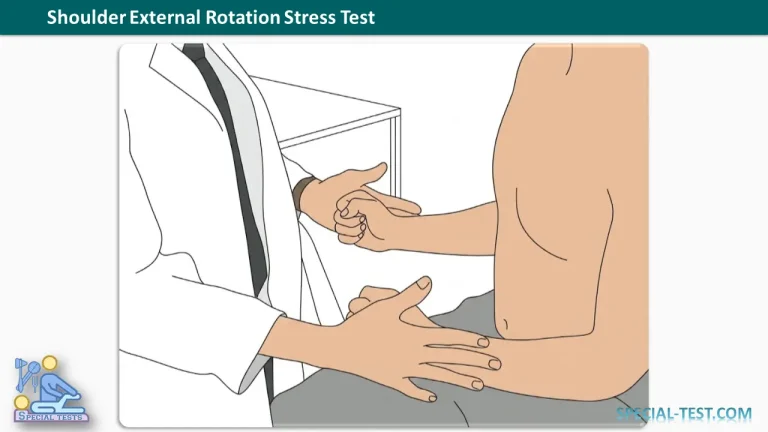
The external rotation stress test, also referred to as the resisted external rotation test, is a clinical examination maneuver used to assess the strength and function of the shoulder’s external rotators, particularly the infraspinatus and teres minor muscles. It is commonly included in the physical examination of patients with suspected rotator cuff pathology.
Pain or weakness during resisted external rotation may indicate rotator cuff dysfunction, including tendinopathy or a tendon tear. However, the test should be interpreted alongside the patient’s history, other physical examination findings, and imaging when clinically indicated.
What Is the External Rotation Stress Test Used For?
The external rotation stress test evaluates the function of the posterior rotator cuff, particularly:
- Infraspinatus: The primary muscle responsible for external rotation of the shoulder when the arm is positioned at the side.
- Teres minor: Assists with external rotation and contributes to glenohumeral joint stability.
The test can help identify suspected rotator cuff dysfunction, including infraspinatus or teres minor involvement. Pain during the maneuver may suggest a painful rotator cuff disorder, while marked weakness may raise concern for a more significant tendon injury.
How to Perform the External Rotation Stress Test
Patient position
- Position the patient sitting or standing comfortably.
- Ask the patient to keep both arms by the sides, with the shoulders in neutral flexion and abduction.
- Flex the elbows to approximately 90 degrees.
Examination technique
- Ask the patient to rotate the forearms outward by externally rotating the shoulders.
- Apply an inward, medially directed force to the distal forearms or hands.
- Instruct the patient to resist the force and maintain external rotation.
- Compare the strength and pain response of both shoulders.
The maneuver should be performed with controlled resistance while keeping the elbows close to the trunk to minimize compensatory movements.
Note: The precise positioning and resistance direction may vary between published examination techniques. The procedure above describes the commonly used resisted external rotation strength test.
What Is a Positive External Rotation Stress Test?
The test is considered positive when it reproduces shoulder pain or reveals weakness during resisted external rotation.
Positive findings include:
- Pain: May indicate rotator cuff tendinopathy or another painful shoulder disorder.
- Weakness: May suggest impaired function of the infraspinatus or teres minor, including a possible rotator cuff tear.
- Marked weakness compared with the opposite shoulder: Raises greater concern for significant rotator cuff dysfunction, particularly when supported by other clinical findings.
A positive result does not independently confirm a tendon tear. Pain-related inhibition, other shoulder disorders, and differences in baseline muscle strength may influence the examination.
External Rotation Stress Test: Sensitivity and Specificity
The reported diagnostic accuracy of a physical examination test depends on the precise maneuver, the population examined, and the condition being diagnosed.
The following values were provided in the original reference material:
| Diagnostic measure | Reported value |
|---|---|
| Sensitivity | 58% |
| Specificity | 96% |
Clinical interpretation
- Sensitivity of 58%: The test may be negative in a substantial proportion of patients who have the target condition. A negative result does not reliably exclude rotator cuff pathology.
- Specificity of 96%: A positive result may increase suspicion for the target condition in the population in which these estimates were established.
These figures should be verified against the original study and its diagnostic target before being used in clinical publications. They should not be generalized to every form of rotator cuff disease without supporting evidence.
Clinical Significance and Limitations
The external rotation stress test is most useful as one component of a comprehensive shoulder examination.
For a more accurate assessment, clinicians should consider combining it with:
- Inspection and palpation of the shoulder.
- Assessment of active and passive range of motion.
- Rotator cuff strength testing.
- The external rotation lag sign when a significant posterosuperior cuff tear is suspected.
- Additional tests directed at other rotator cuff tendons and relevant shoulder structures.
The American Academy of Orthopaedic Surgeons notes that combining appropriate clinical examination tests can improve the assessment of rotator cuff tears.
A definitive diagnosis should be based on the overall clinical presentation and, when appropriate, imaging studies such as ultrasound or MRI.
Frequently Asked Questions (FAQ)
1. What muscles does the external rotation stress test assess?
The test primarily assesses the infraspinatus and teres minor, two muscles that contribute to external rotation of the shoulder and help stabilize the glenohumeral joint.
2. What does a positive external rotation stress test indicate?
Pain or weakness during resisted external rotation may indicate rotator cuff dysfunction. Pain can occur with tendinopathy or other painful shoulder conditions, while substantial weakness may raise suspicion for a tendon tear.
3. Can the external rotation stress test diagnose a rotator cuff tear?
No. The test can support the clinical suspicion of a rotator cuff tear, but it cannot establish the diagnosis by itself. Findings should be interpreted alongside the history, other examination maneuvers, and imaging when indicated.
4. Does a negative external rotation stress test rule out a rotator cuff tear?
No. A negative result does not exclude a tear, particularly if the test has limited sensitivity for the specific lesion being investigated.
5. What is the difference between the external rotation stress test and the external rotation lag sign?
The external rotation stress test evaluates the patient’s ability to produce and maintain external rotation against resistance. The external rotation lag sign assesses whether the patient can maintain a passively positioned, externally rotated shoulder after the examiner releases support. The lag sign is particularly useful when a significant rotator cuff tear is suspected.
6. Is the external rotation stress test specific to the infraspinatus?
No. Although the infraspinatus is the principal external rotator tested with the arm at the side, the teres minor also contributes to the movement. The test does not isolate either muscle completely.
7. When should imaging be considered after a positive test?
Imaging may be appropriate when the history and examination suggest a clinically significant rotator cuff tear, when substantial weakness persists, or when symptoms do not improve as expected. The choice of ultrasound or MRI depends on the clinical question and local practice.
References
- American Academy of Orthopaedic Surgeons (AAOS). Management of Rotator Cuff Injuries: Evidence-Based Clinical Practice Guideline. https://www.aaos.org/rccpg
- Merck Manual Professional Edition. Evaluation of the Shoulder. https://www.merckmanuals.com/professional/musculoskeletal-and-connective-tissue-disorders/approach-to-the-patient-with-joint-symptoms/evaluation-of-the-shoulder
- StatPearls, National Center for Biotechnology Information (NCBI Bookshelf). Comprehensive Shoulder Evaluation Strategies. https://www.ncbi.nlm.nih.gov/books/NBK538309/
- American Academy of Orthopaedic Surgeons (AAOS). Rotator Cuff and Shoulder Conditioning Program. https://orthoinfo.aaos.org/