External Rotation Lag Sign: Purpose, Procedure, Positive Result, and Diagnostic Accuracy
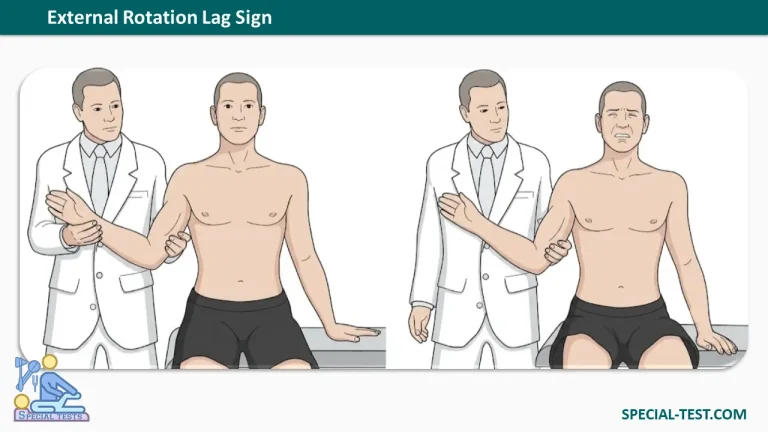
The External Rotation Lag Sign (ERLS) is a clinical orthopedic examination test used to assess rotator cuff function and help identify full-thickness tears of the shoulder tendons, particularly the supraspinatus and infraspinatus. It evaluates the patient’s ability to actively maintain the shoulder in an externally rotated position after the examiner passively places the arm in that position.
The test is especially useful when a rotator cuff tear is suspected during the physical examination of a patient with shoulder pain, weakness, or impaired arm function. Research suggests that the External Rotation Lag Sign has high specificity for full-thickness supraspinatus tears, meaning that a positive result can strongly support the suspicion of a tear. However, its relatively limited sensitivity means that a negative result does not reliably exclude rotator cuff injury.
What Is the External Rotation Lag Sign Used For?
The External Rotation Lag Sign is primarily used to assess the integrity and function of the shoulder’s rotator cuff, particularly the supraspinatus and infraspinatus tendons. Depending on the arm position and the extent of the injury, the test may also help identify involvement of the teres minor.
The rotator cuff consists of four muscles and their tendons: the supraspinatus, infraspinatus, teres minor, and subscapularis. These structures help stabilize the humeral head within the glenoid cavity and contribute to controlled shoulder movement.
The supraspinatus contributes to shoulder elevation and dynamic joint stability, while the infraspinatus and teres minor are important external rotators of the shoulder. Damage to these tendons can impair the patient’s ability to maintain external rotation against gravity.
The External Rotation Lag Sign is particularly useful for:
- Assessing suspected full-thickness rotator cuff tears.
- Identifying weakness or loss of function of the shoulder’s external rotators.
- Supporting the clinical diagnosis of supraspinatus and infraspinatus tendon injuries.
- Helping clinicians determine whether additional investigations, such as ultrasound or magnetic resonance imaging (MRI), may be appropriate.
The test should be interpreted alongside the patient’s history, other physical examination findings, and imaging when indicated. It is not intended to establish a diagnosis in isolation.
How to Perform the External Rotation Lag Sign
Correct positioning is essential for obtaining a meaningful result. The examiner should carefully position the shoulder and avoid allowing the patient to compensate with movements of the trunk or shoulder blade.
Patient Position
- Ask the patient to sit comfortably with their back facing the examiner.
- Position the patient’s elbow in 90 degrees of flexion.
- Keep the shoulder at approximately 20 degrees of elevation in the scapular plane.
- Passively externally rotate the shoulder to near its maximum range of motion, stopping approximately 5 degrees short of maximal external rotation. This helps minimize elastic recoil that could affect the result.
Test Procedure
- Support the patient’s arm at the elbow to maintain the correct shoulder position.
- Hold the patient’s wrist and place the shoulder in the required externally rotated position.
- Ask the patient to actively maintain this position without assistance.
- Release the wrist while continuing to support the elbow.
- Observe whether the patient can maintain external rotation or whether the arm moves toward internal rotation.
The examiner should pay attention to the amount of angular loss after releasing the wrist. A visible inability to maintain the passively achieved position suggests weakness or dysfunction of the external rotator mechanism.
The maneuver should be performed gently, particularly when the patient has significant shoulder pain or restricted movement.
What Is a Positive External Rotation Lag Sign?
The External Rotation Lag Sign is considered positive when the patient cannot maintain the externally rotated position and the arm falls back toward internal rotation after the examiner releases the wrist.
This angular drop, known as the external rotation lag, indicates an inability to sustain the required position actively. It may be associated with a substantial rotator cuff tear, especially when the supraspinatus or infraspinatus tendon is involved.
A larger lag may be associated with a more extensive tear involving additional external rotator structures. However, the amount of lag should not be used alone to determine the exact size or location of a tear.
A positive result raises suspicion for a full-thickness rotator cuff tear and should be correlated with other clinical findings.
A negative result means that the patient can maintain the position during the maneuver. It does not rule out a partial-thickness tear or even every full-thickness tear, because the test has limited sensitivity.
External Rotation Lag Sign: Sensitivity and Specificity
The diagnostic accuracy of the External Rotation Lag Sign has been evaluated in clinical research.
In a study by Castoldi and colleagues involving 401 consecutive patients with 406 painful shoulder conditions, the test was assessed against findings from arthroscopy or open surgery. For isolated full-thickness supraspinatus tears, the reported diagnostic accuracy was as follows.
| Diagnostic measure | Reported value |
|---|---|
| Sensitivity | 56% |
| Specificity | 98% |
Source: Castoldi F, Blonna D, Hertel R. External rotation lag sign revisited: accuracy for diagnosis of full thickness supraspinatus tear. Journal of Shoulder and Elbow Surgery, 2009. PMID: 19223205.
Interpretation of Sensitivity
A sensitivity of 56% means that the test identified approximately 56% of patients with the target condition in the studied population. Some patients with full-thickness supraspinatus tears had a negative test result.
Therefore, a negative External Rotation Lag Sign should not be used to exclude a rotator cuff tear.
Interpretation of Specificity
A specificity of 98% means that approximately 98% of patients without the target condition were correctly identified as negative in that study population.
This high specificity makes a positive result particularly useful when assessing a suspected full-thickness supraspinatus tear. Nevertheless, diagnostic accuracy can vary according to the patient population, the examiner’s technique, the extent of tendon involvement, and the reference standard used.
These figures apply to the specific study population and target diagnosis; they should not automatically be generalized to every type of rotator cuff injury.
Clinical Significance and Limitations
The External Rotation Lag Sign is most informative when the patient has sufficient passive shoulder mobility to achieve the required test position. Pain, stiffness, neurological dysfunction, and inadequate patient effort may affect performance and complicate interpretation.
Research also indicates that the test’s diagnostic performance can differ according to which rotator cuff tendons are involved. In the Castoldi study, sensitivity improved when tears extended beyond the isolated supraspinatus to involve the infraspinatus and teres minor.
A separate study by Miller and colleagues reported a sensitivity of 46% and specificity of 94% for the External Rotation Lag Sign in a clinical investigation of patients with suspected rotator cuff tears. These differences reinforce the importance of interpreting test accuracy in context.
Clinicians should combine the External Rotation Lag Sign with other shoulder examination maneuvers, such as the Jobe (Empty Can) Test and other tests of rotator cuff function, as appropriate. Ultrasound or MRI may be considered when further evaluation is needed.
Conclusion
The External Rotation Lag Sign is a useful clinical maneuver for evaluating suspected rotator cuff tears, particularly full-thickness supraspinatus tears and dysfunction of the external rotators. The examiner passively places the shoulder in near-maximal external rotation and asks the patient to maintain the position after the wrist is released.
A positive result occurs when the arm falls toward internal rotation, indicating an inability to maintain external rotation actively. Reported sensitivity of 56% and specificity of 98% support its role as a relatively specific clinical test, but a negative result does not exclude a tear.
The test is best used as part of a comprehensive shoulder examination, with further imaging and clinical assessment guided by the overall findings.
Frequently Asked Questions (FAQ)
1. What does the External Rotation Lag Sign test assess?
The External Rotation Lag Sign assesses the ability of the shoulder’s rotator cuff, particularly the supraspinatus and infraspinatus, to maintain active external rotation. A positive result may indicate a full-thickness rotator cuff tear.
2. How is the External Rotation Lag Sign performed?
The patient sits with their back toward the examiner. The elbow is flexed to 90 degrees, and the shoulder is positioned at approximately 20 degrees of elevation and near-maximal external rotation. The examiner releases the wrist while supporting the elbow and observes whether the patient can maintain the position.
3. What is a positive External Rotation Lag Sign?
The test is positive when the patient’s arm falls toward internal rotation after the examiner releases the wrist, demonstrating an inability to maintain the externally rotated position actively.
4. What are the sensitivity and specificity of the External Rotation Lag Sign?
For isolated full-thickness supraspinatus tears, Castoldi and colleagues reported a sensitivity of 56% and a specificity of 98%. These values indicate that the test is more useful for supporting a suspected tear when positive than for excluding a tear when negative.
5. Can a negative External Rotation Lag Sign rule out a rotator cuff tear?
No. Because sensitivity is limited, some patients with full-thickness tears may have a negative result. Other clinical findings and imaging may be needed when suspicion remains.
6. Which rotator cuff muscles are evaluated by the External Rotation Lag Sign?
The test primarily evaluates external rotator function, particularly the infraspinatus and teres minor, while also helping identify full-thickness supraspinatus tears. Diagnostic performance depends on the position used and the tendons involved.
References
- Castoldi F, Blonna D, Hertel R. External rotation lag sign revisited: accuracy for diagnosis of full thickness supraspinatus tear. Journal of Shoulder and Elbow Surgery. 2009;18(4):529–534. PubMed: PMID 19223205.
- Hertel R, Ballmer FT, Lombert SM, Gerber C. Lag signs in the diagnosis of rotator cuff rupture. Journal of Shoulder and Elbow Surgery. 1996;5(4):307–313. PubMed: PMID 8872929.
- Miller CA, Forrester GA, Lewis JS. The validity of the lag signs in diagnosing full-thickness tears of the rotator cuff: a preliminary investigation. Archives of Physical Medicine and Rehabilitation. 2008;89(6):1162–1168. PubMed: PMID 18503815.
- OrthoFixar. External Rotation Lag Sign.
- Campbell’s Operative Orthopaedics. Reference textbook for orthopedic examination and management.