Spinous Process Tap Test: Purpose, Procedure, and Positive Findings
What Is the Spinous Process Tap Test?
The Spinous Process Tap Test is a physical examination technique used to assess pain and tenderness in the lumbar spine. Also known as a lumbar spinous process percussion test, it involves gently tapping the spinous processes of the lumbar vertebrae and the surrounding paraspinal muscles to identify painful spinal segments.
Traditionally, the test is described as a clinical assessment for lumbar spine syndrome, a broad term referring to symptoms associated with disorders affecting the lower back.
The examination may help clinicians identify localized spinal tenderness or pain radiating into the lower extremities. These findings can suggest irritation of spinal structures or possible nerve root involvement.
However, the Spinous Process Tap Test is not sufficient on its own to diagnose a particular lumbar spine disorder. Its findings must be interpreted alongside the patient’s medical history, neurological examination, and other appropriate clinical tests.
What Is the Purpose of the Spinous Process Tap Test?
The primary purpose of the Spinous Process Tap Test is to evaluate pain originating from or associated with the lumbar spinal region.
The test may be incorporated into a comprehensive assessment of patients experiencing lower back pain, spinal tenderness, or symptoms suggestive of lumbar radiculopathy.
Its clinical objectives include identifying painful lumbar spinal segments, assessing localized tenderness, determining whether percussion reproduces radiating symptoms, and helping guide further physical examination.
Localized pain may occur in patients with degenerative spinal conditions, inflammatory irritation, or musculoskeletal disorders affecting the lumbar region.
Pain radiating from the lower back into the buttock or leg may raise suspicion of nerve root irritation, potentially associated with lumbar intervertebral disc pathology.
Importantly, these responses are nonspecific and cannot independently establish the underlying diagnosis.
How to Perform the Spinous Process Tap Test
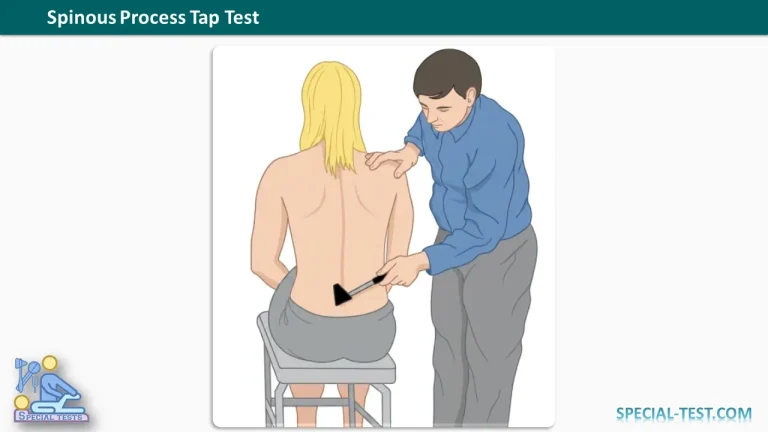
The Spinous Process Tap Test procedure is relatively straightforward and is performed by a trained healthcare professional using a reflex hammer.
Patient Position
The patient is seated comfortably on an examination table or chair, with the lumbar spine slightly flexed forward.
This position allows the examiner to access and identify the lumbar spinous processes.
The patient should remain relaxed throughout the examination.
Examiner Position
The examiner stands behind the seated patient, providing clear access to the lumbar spine and adjacent paraspinal musculature.
Before performing percussion, the examiner may palpate the lumbar spinous processes to identify anatomical landmarks and areas of tenderness.
Test Procedure
Step 1: Position the patient in a seated posture with slight forward flexion of the lumbar spine.
Step 2: Identify the lumbar spinous processes through palpation.
Step 3: Using a reflex hammer, gently tap the spinous processes of the lumbar vertebrae.
Step 4: Continue the examination systematically across the lumbar spinal levels, observing the patient’s response.
Step 5: Gently tap the paraspinal musculature on either side of the lumbar spine to assess associated tenderness.
Step 6: Ask the patient whether the tapping produces localized lower back pain, radiating pain, or other symptoms.
The examiner should document the location, severity, and distribution of any symptoms reproduced during the examination.
Percussion should be gentle and controlled. If a vertebral fracture or another serious spinal condition is suspected, provocative percussion should be avoided until the patient has been appropriately evaluated.
What Is a Positive Spinous Process Tap Test?
A positive Spinous Process Tap Test occurs when percussion reproduces localized spinal pain or radiating symptoms.
The clinical interpretation depends on the location and characteristics of the pain.
1. Localized Lumbar Pain
Localized pain over a lumbar spinous process may indicate irritation of structures associated with the affected spinal segment.
Possible contributing conditions include degenerative changes, local inflammatory irritation, muscular disorders, and other causes of mechanical lower back pain.
However, localized percussion tenderness does not specifically confirm lumbar spondylosis, facet joint pathology, or inflammatory degeneration.
Focal bony tenderness may also warrant assessment for vertebral injury, particularly in patients with trauma, osteoporosis, or other fracture risk factors.
2. Radicular Pain
Radicular pain refers to pain originating from irritation or dysfunction of a spinal nerve root, which may radiate from the lower back into the buttock or lower extremity.
If tapping a lumbar spinous process reproduces radiating leg pain, the examiner should investigate possible lumbar nerve root involvement.
A herniated lumbar intervertebral disc is one potential cause, although spinal stenosis and other disorders may produce similar symptoms.
Additional neurological and neurodynamic examinations are necessary before attributing the findings to disc pathology.
3. Negative Spinous Process Tap Test
A negative result occurs when percussion does not reproduce significant localized or radiating pain.
Although this may indicate the absence of percussion-provoked tenderness, it does not exclude lumbar disc herniation, nerve root compression, degenerative spinal disease, or other causes of lower back pain.
Clinical Significance of the Spinous Process Tap Test
The Spinous Process Tap Test is best considered an adjunctive examination technique, rather than a definitive diagnostic test.
A comprehensive lumbar spine examination may include assessment of spinal posture, lumbar range of motion, spinous process palpation, lower-limb muscle strength, sensation, tendon reflexes, and nerve tension signs.
Other commonly used clinical tests include the Straight Leg Raise Test, Slump Test, and Femoral Nerve Stretch Test.
Evidence from systematic reviews indicates that individual physical examination findings often have limited diagnostic accuracy when used alone to identify lumbar disc herniation or radiculopathy.
Combining clinical history with several relevant examination findings generally provides a more informative assessment.
Limitations and Precautions
Despite its clinical simplicity, the Spinous Process Tap Test has important limitations.
There is insufficient high-quality evidence establishing the independent sensitivity and specificity of this exact reflex-hammer technique for diagnosing lumbar degenerative disease or disc herniation.
Furthermore, pain produced by percussion may originate from multiple anatomical structures, making it difficult to distinguish muscular, ligamentous, bony, and neurological conditions from the test alone.
The examiner should exercise particular caution in patients with recent spinal trauma, known osteoporosis, suspected vertebral fracture, or significant unexplained spinal pain.
Patients with new bladder or bowel dysfunction, saddle anesthesia, or progressive neurological weakness require urgent medical evaluation rather than routine provocative testing.
Imaging studies such as MRI or radiography may be appropriate when clinical findings suggest serious spinal pathology or when further investigation is indicated.
Summary
The Spinous Process Tap Test is a clinical examination technique used to evaluate lumbar spinal tenderness and pain responses.
The patient sits with the lumbar spine slightly flexed while the examiner gently taps the lumbar spinous processes and paraspinal musculature using a reflex hammer.
Localized pain may suggest irritation of structures around the affected spinal segment, whereas radiating pain may raise suspicion of lumbar nerve root involvement or possible intervertebral disc pathology.
Nevertheless, a positive result cannot establish a specific spinal diagnosis. The test should be interpreted as part of a comprehensive musculoskeletal and neurological examination.
Frequently Asked Questions (FAQ)
What is the Spinous Process Tap Test used for?
The Spinous Process Tap Test is used to assess lumbar spinal tenderness and reproduce pain associated with possible spinal segment irritation. It may help identify areas requiring further clinical investigation in patients with lower back pain.
How is the Spinous Process Tap Test performed?
The patient sits with the lumbar spine slightly flexed. The examiner gently taps the lumbar spinous processes and surrounding paraspinal muscles using a reflex hammer, observing whether localized or radiating pain develops.
What indicates a positive Spinous Process Tap Test?
A positive result involves pain reproduced by percussion. Localized pain may indicate irritation of structures near the affected spinal level, while radiating pain may suggest possible nerve root involvement.
Can the Spinous Process Tap Test diagnose lumbar disc herniation?
No. Radiating pain during the test may raise suspicion of lumbar disc pathology, but the finding is not specific enough to confirm a herniated disc. Further neurological assessment and, when indicated, imaging are necessary.
Does a positive test always indicate a serious spinal disorder?
No. Percussion tenderness can occur with several musculoskeletal conditions. However, significant focal pain, particularly after trauma or in individuals with osteoporosis, should prompt consideration of a vertebral fracture.
What is the difference between localized pain and radicular pain?
Localized pain remains concentrated around a specific region of the lumbar spine. Radicular pain typically travels along the distribution of an irritated spinal nerve root and may extend into the buttock or leg.
Is the Spinous Process Tap Test reliable?
The exact Spinous Process Tap Test lacks sufficient diagnostic accuracy evidence to be considered reliable as a standalone test for identifying specific lumbar disorders. It is most useful when combined with patient history and other examination findings.
What other tests are used to evaluate lumbar radiculopathy?
Common assessments include the Straight Leg Raise Test, Slump Test, Femoral Nerve Stretch Test, lower-limb muscle strength testing, sensory examination, and deep tendon reflex assessment. These tests help clinicians evaluate possible nerve root involvement.
References
- OrthoFixar – Complete Spine Examination: Cervical, Thoracic & Lumbar Guide. Overview of lumbar spine assessment, palpation, percussion, and special tests.
- van der Windt DAWM, et al. Physical examination for lumbar radiculopathy due to disc herniation in patients with low-back pain. Cochrane Database of Systematic Reviews. 2010.
- Kreiner DS, et al. An evidence-based clinical guideline for the diagnosis and treatment of lumbar disc herniation with radiculopathy. The Spine Journal. 2014.
- Clinical classification in low back pain: Best-evidence diagnostic rules based on systematic reviews.
- Finucane LM, et al. International Framework for Red Flags for Potential Serious Spinal Pathologies. Journal of Orthopaedic & Sports Physical Therapy. 2020.
- Buckup K, Buckup J. Clinical Tests for the Musculoskeletal System, 3rd Edition. Traditional description of the Spinous Process Tap Test.