Sitting Root Test: Procedure, Positive Signs, and Clinical Significance
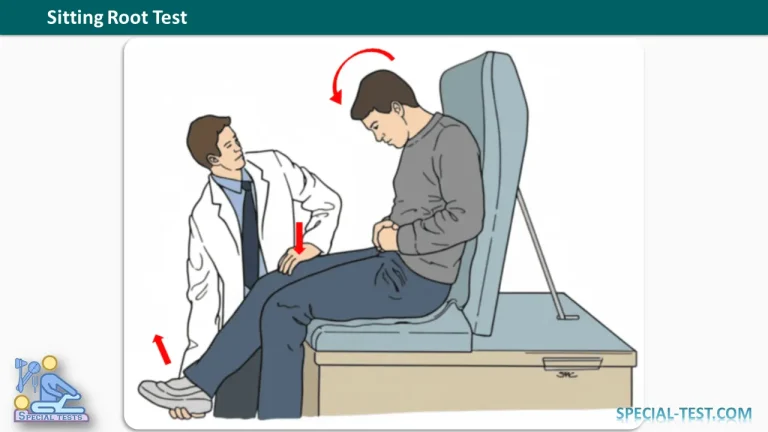
The Sitting Root Test is a clinical orthopedic examination used to evaluate sciatic nerve irritation, lumbar nerve root tension, and possible lumbosacral radiculopathy. It is particularly useful when assessing patients who experience lower back pain accompanied by radiating leg pain, numbness, or tingling.
Also described as a variation of the seated straight leg raise test, the Sitting Root Test combines cervical spine flexion, hip flexion, and knee extension to increase mechanical loading of the neural structures. It is closely related to the Slump Test and the traditional Straight Leg Raise (SLR) Test.
The test provides valuable information during the physical examination of patients with suspected lumbar disc herniation or sciatic nerve involvement. However, its findings must be interpreted alongside the patient’s medical history, neurological examination, and other diagnostic assessments.
What Is the Sitting Root Test Used For?
The primary purpose of the Sitting Root Test is to assess mechanosensitivity of the sciatic nerve and lumbosacral nerve roots, particularly when neural irritation may be responsible for radiating lower limb symptoms.
Clinicians commonly use this examination when investigating conditions such as:
- Lumbar disc herniation: A displaced intervertebral disc may irritate or compress a nearby spinal nerve root, producing radiating leg pain.
- Lumbar radiculopathy: Irritation or dysfunction of a lumbosacral nerve root can cause pain, paresthesia, sensory changes, or muscle weakness.
- Sciatica: Pain extending from the buttock into the posterior thigh or lower leg may be reproduced during neural tension testing.
- Sciatic nerve irritation or entrapment: Increased sensitivity of the sciatic nerve along its peripheral course may also produce symptoms during the examination.
The Sitting Root Test is a screening component of the physical examination rather than a definitive diagnostic test. A positive finding raises suspicion of neural involvement but does not independently establish the presence or location of a lumbar disc herniation.
Anatomical and Biomechanical Principles
The sciatic nerve originates from the L4–S3 spinal nerve roots through the lumbosacral plexus. It travels through the gluteal region and along the posterior thigh before dividing into its major terminal branches.
The Sitting Root Test applies mechanical loading through several movements:
- Cervical flexion: Bending the neck forward increases mechanical loading along the spinal neural and dural structures.
- Hip flexion: Sitting with the hips flexed to approximately 90 degrees places the sciatic nerve pathway in a lengthened position.
- Knee extension: Straightening the knee further increases mechanical loading on the sciatic nerve and its related neural structures.
Combining these movements may reproduce symptoms in patients with heightened neural mechanosensitivity.
Importantly, neural tension tests assess the response of nervous tissue to movement and loading; they do not directly measure nerve root compression.
How to Perform the Sitting Root Test
The Sitting Root Test should be performed by a qualified healthcare professional using slow, controlled movements.
Patient Position
- Ask the patient to sit upright at the edge of an examination table.
- Position both hips at approximately 90 degrees of flexion, with the knees initially flexed and the feet hanging freely without touching the floor.
- Allow the patient to rest the hands comfortably on the thighs or examination table.
- Instruct the patient to bend the neck forward, bringing the chin toward the chest without forcing the movement.
Examination Procedure
- The examiner stands beside the patient and identifies the lower limb to be examined.
- Place one hand over the distal thigh to stabilize the limb and minimize compensatory hip movements.
- With the other hand, gradually extend the patient’s knee toward a straightened position.
- Alternatively, instruct the patient to actively straighten the knee while maintaining the required seated position.
- Observe the patient’s response and ask whether the movement reproduces familiar pain, tingling, or numbness.
- Record the location, intensity, and distribution of any reproduced symptoms.
- Compare the findings with the opposite lower limb when clinically appropriate.
If symptoms are not reproduced, the examiner may consider additional controlled movements, such as further trunk flexion, as part of a related neurodynamic assessment.
Clinical precaution: The movement should not be forced beyond the patient’s tolerance. Testing should be stopped if severe pain or concerning neurological symptoms develop.
What Is a Positive Sitting Root Test?
A positive Sitting Root Test occurs when knee extension in the seated testing position reproduces the patient’s familiar radiating symptoms, suggesting increased neural mechanosensitivity.
Typical positive findings include:
- Shooting or electric-like pain extending from the buttock into the posterior thigh.
- Pain radiating into the calf or lower leg.
- Numbness, tingling, or burning sensations along the distribution of the sciatic nerve.
- Reproduction of symptoms comparable to those experienced during the Straight Leg Raise Test.
- Compensatory backward trunk movement or leaning backward to reduce discomfort.
The examiner should distinguish genuine reproduction of the patient’s characteristic radiating symptoms from ordinary hamstring stretching discomfort.
A positive result suggests possible sciatic nerve irritation or lumbar nerve root involvement, but it does not confirm a specific structural diagnosis.
What Does a Negative Sitting Root Test Mean?
A negative Sitting Root Test occurs when the patient can extend the knee without reproducing the characteristic radiating neurological symptoms.
Although a negative result may reduce clinical suspicion of neural mechanosensitivity, it does not completely exclude lumbar radiculopathy, disc herniation, or other neurological disorders.
The examiner must consider the complete clinical picture before interpreting the finding.
Sitting Root Test vs. Slump Test vs. Straight Leg Raise Test
These examinations share similar neurodynamic principles but differ in positioning and testing technique.
| Feature | Sitting Root Test | Slump Test | Straight Leg Raise Test |
|---|---|---|---|
| Patient position | Sitting | Sitting with spinal flexion | Supine |
| Cervical flexion | Included | Included | Not routinely required |
| Primary movement | Knee extension | Sequential spinal, neck, knee, and ankle movements | Hip flexion with knee extended |
| Main purpose | Assess neural irritation in sitting | Assess neural mechanosensitivity | Evaluate radiating leg pain and neural mechanosensitivity |
| Positive response | Reproduction of familiar radiating symptoms | Symptom reproduction influenced by neural loading and unloading | Reproduction of characteristic radicular leg pain |
The Slump Test generally involves additional spinal flexion and sequential structural differentiation, such as changes in cervical position or ankle dorsiflexion. These movements help determine whether symptoms are influenced by neural loading.
The traditional Straight Leg Raise Test, by contrast, is performed with the patient lying on the back while the examiner raises the extended lower limb.
Clinical Significance and Diagnostic Accuracy
The Sitting Root Test can support the assessment of lumbar radicular symptoms, especially when combined with neurological testing of muscle strength, sensation, and deep tendon reflexes.
Research on related neurodynamic examinations shows that their diagnostic performance varies considerably across patient populations and diagnostic criteria.
A study published in Archives of Physical Medicine and Rehabilitation found that the Slump Test demonstrated relatively high sensitivity for certain MRI findings, but limited specificity reduced its ability to confirm nerve root compression independently.
Furthermore, a study by Davis and colleagues reported positive seated Slump Test responses in some asymptomatic young adults, highlighting the importance of interpreting symptoms carefully rather than treating every painful response as pathological.
Reliable, widely established sensitivity and specificity values for the Sitting Root Test as a distinct examination are not available. Diagnostic accuracy estimates for the Slump Test or Straight Leg Raise Test should not automatically be applied to it.
Clinicians should consider alternative explanations for posterior thigh pain, including hamstring injury, myofascial pain, and other musculoskeletal or peripheral nerve disorders.
Patients with progressive leg weakness, new bladder or bowel dysfunction, or numbness around the groin and perineum require urgent medical evaluation rather than routine provocative testing.
Frequently Asked Questions (FAQ)
1. What is the Sitting Root Test?
The Sitting Root Test is an orthopedic examination performed in a seated position to evaluate sciatic nerve irritation and lumbar nerve root mechanosensitivity. It involves neck flexion and controlled knee extension while monitoring for radiating lower limb symptoms.
2. What does a positive Sitting Root Test indicate?
A positive result suggests possible irritation or increased mechanosensitivity involving the sciatic nerve or lumbosacral nerve roots. It may occur in patients with lumbar radiculopathy or disc herniation, although further clinical evaluation is required to establish the diagnosis.
3. Is the Sitting Root Test the same as the Slump Test?
No. Although the tests share similar principles, the Slump Test typically includes more pronounced thoracic and lumbar spinal flexion, along with sequential ankle and cervical movements used for structural differentiation.
4. Can the Sitting Root Test diagnose lumbar disc herniation?
No. A positive result alone cannot confirm lumbar disc herniation. Diagnosis depends on the patient’s history, physical examination, neurological findings, and, when indicated, imaging such as magnetic resonance imaging (MRI).
5. What is the difference between the Sitting Root Test and Straight Leg Raise Test?
The principal difference is patient positioning. The Sitting Root Test is performed while the patient sits with the hip flexed, whereas the Straight Leg Raise Test is conducted in the supine position with the examiner raising the extended leg.
Both are used to investigate symptoms potentially associated with lumbosacral nerve irritation.
6. Can hamstring tightness cause discomfort during the Sitting Root Test?
Yes. Hamstring tightness or injury may produce posterior thigh discomfort during knee extension. However, localized muscular stretching discomfort is not equivalent to reproduction of the patient’s characteristic radiating neurological symptoms.
7. Can the Sitting Root Test be performed actively or passively?
Yes. The patient may actively extend the knee, or the clinician may perform passive knee extension. In both cases, the movement should be controlled, and symptom reproduction should be carefully documented.
Conclusion
The Sitting Root Test is a useful clinical examination for evaluating sciatic nerve irritation and possible lumbar nerve root involvement in patients with radiating lower limb pain.
By combining cervical flexion, approximately 90 degrees of hip flexion, and knee extension, the test increases mechanical loading on the neural structures and may reproduce symptoms associated with lumbar radiculopathy.
A positive finding is characterized primarily by the reproduction of familiar radiating leg pain, numbness, or tingling. However, because similar symptoms can arise from different conditions, the Sitting Root Test should always be interpreted as part of a comprehensive musculoskeletal and neurological assessment.
References
- Orthofixar. Sitting Root Test: Procedure, Positive Findings, and Clinical Significance. https://orthofixar.com/special-test/sitting-root-test/
- Delitto A, George SZ, Van Dillen L, et al. Low Back Pain: Clinical Practice Guidelines Linked to the International Classification of Functioning, Disability, and Health. Journal of Orthopaedic & Sports Physical Therapy. 2012;42(4)–A57. NCBI PubMed Central
- Davis DS, Anderson IB, Carson MG, et al. Upper Limb Neural Tension and Seated Slump Tests: The False Positive Rate among Healthy Young Adults without Cervical or Lumbar Symptoms. Journal of Manual & Manipulative Therapy. 2008;16(3):136–141. PubMed
- Accuracy of Clinical Tests in Detecting Disk Herniation and Nerve Root Compression in Subjects With Lumbar Radicular Symptoms. Archives of Physical Medicine and Rehabilitation. 2018. PubMed
- Examination of Thoracic and Lumbosacral Spine Guide for Neurosurgery Residents. NCBI PubMed Central. Full Text
- Nee RJ, Boyd BS, Sierra-Silvestre E, Coppieters MW. Diagnostic Accuracy of the Straight Leg Raise Test for Lumbosacral Radicular Pain: A Systematic Review With Meta-analysis. Musculoskeletal Science and Practice. 2026;86:103666. PubMed
- StatPearls. Sciatica. NCBI Bookshelf. https://www.ncbi.nlm.nih.gov/books/NBK507908/