Springing Test: Lumbar Spine Examination, Procedure & Interpretation
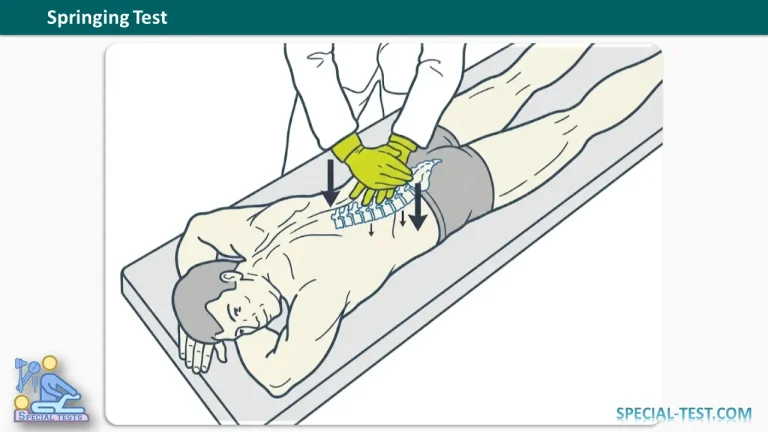
What Is the Springing Test?
The Springing Test, also known as the Lumbar Spring Test or Lumbar Spine Springing Test, is a manual orthopedic examination technique used to assess segmental mobility, mechanical stiffness, and pain provocation in the lumbar spine.
Healthcare professionals, particularly physical therapists, orthopedic clinicians, and other musculoskeletal specialists, use this test as part of a comprehensive assessment of patients with low back pain, restricted spinal mobility, or suspected lumbar segmental dysfunction.
The examination involves applying gentle posterior-to-anterior (PA) pressure over selected lumbar vertebrae to assess their resistance and response to movement. Clinicians evaluate whether the tested segment demonstrates an expected elastic response, reduced mobility (hypomobility), or excessive mobility (hypermobility).
Traditionally, the Springing Test has also been described as a provocative examination for the posterior longitudinal ligament (PLL), an important ligament involved in spinal stability. However, pain reproduced during the test cannot reliably identify the PLL as the specific source of symptoms.
What Is the Purpose of the Springing Test?
The primary purpose of the Springing Test is to identify possible functional impairments affecting individual segments of the lumbar spine.
Its clinical applications include:
- Assessment of lumbar segmental mobility: Evaluating the resistance and elastic response of individual vertebral segments.
- Identification of hypomobility: Detecting areas that appear unusually stiff or demonstrate limited passive movement.
- Assessment of hypermobility: Identifying segments that appear to move more freely than neighboring regions.
- Pain provocation: Determining whether mechanical pressure reproduces the patient’s familiar low back pain.
- Clinical examination planning: Contributing findings that can be compared with other physical examination results.
The Springing Test is commonly included in manual therapy examinations. Nevertheless, findings should be interpreted alongside the patient’s symptoms, medical history, neurological examination, and functional assessment rather than used as an independent diagnosis.
How to Perform the Springing Test
The Springing Test procedure is performed with the patient lying prone on an examination table.
Step-by-Step Examination Technique
- Patient positioning: Ask the patient to lie comfortably in the prone position (face down), with the lumbar muscles relaxed.
- Identify the lumbar segment: The examiner locates the vertebral level being assessed by palpating the posterior spinal landmarks.
- Place the palpating fingers: Position the index and middle fingers over the articular processes or laminae of the selected vertebra.
- Position the opposite hand: Place the ulnar border of the other hand across the palpating fingers, approximately perpendicular to them.
- Apply gentle pressure: Deliver small, controlled, repeated pressures from posterior to anterior (from the back toward the front of the body).
- Assess segmental resistance: Feel how the vertebral region responds to the pressure, including the apparent stiffness, elastic recoil, and movement resistance.
- Evaluate symptom reproduction: Ask the patient whether the pressure produces discomfort or recreates their usual low back pain.
- Compare adjacent levels: Repeat the examination at nearby lumbar segments to identify differences in pain response and perceived mobility.
The examiner should apply pressure gradually and avoid forceful movements. The technique must be adapted to the patient’s symptoms, medical condition, and tolerance.
What Is a Positive Springing Test?
A positive Springing Test generally describes an abnormal response to manual pressure, including altered perceived segmental mobility or reproduction of familiar pain.
Three main findings may be observed.
1. Normal Segmental Mobility
A lumbar segment with an expected mechanical response demonstrates a degree of elastic resistance when gentle pressure is applied.
The examiner perceives controlled movement followed by an appropriate spring-like recoil.
This finding is traditionally interpreted as compatible with normal segmental mobility, particularly when pressure does not reproduce the patient’s familiar symptoms.
2. Reduced Mobility (Hypomobility)
A lumbar segment that feels unusually rigid or demonstrates reduced spring-like resistance may be classified clinically as hypomobile.
In traditional manual examination terminology, marked movement restriction may be described as a segmental blockade.
However, perceived stiffness does not necessarily establish a fixed anatomical restriction or identify its cause.
3. Excessive Mobility (Hypermobility)
A segment that appears to move more readily than adjacent levels, or demonstrates less resistance to applied pressure, may be described as hypermobile.
This observation can raise suspicion of altered spinal movement control or increased segmental motion.
Importantly, perceived hypermobility during manual palpation does not independently confirm structural lumbar instability.
Pain Provocation
Reproduction of the patient’s recognizable low back pain is another clinically relevant finding.
Pain may occur with normal, reduced, or increased perceived mobility. The clinician should document its location, intensity, and similarity to the patient’s usual symptoms.
Springing Test and the Posterior Longitudinal Ligament
The posterior longitudinal ligament (PLL) is a fibrous structure extending along the posterior surfaces of the vertebral bodies within the vertebral canal.
It contributes to spinal stability, helps limit excessive flexion, and is anatomically associated with the intervertebral discs.
Traditional descriptions of the Springing Test suggest that applying posterior-to-anterior pressure may provoke deep, dull, poorly localized lumbar pain associated with the posterior longitudinal ligament.
However, this interpretation has an important limitation.
Pain reproduced by the Springing Test is not specific to posterior longitudinal ligament injury. Multiple spinal structures may contribute to mechanical low back pain, and the test cannot isolate ligament pathology.
Consequently, clinicians should consider posterior longitudinal ligament involvement only as one possible explanation within a broader clinical assessment.
Clinical Accuracy and Reliability of the Springing Test
Although the Springing Test is widely used in musculoskeletal examination, research has identified limitations in the reliability and validity of manual lumbar segmental mobility testing.
A study by Schneider and colleagues, published in the Journal of Manipulative and Physiological Therapeutics, assessed the reliability of springing palpation among patients with low back pain.
The researchers found that:
- Agreement between examiners was poor when assessing segmental motion restriction.
- Pain provocation findings demonstrated fair-to-good interexaminer reliability.
- Identifying painful segments was generally more reproducible than estimating movement restriction.
Similarly, a systematic review by Stolz and colleagues concluded that the available evidence does not support using segmental motion tests independently for diagnosing lumbar dysfunction.
An additional study comparing manual assessments with dynamic magnetic resonance imaging found poor agreement between perceived lumbar mobility and objectively measured intervertebral motion.
These findings emphasize that the Springing Test is best considered a component of the physical examination rather than a definitive diagnostic procedure.
Clinical Precautions
The Springing Test should be performed by a trained healthcare professional who can determine whether manual pressure is appropriate.
Special caution or avoidance may be necessary when the patient has suspected spinal fracture, significant trauma, known spinal infection or malignancy, severe osteoporosis, or other conditions that compromise spinal integrity.
Patients with progressive neurological weakness, saddle anesthesia, or new bladder or bowel dysfunction require urgent medical assessment rather than routine mechanical testing.
The examination should be discontinued if it causes severe pain, neurological symptoms, or substantial worsening of the patient’s condition.
Frequently Asked Questions (FAQs)
1. What is the Springing Test used for?
The Springing Test is primarily used to assess perceived segmental mobility, stiffness, and pain provocation in the lumbar spine. It may help clinicians identify areas requiring further examination.
2. What does a positive Springing Test indicate?
A positive result may involve reduced spring-like movement, excessive perceived mobility, or reproduction of familiar low back pain. These findings suggest a possible mechanical impairment but do not establish a specific diagnosis.
3. How is the Springing Test performed?
The patient lies prone while the examiner applies controlled posterior-to-anterior pressure over selected lumbar vertebral structures. The examiner evaluates resistance, elastic response, and the reproduction of symptoms.
4. Can the Springing Test detect lumbar instability?
The test may identify perceived excessive mobility, but it cannot reliably diagnose structural lumbar instability on its own. Additional clinical assessment and, when appropriate, imaging may be needed.
5. Does the Springing Test examine the posterior longitudinal ligament?
Traditional clinical descriptions associate the test with posterior longitudinal ligament pain provocation. However, there is insufficient evidence that a painful response specifically identifies pathology of this ligament.
6. Is the Springing Test painful?
The examination is generally performed with gentle pressure and may be painless. Patients with mechanical low back pain may experience discomfort or reproduction of their familiar symptoms.
7. How reliable is the Springing Test?
Research suggests that pain provocation findings are generally more reliable between examiners than judgments of segmental stiffness or mobility. Overall, the test has limited value as a stand-alone diagnostic assessment.
8. Is the Springing Test the same as the Prone Instability Test?
No. Although both involve posterior-to-anterior pressure on the lumbar spine, the Prone Instability Test also assesses changes in pain when the patient activates the trunk muscles by lifting the legs. They are different clinical examination procedures.
Conclusion
The Lumbar Spine Springing Test is a manual orthopedic examination technique used to evaluate perceived vertebral mobility, stiffness, and pain reproduction.
A normal response typically involves elastic resistance, while reduced or excessive movement may suggest segmental hypomobility or hypermobility. Reproduction of familiar low back pain can also contribute useful information to the clinical examination.
Although the test has traditionally been associated with assessment of the posterior longitudinal ligament, it cannot independently confirm ligament injury, spinal instability, or a specific source of lumbar pain.
For accurate clinical interpretation, healthcare professionals should combine Springing Test findings with other validated examination procedures, neurological assessment, and the patient’s overall clinical presentation.
References
- OrthoFixar. Springing Test: Procedure, Positive Findings, Posterior Longitudinal Ligament, and Clinical Examination.
https://orthofixar.com/special-test/springing-test/ - Schneider M, Erhard R, Brach J, et al. Spinal palpation for lumbar segmental mobility and pain provocation: An interexaminer reliability study. Journal of Manipulative and Physiological Therapeutics. 2008;31(6):465–473.
https://pubmed.ncbi.nlm.nih.gov/18722203/ - Stolz M, et al. Evidence and recommendations for the use of segmental motion testing for patients with low back pain: A systematic review. Musculoskeletal Science and Practice. 2020;45:102076.
https://pubmed.ncbi.nlm.nih.gov/31733430/ - Landel R, Kulig K, Fredericson M, Li B, Powers CM. Intertester reliability and validity of motion assessments during lumbar spine accessory motion testing. Physical Therapy. 2008.
https://pubmed.ncbi.nlm.nih.gov/18029394/ - Aryal V, Black AC, Jimenez A. Anatomy, Back, Posterior Longitudinal Ligament. StatPearls. NCBI Bookshelf.
https://www.ncbi.nlm.nih.gov/books/NBK560691/ - Hicks GE, Fritz JM, Delitto A, Mishock J. Interrater reliability of clinical examination measures for identification of lumbar segmental instability. Archives of Physical Medicine and Rehabilitation. 2003.
https://pubmed.ncbi.nlm.nih.gov/14669195/ - Tsartsapakis I, Zafeiroudi A, Grivas GV. Clinical Evaluation of Functional Lumbar Segmental Instability: Reliability, Validity, and Subclassification of Manual Tests—A Scoping Review. Journal of Functional Morphology and Kinesiology. 2025;10(4):400.
https://pubmed.ncbi.nlm.nih.gov/41133590/