Shoulder Depression Test: Procedure, Positive Sign & Clinical Significance
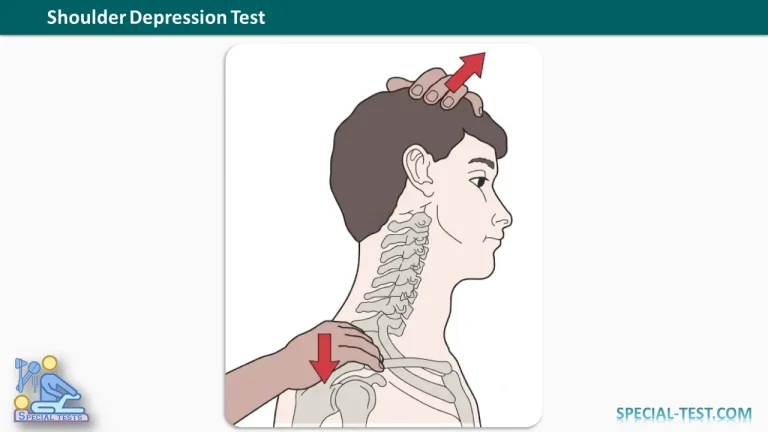
The Shoulder Depression Test is an orthopedic physical examination technique used to assess possible irritation or compression of the cervical nerve roots and brachial plexus. It is commonly performed in patients experiencing neck pain, shoulder discomfort, radiating arm pain, numbness, or tingling.
The test involves lateral flexion of the cervical spine combined with downward pressure on the opposite shoulder. This movement places mechanical tension on neural and surrounding soft-tissue structures, potentially reproducing symptoms associated with cervical radiculopathy, brachial plexopathy, or nerve root irritation.
Although the Shoulder Depression Test can provide useful clinical information, it should be interpreted alongside the patient’s medical history, neurological examination, and other diagnostic findings.
What Is the Shoulder Depression Test Used For?
The primary purpose of the Shoulder Depression Test is to evaluate whether mechanical loading of the cervical nerve roots or brachial plexus reproduces a patient’s neurological symptoms.
It may be included in the assessment of several conditions:
- Cervical radiculopathy: Irritation or dysfunction of a cervical spinal nerve root, potentially producing pain, sensory disturbances, or weakness in the upper extremity.
- Brachial plexopathy: Injury or dysfunction involving the network of nerves supplying the shoulder, arm, and hand.
- Cervical foraminal stenosis: Narrowing of the intervertebral foramina, which may contribute to nerve root compression.
- Cervical spondylosis: Degenerative changes in the cervical spine, including osteophyte formation, that may affect adjacent neural structures.
- Neural mechanosensitivity: Increased sensitivity of nervous tissue to mechanical movement or tension.
The test may also reproduce symptoms associated with restricted or irritated surrounding soft tissues, although these findings are not specific to a particular pathological condition.
How to Perform the Shoulder Depression Test
The Shoulder Depression Test should be performed by a qualified healthcare professional using gentle, controlled movements.
Step-by-Step Procedure
- Patient positioning: Ask the patient to sit comfortably in an upright position, with the shoulders relaxed and arms resting naturally at the sides.
- Examiner positioning: The examiner stands behind or beside the patient, positioning one hand near the head and the other over the shoulder being examined.
- Cervical lateral flexion: Gently side-bend the patient’s head away from the shoulder being tested. For example, when examining the right side, the patient’s head is flexed toward the left.
- Shoulder depression: While maintaining cervical lateral flexion, gently apply downward pressure to the right shoulder. This increases the distance between the neck and shoulder, placing tension on neural and soft-tissue structures on the right.
- Symptom assessment: Observe the patient’s response and ask whether the maneuver reproduces their familiar pain, tingling, numbness, or radiating symptoms.
- Comparison: When appropriate, repeat the examination on the opposite side to compare symptom responses.
The examiner should avoid excessive force and discontinue the procedure if severe pain, significant neurological symptoms, or unusual discomfort occurs.
Clinical example: When the head is side-bent to the left and the right shoulder is depressed, the right-sided cervical nerve roots and brachial plexus are placed under increased tension.
This procedure is described in the orthopedic examination resource published by OrthoFixar. [1]
What Is a Positive Shoulder Depression Test?
A positive Shoulder Depression Test occurs when the maneuver reproduces or increases the patient’s familiar neurological symptoms, particularly radiating pain, tingling, or paresthesia extending from the neck or shoulder into the upper extremity.
A positive response may suggest irritation or increased mechanical sensitivity of the cervical nerve roots or brachial plexus.
Possible contributing conditions include:
- Cervical nerve root irritation associated with disc herniation.
- Foraminal narrowing caused by degenerative changes or osteophytes.
- Brachial plexus irritation or injury.
- Adhesions or restricted mobility of tissues surrounding the nerve roots.
- Reduced mobility of adjacent cervical joints or soft tissues.
Historically, pain provoked during this test has been attributed to compression, adhesions surrounding dural nerve root sleeves, or restricted joint capsules. However, the test cannot independently demonstrate that any of these specific abnormalities is present.
The location and distribution of symptoms are particularly important. Radiating symptoms following a recognizable nerve root distribution are more suggestive of neurological involvement than isolated local neck or trapezius discomfort.
How to Interpret Shoulder Depression Test Results
Interpretation should consider both the side on which symptoms occur and the nature of the reproduced discomfort.
Symptoms on the Stretched Side
When the head moves away from the depressed shoulder, the neural structures on that side experience increased mechanical tension.
Reproduction of familiar radiating arm pain or paresthesia may suggest irritation of the brachial plexus or cervical nerve roots.
Symptoms on the Side of Cervical Lateral Flexion
Lateral flexion may also reduce the dimensions of the intervertebral foramina on the side toward which the head bends.
Consequently, symptoms on that side may be compatible with mechanically sensitive nerve roots, including those affected by degenerative foraminal narrowing.
However, symptoms alone cannot establish the exact anatomical source of irritation.
Dermatome and Myotome Assessment
Dermatomes represent areas of skin supplied predominantly by individual spinal nerve roots, while myotomes describe muscle groups associated with particular nerve roots.
A clinician may assess:
- C5: Shoulder abduction strength and sensation over the lateral upper arm.
- C6: Wrist extension strength and sensation toward the thumb.
- C7: Elbow extension strength and sensation around the middle finger.
- C8: Finger flexion strength and sensation toward the little finger.
- T1: Finger abduction strength and intrinsic hand muscle function.
These findings help identify possible neurological involvement, but dermatomal patterns overlap and cannot always distinguish cervical radiculopathy from brachial plexopathy.
A comprehensive neurological examination includes strength testing, sensory assessment, and deep tendon reflexes. [4,5]
Clinical Significance and Diagnostic Accuracy
The Shoulder Depression Test has historically been used as a provocative examination technique for suspected cervical nerve root and brachial plexus disorders.
However, there is insufficient evidence to establish reliable sensitivity or specificity values for this test.
A systematic review published in the European Spine Journal in 2007 specifically searched for diagnostic studies involving the Shoulder Depression Test but identified no qualifying studies evaluating its diagnostic accuracy. [2]
A more recent systematic review and meta-analysis published in BMC Musculoskeletal Disorders in February 2026 evaluated several physical examination tests for cervical radiculopathy, including Spurling’s test, upper limb neurodynamic tests, and the shoulder abduction relief test. The Shoulder Depression Test was not among the tests evaluated. [3]
Therefore, a positive result should be considered a supportive clinical finding rather than definitive proof of cervical radiculopathy or brachial plexopathy.
Shoulder Depression Test vs. Other Cervical Special Tests
Several examination techniques may be used alongside the Shoulder Depression Test.
Spurling’s Test
Spurling’s test is designed to provoke cervical radicular symptoms through a combination of neck positioning and axial compression. It is commonly used when cervical nerve root compression is suspected.
Upper Limb Tension Test (ULTT)
Also called an upper limb neurodynamic test, the ULTT evaluates the response of peripheral neural structures to controlled movements of the arm, wrist, elbow, and cervical spine.
Shoulder Abduction Relief Test
This test evaluates whether placing the symptomatic hand on or near the head reduces radiating arm pain.
Unlike the Shoulder Depression Test, which attempts to provoke symptoms, the shoulder abduction relief test assesses symptom reduction.
These procedures evaluate different aspects of neural involvement and should not be considered interchangeable.
Limitations and Precautions
The Shoulder Depression Test is not appropriate as a standalone diagnostic tool. Reproduction of symptoms does not reliably identify the exact location or cause of a neurological lesion.
The maneuver should be avoided or deferred when cervical instability, acute cervical trauma, or another serious spinal condition is suspected. Patients with progressive neurological deficits or signs of cervical myelopathy require prompt medical assessment.
When clinical findings remain unclear, further evaluation with MRI, electromyography (EMG), or nerve conduction studies may be appropriate, depending on the suspected diagnosis.
Frequently Asked Questions (FAQ)
1. What does the Shoulder Depression Test assess?
The Shoulder Depression Test assesses symptom responses to mechanical tension involving the cervical nerve roots, brachial plexus, and surrounding tissues. It may help identify possible neural irritation in patients with neck and arm symptoms.
2. What indicates a positive Shoulder Depression Test?
A positive test generally involves reproduction or worsening of familiar radiating pain, numbness, or tingling during cervical lateral flexion and downward shoulder pressure. Localized muscular discomfort alone is less specific.
3. Can the Shoulder Depression Test diagnose cervical radiculopathy?
No. A positive result may support suspicion of cervical nerve root irritation, but it cannot independently confirm cervical radiculopathy. Clinical history, neurological examination, and other investigations may be necessary.
4. What is the difference between the Shoulder Depression Test and Spurling’s Test?
The Shoulder Depression Test uses opposite-side cervical lateral flexion and shoulder depression to increase mechanical tension. Spurling’s test uses cervical positioning and axial compression to provoke symptoms associated with cervical nerve root involvement.
5. Can the Shoulder Depression Test identify brachial plexus injuries?
It may reproduce symptoms associated with brachial plexus irritation, but it cannot confirm a plexus injury or determine its severity. Additional neurological and electrodiagnostic assessment may be required.
6. Is the Shoulder Depression Test painful?
The maneuver may provoke familiar symptoms in patients with mechanically sensitive neural structures. It should be performed gently, without forcing the neck or shoulder into painful positions.
7. What is the sensitivity and specificity of the Shoulder Depression Test?
Reliable sensitivity and specificity values have not been established through adequate diagnostic accuracy studies. Its results should therefore be interpreted cautiously and combined with other clinical findings.
Conclusion
The Shoulder Depression Test is a cervical spine and upper-extremity examination maneuver used to assess potential cervical nerve root irritation and brachial plexus involvement.
It is performed by laterally flexing the patient’s neck while applying downward pressure to the opposite shoulder. Reproduction of familiar radiating pain, numbness, or tingling may indicate neural mechanosensitivity.
However, because its diagnostic accuracy remains insufficiently established, the Shoulder Depression Test should be used as part of a comprehensive clinical examination rather than as an isolated diagnostic procedure.
References
- OrthoFixar. Shoulder Depression Test: Purpose, Procedure, and Interpretation. Updated May 2024.
https://orthofixar.com/special-test/shoulder-depression-test/ - Rubinstein SM, Pool JJM, van Tulder MW, et al. A systematic review of the diagnostic accuracy of provocative tests of the neck for diagnosing cervical radiculopathy. European Spine Journal. 2007;16(3):307–319.
https://pubmed.ncbi.nlm.nih.gov/17013656/ - Thoomes EJ, Arvanitidis M, van Geest S, et al. Diagnostic accuracy of physical examination tests for painful cervical radiculopathy: update of a systematic review and meta-analysis. BMC Musculoskeletal Disorders. 2026;27:338.
https://pubmed.ncbi.nlm.nih.gov/41680685/ - Margetis K, Magnus W, Mesfin FB. Cervical Radiculopathy. StatPearls. NCBI Bookshelf. Updated August 2025.
https://www.ncbi.nlm.nih.gov/books/NBK441828/ - NCBI Bookshelf. Electrodiagnostic Evaluation of Cervical Radiculopathy. StatPearls.
https://www.ncbi.nlm.nih.gov/books/NBK563152/ - Wainner RS, Fritz JM, Irrgang JJ, et al. Reliability and diagnostic accuracy of the clinical examination and patient self-report measures for cervical radiculopathy. Spine. 2003;28(1):52–62.
https://pubmed.ncbi.nlm.nih.gov/12544957/