Shoulder Abduction Test (Bakody Sign): Procedure & Accuracy
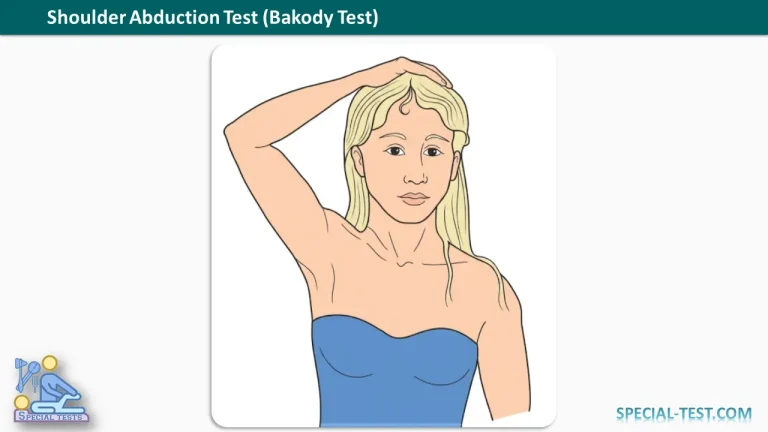
What Is the Shoulder Abduction Test (Bakody Test)?
The Shoulder Abduction Test, also known as the Bakody Test, Bakody Sign, or Shoulder Abduction Relief Test, is a clinical examination maneuver used to evaluate patients with suspected cervical radiculopathy or cervical nerve root irritation.
The test assesses whether placing the affected arm over the head reduces radiating pain, numbness, or tingling associated with cervical nerve root compression.
The Bakody Test is particularly useful during the examination of patients with neck pain radiating into the shoulder, arm, or hand. It may provide additional diagnostic information when cervical disc herniation, degenerative cervical spine disease, or narrowing of the neural foramina is suspected.
Although some clinical descriptions associate the test primarily with C4–C6 nerve root irritation, the shoulder abduction relief sign can also occur with lower cervical nerve root involvement, including C7. Importantly, the test cannot independently identify the exact affected nerve root.
The maneuver may also help clinicians consider thoracic outlet syndrome (TOS) when overhead arm positioning aggravates symptoms rather than relieving them.
How to Perform the Shoulder Abduction Test (Bakody Test)
The Bakody Test is a simple clinical examination that can be performed without specialized equipment.
Patient Position
The patient is usually seated or standing comfortably, although the maneuver can also be performed in a supine position.
Test Procedure
- Ask the patient to sit upright with the neck and shoulders relaxed.
- Identify the symptomatic arm and document the patient’s initial pain, numbness, or tingling.
- Instruct the patient to abduct the affected shoulder, raising the arm laterally toward approximately 90 degrees.
- Flex the elbow and ask the patient to place the palm of the hand on the top of the head or behind the head.
- Allow the patient to maintain this position for approximately 30 seconds, provided it is comfortable.
- Observe whether the patient’s radiating arm symptoms improve, disappear, remain unchanged, or worsen.
The examiner can assist with passive shoulder abduction if the patient cannot comfortably perform the movement independently.
The procedure should be performed gently, without forcing the shoulder into a painful position.
What Is a Positive Shoulder Abduction Test?
A positive Bakody Test occurs when the patient’s familiar radicular symptoms decrease or completely resolve after placing the affected hand on the head.
Symptoms that may improve include:
- Radiating neck-to-arm pain.
- Tingling or pins-and-needles sensations.
- Arm discomfort associated with cervical nerve root irritation.
- Subjective numbness or other positional sensory symptoms.
This improvement suggests that the shoulder abduction position modifies mechanical loading or tension around the irritated cervical nerve roots.
Why Does Shoulder Abduction Relieve Cervical Radicular Pain?
Shoulder abduction changes the position of the upper limb, shoulder girdle, and brachial plexus.
Placing the hand on the head may reduce mechanical tension transmitted to certain cervical nerve roots, temporarily relieving irritation associated with nerve root compression.
This mechanism helps explain why some patients with cervical radiculopathy naturally place their hand on their head to reduce arm pain.
However, a positive result is a supportive clinical finding rather than definitive proof of cervical disc herniation or nerve root compression.
Which Cervical Nerve Roots Are Evaluated?
The Shoulder Abduction Test has traditionally been described in association with C4, C5, and C6 nerve root irritation, but symptom relief may also occur in patients with C7 involvement.
The affected nerve root is better identified by combining the test findings with the neurological examination.
For example:
- C5 nerve root: Shoulder or lateral upper-arm pain, potentially accompanied by deltoid weakness.
- C6 nerve root: Pain or tingling extending toward the thumb, sometimes accompanied by wrist extension weakness or reduced brachioradialis reflex.
- C7 nerve root: Symptoms extending toward the middle finger, potentially associated with triceps weakness or a diminished triceps reflex.
Dermatomal distributions can overlap, and symptoms do not always follow textbook patterns. Therefore, muscle strength, sensation, tendon reflexes, and other examination findings are necessary for accurate clinical assessment.
Shoulder Abduction Test and Thoracic Outlet Syndrome
The Bakody Test may also provide information during the differential diagnosis of thoracic outlet syndrome (TOS), a condition involving compression or irritation of neurovascular structures passing between the neck and upper limb.
In cervical radiculopathy, placing the hand on the head may relieve symptoms.
By contrast, some patients with thoracic outlet syndrome experience increased pain, numbness, tingling, or arm heaviness during overhead positioning.
This difference can be clinically helpful, but symptom aggravation during the Bakody maneuver does not establish a diagnosis of thoracic outlet syndrome.
Thoracic outlet symptoms can be associated with abnormalities involving the scalene muscles, first rib, cervical rib, or surrounding anatomical structures.
Additional evaluation, including the Elevated Arm Stress Test (Roos Test), appropriate neurological examination, and selected imaging studies, may be necessary when TOS is suspected.
Shoulder Abduction Test Sensitivity and Specificity
The diagnostic accuracy of the Shoulder Abduction Test varies across studies, reflecting differences in patient populations, examination techniques, and diagnostic reference standards.
Earlier studies reported widely varying results, including:
- Sensitivity: Approximately 17–78%.
- Specificity: Approximately 75–92%.
A more recent systematic review and meta-analysis published in 2026 reported the following pooled estimates:
| Diagnostic measure | Result |
|---|---|
| Sensitivity | 49% |
| Specificity | 76% |
| Positive likelihood ratio (LR+) | 2.08 |
| Negative likelihood ratio (LR−) | 0.66 |
The review evaluated the shoulder abduction test across two diagnostic accuracy studies and rated the certainty of evidence as very low.
Clinical Interpretation
Sensitivity describes the proportion of patients with cervical radiculopathy who have a positive test.
A pooled sensitivity of 49% suggests that the test may fail to identify a substantial proportion of patients with the condition. Therefore, a negative Bakody Test cannot reliably exclude cervical radiculopathy.
Specificity describes the proportion of patients without the condition who have a negative result.
A pooled specificity of 76% indicates that symptom relief provides some diagnostic information, but false-positive results remain possible.
Consequently, the Shoulder Abduction Test should be interpreted alongside patient history, neurological examination, and other cervical spine examination maneuvers.
Clinical Significance of the Bakody Sign
The Shoulder Abduction Relief Test is particularly useful because it assesses symptom reduction rather than provoking pain.
It can be incorporated into a comprehensive cervical spine examination alongside:
- Spurling Test.
- Cervical Distraction Test.
- Upper Limb Tension Test.
- Muscle strength, reflex, and sensory assessments.
A positive finding increases clinical suspicion of cervical radiculopathy when it agrees with the patient’s symptoms and neurological findings.
If significant or progressive neurological deficits, red flags, or persistent symptoms are present, further evaluation may include cervical spine magnetic resonance imaging (MRI) or electrodiagnostic studies.
The Bakody Test should not be used as a standalone diagnostic investigation.
Frequently Asked Questions (FAQs)
1. What is the Shoulder Abduction Test used for?
The Shoulder Abduction Test is primarily used to assess suspected cervical radiculopathy. It identifies whether placing the affected hand on the head reduces radiating arm symptoms associated with cervical nerve root irritation.
2. What does a positive Bakody Sign indicate?
A positive Bakody Sign occurs when radiating arm pain or related symptoms improve or disappear with shoulder abduction. This finding supports the possibility of cervical nerve root irritation or compression but does not confirm a diagnosis independently.
3. Which cervical nerve roots are assessed by the Bakody Test?
The maneuver is commonly described in relation to the C4–C6 nerve roots, although relief may occur with C7 or other lower cervical nerve root involvement. The exact level must be assessed through neurological findings and, when appropriate, imaging.
4. Can the Shoulder Abduction Test diagnose a cervical disc herniation?
No. A positive test can support suspicion of cervical radiculopathy caused by a disc herniation, but it cannot establish the structural cause. MRI may be indicated when symptoms persist, neurological deficits progress, or concerning clinical features are identified.
5. What is the difference between the Bakody Test and Spurling Test?
The Bakody Test evaluates whether shoulder abduction relieves radicular symptoms. In contrast, the Spurling Test attempts to reproduce familiar radiating symptoms through cervical positioning and compression. Both tests contribute different information to the assessment of cervical radiculopathy.
6. Can the Bakody Test help identify thoracic outlet syndrome?
Worsening symptoms during overhead arm positioning may raise suspicion of thoracic outlet syndrome. However, the Bakody Test is not a validated standalone diagnostic test for TOS, and additional clinical assessment is required.
7. What does a negative Shoulder Abduction Test mean?
A negative result means that placing the hand on the head does not produce meaningful relief of the patient’s symptoms. Because the test has limited sensitivity, a negative result does not rule out cervical radiculopathy.
8. Is the Shoulder Abduction Test reliable?
The test is clinically useful as part of a broader examination, but its diagnostic accuracy is limited. Evidence from a 2026 systematic review indicates that findings should be interpreted cautiously and combined with other clinical information.
Conclusion
The Shoulder Abduction Test (Bakody Test) is a straightforward orthopedic examination maneuver used primarily to assess suspected cervical radiculopathy.
A positive test is characterized by relief of radiating arm pain or other radicular symptoms when the affected hand is placed on the head.
Although the maneuver can support clinical suspicion of cervical nerve root irritation, its limited sensitivity means that a negative result cannot exclude cervical radiculopathy.
For accurate diagnosis, clinicians should combine the Bakody Test with a comprehensive neurological examination, other cervical spine special tests, and appropriate diagnostic investigations when indicated.
References
- Orthofixar. Shoulder Abduction Test (Bakody Sign). Updated March 2025.
- Thoomes EJ, et al. Diagnostic accuracy of physical examination tests for painful cervical radiculopathy: update of a systematic review and meta-analysis. BMC Musculoskeletal Disorders. 2026.
- Rubinstein SM, et al. A systematic review of the diagnostic accuracy of provocative tests of the neck for diagnosing cervical radiculopathy. European Spine Journal. 2007;16(3):307–319.
- Davidson RI, Dunn EJ, Metzmaker JN. The shoulder abduction test in the diagnosis of radicular pain in cervical extradural compressive monoradiculopathies. Spine. 1981;6(5):441–446.
- Fast A, Parikh S, Marin EL. The shoulder abduction relief sign in cervical radiculopathy. Archives of Physical Medicine and Rehabilitation. 1989;70(5):402–403.
- Childress MA, Becker BA. Nonoperative Management of Cervical Radiculopathy. American Family Physician. 2016;93(9):746–754.
- Chim H, Hagan RR, INTOS Workgroup. Consensus Recommendations for Neurogenic Thoracic Outlet Syndrome. Plastic and Reconstructive Surgery – Global Open. 2024;12(8).
- A Clinical Review of Hand Manifestations of Cervical Myelopathy, Cervical Radiculopathy, and Peripheral Nerve Neuropathies. PubMed Central, 2024.