Goldthwait Test: Purpose, Procedure, Positive Results, and Clinical Significance
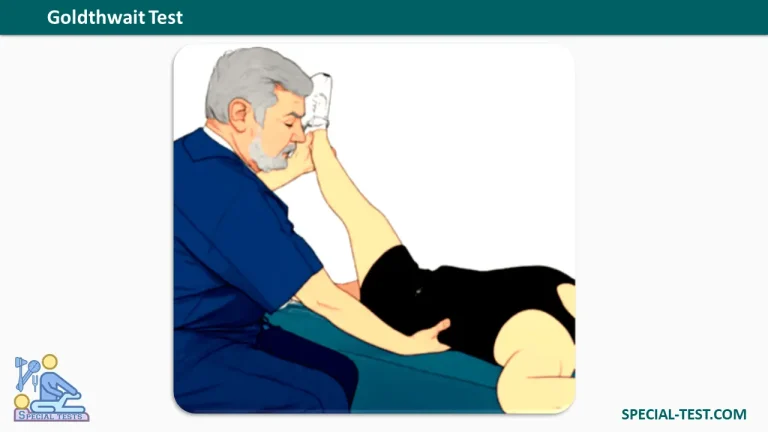
The Goldthwait Test is an orthopedic physical examination technique used to help differentiate sacroiliac (SI) joint dysfunction from lumbar spine pathology in patients experiencing low back pain, buttock pain, or posterior pelvic discomfort.
The test combines a passive Straight Leg Raise (SLR) maneuver with palpation of the lumbar interspinous spaces. By observing when pain develops in relation to lumbar spine movement, clinicians can obtain additional information about the possible anatomical source of a patient’s symptoms.
The Goldthwait Test may also reveal symptoms suggestive of lumbosacral nerve root irritation, particularly when pain radiates from the lower back or buttock into the lower extremity.
However, the test should be considered a supplementary clinical examination technique rather than a definitive diagnostic procedure. Its individual diagnostic accuracy has not been established by the research cited below.
What Is the Purpose of the Goldthwait Test?
The primary purpose of the Goldthwait Test is to assist healthcare professionals in distinguishing between two potential sources of low back pain:
- Sacroiliac joint pain: Pain originating from the SI joint or surrounding structures, often experienced around the posterior pelvis, buttock, or lower back.
- Lumbar spine pathology: Pain potentially associated with lumbar intervertebral discs, facet joints, or other spinal structures.
The Goldthwait Test may also help identify symptoms compatible with lumbar radiculopathy, particularly when leg elevation reproduces shooting pain, tingling, or radiating discomfort along a nerve root distribution.
The test is traditionally used as part of the orthopedic examination of patients with mechanical low back pain and suspected lumbopelvic dysfunction.
How to Perform the Goldthwait Test
The Goldthwait Test procedure involves a combination of lumbar spine palpation and passive straight-leg elevation.
Patient Position
- The patient lies in a supine position (face upward) on a firm examination table.
- Both lower limbs should remain relaxed and extended.
- The examiner stands alongside the patient, allowing access to the lumbar spine and the lower extremity being tested.
Examiner Position and Technique
Step 1: Palpate the lumbar interspinous spaces
The examiner places one hand underneath the patient’s lower back, positioning the fingertips within successive lumbar interspinous spaces, typically:
- L5–S1
- L4–L5
- L3–L4
- L2–L3
This position allows the examiner to monitor palpable movement between adjacent lumbar spinous processes during the test.
Step 2: Perform a passive Straight Leg Raise
Using the opposite hand, the examiner slowly raises the patient’s lower extremity while maintaining the knee in extension.
The leg should be elevated progressively without sudden or forceful movement.
Step 3: Monitor lumbar spine movement
During leg elevation, the examiner continuously palpates the lumbar interspinous spaces to identify when lumbar movement begins.
Step 4: Observe the onset and distribution of pain
The examiner records:
- Whether pain appears before or during palpable lumbar movement.
- The location and intensity of the patient’s symptoms.
- Whether pain remains localized or radiates into the lower extremity.
- The approximate angle of hip flexion at which symptoms develop.
The examination may be repeated on the opposite leg to compare findings.
What Is a Positive Goldthwait Test?
A positive Goldthwait Test traditionally refers to reproduction of the patient’s familiar pain during straight-leg elevation. Interpretation depends primarily on the relationship between pain onset and lumbar spine movement.
1. Pain Before Lumbar Spine Movement: Possible SI Joint Involvement
If the patient experiences pain before the examiner detects lumbar interspinous movement, the traditional interpretation suggests a possible sacroiliac joint source.
Clinical explanation: During the early phase of passive leg elevation, mechanical stress may be transmitted through the pelvic region and sacroiliac joint before appreciable lumbar movement occurs.
Pain during this phase may raise suspicion of SI joint involvement, particularly when symptoms are localized around the posterior pelvis or buttock.
Nevertheless, this finding cannot independently establish an SI joint diagnosis. Other musculoskeletal structures may also contribute to pain during leg elevation.
2. Pain During Lumbar Spine Movement: Possible Lumbar Pathology
If pain develops as palpable movement occurs between the lumbar spinous processes, the traditional interpretation suggests that the symptoms may originate from the lumbar spine.
Potential conditions considered in the differential diagnosis include:
- Lumbar facet joint pain: Pain associated with structures surrounding the lumbar facet joints.
- Intervertebral disc pathology: Disc-related pain or other disc abnormalities.
- Lumbar segmental instability: Abnormal motion or impaired mechanical control involving lumbar spinal segments.
Although these conditions may be suspected, the Goldthwait Test cannot reliably distinguish between them or confirm an individual anatomical lesion.
3. Radiating Pain Along the Sciatic Nerve Distribution: Possible Neural Involvement
If straight-leg elevation reproduces radiating pain extending from the buttock into the lower extremity, the finding may suggest lumbosacral nerve root irritation.
Possible causes include:
- Lumbar disc herniation
- Lumbosacral radiculopathy
- Other conditions affecting the lumbar or sacral nerve roots
This response resembles findings associated with the conventional Straight Leg Raise Test, which is used to evaluate possible lumbosacral nerve root irritation.
According to the NCBI Bookshelf review of the Straight Leg Raise Test, reproduction of characteristic radiating leg pain during passive elevation can contribute to the assessment of nerve root involvement.
However, isolated hamstring tightness or nonspecific posterior thigh discomfort should not automatically be interpreted as radiculopathy.
Goldthwait Test Interpretation: Summary Table
| Clinical Finding | Traditional Interpretation |
|---|---|
| Pain before lumbar interspinous movement | Possible sacroiliac joint involvement |
| Pain during palpable lumbar movement | Possible lumbar spine pathology |
| Radiating pain along a nerve root distribution | Possible lumbosacral nerve root irritation |
| No reproduction of familiar pain | Negative test; does not exclude lumbar or SI joint pathology |
Clinical Significance of the Goldthwait Test
The Goldthwait Test can serve as an additional assessment technique during the evaluation of low back pain and sacroiliac joint dysfunction.
However, clinicians should interpret findings alongside the patient’s medical history, neurological examination, lumbar range of motion, pain distribution, and results from other physical examination maneuvers.
Other commonly used examination tests include:
- Straight Leg Raise Test: Evaluates symptoms suggestive of lumbosacral nerve root irritation.
- FABER Test: Assesses pain provoked by hip flexion, abduction, and external rotation.
- Gaenslen’s Test: Applies mechanical stress across the pelvic region and SI joints.
- Sacral Thrust Test: Provokes familiar pain through posterior-to-anterior pressure applied to the sacrum.
- Thigh Thrust Test: Assesses SI joint-related pain through a directed force transmitted along the femur.
Importantly, clinical research does not support diagnosing SI joint pain from a single examination finding alone.
A systematic review and meta-analysis published in the Journal of Orthopaedic & Sports Physical Therapy in 2021 found that even clusters of SI joint pain provocation tests have limited ability to confirm SI joint pain, although negative test clusters can be more useful for reducing suspicion of the condition.
Consequently, Goldthwait Test findings should guide further clinical assessment rather than be treated as diagnostic proof.
Frequently Asked Questions (FAQs)
1. What is the Goldthwait Test used for?
The Goldthwait Test is traditionally used to help distinguish sacroiliac joint-related pain from lumbar spine pathology. It may also reproduce symptoms associated with lumbosacral nerve root irritation.
2. How do you perform the Goldthwait Test?
The patient lies supine while the examiner places one hand beneath the lumbar spine to palpate interspinous movement. With the other hand, the examiner gradually raises the patient’s straight leg and observes when pain occurs relative to lumbar movement.
3. What does a positive Goldthwait Test indicate?
A positive result indicates reproduction of familiar symptoms during the maneuver. Pain occurring before palpable lumbar movement traditionally suggests SI joint involvement, whereas pain during lumbar movement suggests a possible lumbar source. Neither finding is diagnostic by itself.
4. What is the difference between the Goldthwait Test and the Straight Leg Raise Test?
The Straight Leg Raise Test primarily assesses possible lumbosacral nerve root irritation by reproducing radiating leg symptoms during passive leg elevation.
The Goldthwait Test incorporates the same general leg-raising maneuver but adds palpation of lumbar interspinous movement to help interpret the possible source of pain.
5. Can the Goldthwait Test diagnose a herniated lumbar disc?
No. The Goldthwait Test cannot independently diagnose lumbar disc herniation. Radiating leg pain may prompt further neurological examination and, when clinically appropriate, additional investigations such as MRI.
6. Is the Goldthwait Test reliable for diagnosing sacroiliac joint dysfunction?
The diagnostic reliability and accuracy of the Goldthwait Test itself are not well established in the cited literature. Published research on other SI joint examination techniques demonstrates limitations, especially when individual tests are used in isolation.
7. Who should perform the Goldthwait Test?
The test should be performed by a trained healthcare professional, such as a physician or physical therapist, familiar with lumbar spine examinations and neurological assessment. Painful or forceful testing should be avoided.
Conclusion
The Goldthwait Test is a traditional orthopedic examination maneuver intended to help differentiate sacroiliac joint pain from lumbar spine pathology by comparing the onset of pain with palpable lumbar movement during passive straight-leg elevation.
Pain occurring before lumbar movement may suggest SI joint involvement, whereas pain arising during lumbar movement may indicate a lumbar source. Radiating leg pain can also raise suspicion of nerve root irritation.
Despite its traditional clinical applications, the Goldthwait Test should not be used as a standalone diagnostic tool. Combining examination findings with an appropriate medical history, neurological evaluation, and other validated clinical assessments provides a more reliable approach to identifying the potential causes of low back pain.
References
- OrthoFixar. Goldthwait Test: Differentiating Lumbar Spine Pathology From SI Joint Pain. https://orthofixar.com/special-test/goldthwait-test/
- Camino Willhuber GO, Piuzzi NS. Straight Leg Raise Test. StatPearls. NCBI Bookshelf. https://www.ncbi.nlm.nih.gov/books/NBK539717/
- Saueressig T, Owen PJ, Diemer F, Zebisch J, Belavy DL. Diagnostic Accuracy of Clusters of Pain Provocation Tests for Detecting Sacroiliac Joint Pain: Systematic Review With Meta-analysis. J Orthop Sports Phys Ther. 2021;51(9):422–431. https://pubmed.ncbi.nlm.nih.gov/34210160/
- Huijbregts P. Evidence-Based Diagnosis and Treatment of the Painful Sacroiliac Joint. J Man Manip Ther. 2008. https://pmc.ncbi.nlm.nih.gov/articles/PMC2582421/
- Schneider BJ, et al. Validity of Physical Exam Maneuvers in the Diagnosis of Sacroiliac Joint Pathology. Pain Med. 2020;21(2):255–260. https://pubmed.ncbi.nlm.nih.gov/31393577/
- Successful Diagnosis of Sacroiliac Joint Dysfunction. PubMed, PMID: 34675642. https://pubmed.ncbi.nlm.nih.gov/34675642/