Thigh Thrust Test: Procedure, Positive Sign & Accuracy
What Is the Thigh Thrust Test?
The Thigh Thrust Test is a clinical orthopedic examination maneuver used to assess pain originating from the sacroiliac (SI) joint. It is a pain provocation test commonly performed during the physical examination of patients presenting with lower back pain, buttock pain, or suspected sacroiliac joint dysfunction.
The test is also known as the:
- Posterior Shear Test
- Posterior Pelvic Provocation Test
- SI Joint Thigh Thrust Test
The primary purpose of the test is to reproduce the patient’s familiar pain by applying a controlled posteriorly directed force through the femur, creating a shearing stress across the sacroiliac joint.
The Thigh Thrust Test is frequently included in a cluster of sacroiliac joint provocation tests because no single physical examination maneuver can reliably confirm SI joint pain.
Importantly, sacroiliac joint pain and sacroiliac joint dysfunction are not identical concepts. SI joint pain describes symptoms arising from the joint region, whereas dysfunction generally refers to altered joint movement or positioning. The Thigh Thrust Test primarily evaluates pain reproduction rather than directly measuring joint movement.
What Is the Thigh Thrust Test Used For?
The Thigh Thrust Test for SI joint pain helps clinicians investigate whether the sacroiliac joint may contribute to a patient’s symptoms.
The sacroiliac joints connect the sacrum to the iliac bones of the pelvis. These joints provide stability and help transfer forces between the spine and lower extremities.
Sacroiliac joint-related pain may occur in the lower back, posterior pelvis, or buttock and can sometimes extend into the thigh.
Clinicians may use the Thigh Thrust Test when evaluating patients with:
- Persistent lower back pain.
- Unilateral or bilateral buttock pain.
- Pain localized around the posterior pelvic region.
- Suspected sacroiliac joint-mediated pain.
- Pregnancy-related pelvic girdle pain.
- Chronic lumbopelvic pain of uncertain origin.
The examination helps reproduce symptoms and identify possible pain generators. However, a positive result does not independently establish the diagnosis.
How to Perform the Thigh Thrust Test
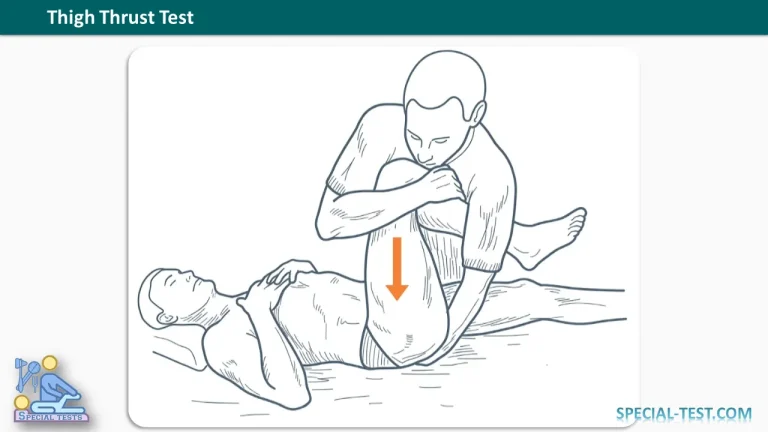
The Thigh Thrust Test is performed with the patient lying in the supine position on an examination table.
Patient Position
The patient lies comfortably on their back, with the pelvis supported by the examination table.
The examiner flexes the hip and knee of the tested side to approximately 90 degrees. The hip may be positioned in slight adduction to facilitate the application of force through the femur.
Examiner Position and Procedure
- Position the patient: Ask the patient to lie supine with the lower extremities initially relaxed.
- Flex the hip and knee: Bring the hip of the tested side into approximately 90 degrees of flexion, keeping the knee bent.
- Stabilize the pelvis: Place one hand beneath the sacrum or posterior pelvis to provide support and counterpressure.
- Position the opposite hand: Place the other hand over the flexed knee or along the femoral axis to control the direction of the applied force.
- Apply posterior pressure: Gradually direct a controlled force through the longitudinal axis of the femur toward the examination table, creating a posterior shearing stress across the SI joint.
- Assess pain reproduction: Ask whether the maneuver reproduces the patient’s familiar pain and identify its precise location.
- Compare sides when appropriate: The procedure may be repeated on the opposite side to compare symptom responses.
An alternative technique involves stabilizing the contralateral anterior superior iliac spine (ASIS) while applying longitudinal pressure through the flexed femur.
Clinical tip: Pressure should be gradual and controlled. The objective is to reproduce familiar symptoms, not to perform a high-velocity manipulation or forcefully push the hip beyond its comfortable range.
What Is a Positive Thigh Thrust Test?
A positive Thigh Thrust Test occurs when the applied posterior shearing force reproduces the patient’s familiar pain in the sacroiliac joint region.
The characteristic finding is:
Reproduction of familiar, well-localized pain deep in the buttock or posterior pelvic region on the tested side.
Pain may be felt around or immediately below the posterior superior iliac spine.
The examiner should distinguish reproduction of the patient’s usual symptoms from nonspecific discomfort caused by pressure or positioning.
A negative test occurs when the maneuver does not reproduce the patient’s familiar sacroiliac region pain.
Clinical Interpretation
A positive test suggests that structures in the sacroiliac region may contribute to the patient’s symptoms. Nevertheless, other conditions, including lumbar spine disorders and hip pathology, may produce overlapping pain patterns.
Therefore, test findings should be interpreted alongside the clinical history, pain distribution, neurological assessment, hip examination, and additional SI joint provocation tests.
Thigh Thrust Test Sensitivity and Specificity
The diagnostic accuracy of the Thigh Thrust Test varies considerably across published studies.
Two important measures are:
- Sensitivity: The ability of the test to identify patients who have the target condition.
- Specificity: The ability of the test to correctly identify patients who do not have the target condition.
Reported Diagnostic Accuracy
| Study | Sensitivity | Specificity |
|---|---|---|
| Ozgocmen et al. (2008), as summarized by Orthofixar | 55% | 70% |
| Laslett et al. (2005) | 88% | 69% |
| Nejati et al. (2020) | 74.4% | 44.4% |
The 55% sensitivity and 70% specificity figures reported by Orthofixar relate to research investigating pain provocation tests in patients with chronic low back pain and early active sacroiliitis.
Laslett and colleagues reported a sensitivity of 88% and specificity of 69% for the thigh thrust maneuver in their investigation of SI joint pain.
In another study, Nejati and colleagues reported 74.4% sensitivity and 44.4% specificity.
These differences reflect variations in study populations, examination methods, diagnostic reference standards, and definitions of a positive diagnosis. Studies of inflammatory sacroiliitis are also not directly interchangeable with studies of SI joint-mediated pain.
Consequently, the Thigh Thrust Test should not be assigned one universal sensitivity or specificity value.
How Reliable Is the Thigh Thrust Test?
Although the Thigh Thrust Test is useful in clinical assessment, its diagnostic value is limited when performed alone.
The reliability of the examination depends partly on standardized technique and consistent interpretation of pain reproduction.
Research generally supports combining several SI joint provocation maneuvers rather than relying on one isolated finding.
Commonly used additional examinations include:
- SI Joint Distraction Test: Applies separating stress across the anterior pelvis.
- SI Joint Compression Test: Applies compressive loading through the pelvis.
- Sacral Thrust Test: Applies anterior pressure over the sacrum while the patient lies prone.
- Gaenslen’s Test: Stresses the pelvis by positioning the hips in opposing directions.
- FABER Test: Evaluates pain reproduction with hip flexion, abduction, and external rotation.
A commonly used clinical approach evaluates whether at least three of five SI joint provocation tests reproduce familiar pain.
However, evidence has evolved regarding the accuracy of these clusters.
A 2021 systematic review and meta-analysis found that positive SI joint provocation test clusters have limited ability to definitively confirm SI joint pain. Negative clusters were more useful for decreasing the likelihood that the SI joint was the primary pain source.
This supports using the Thigh Thrust Test as part of a comprehensive musculoskeletal examination rather than as a standalone diagnostic procedure.
Limitations of the Thigh Thrust Test
Several factors limit the diagnostic interpretation of the test.
First, the maneuver places mechanical stress across several structures of the posterior pelvis, so symptom reproduction does not necessarily isolate the sacroiliac joint itself.
Second, patients with lumbar spine disorders, hip conditions, or other causes of posterior pelvic pain may experience similar symptoms.
Third, diagnostic accuracy varies depending on patient selection and the reference standard used in research.
Finally, the test cannot reliably determine the precise anatomical pathology responsible for pain or distinguish every inflammatory condition from mechanical joint-related pain.
When the diagnosis remains uncertain, clinicians may consider additional investigations according to the patient’s clinical presentation. In selected cases, image-guided diagnostic SI joint injections may help evaluate the joint as a source of pain.
Frequently Asked Questions (FAQ)
1. What does the Thigh Thrust Test assess?
The Thigh Thrust Test assesses whether applying a posterior shearing force through the femur reproduces pain associated with the sacroiliac joint region. It is mainly used during the evaluation of suspected SI joint-mediated lower back or buttock pain.
2. What indicates a positive Thigh Thrust Test?
The test is positive when the maneuver reproduces the patient’s familiar, localized pain in the posterior pelvis or deep buttock region on the tested side. General discomfort without reproduction of familiar symptoms is less diagnostically meaningful.
3. What is the sensitivity and specificity of the Thigh Thrust Test?
Orthofixar reports sensitivity of 55% and specificity of 70% from a study evaluating early active sacroiliitis. Other published findings include sensitivity of 88% and specificity of 69% in Laslett et al. (2005). Values depend on the population and diagnostic reference standard.
4. Can the Thigh Thrust Test diagnose SI joint dysfunction?
No. A positive test alone cannot definitively diagnose sacroiliac joint dysfunction or confirm the SI joint as the source of pain. Clinicians interpret the result together with other provocation tests, clinical history, and examination findings.
5. What is the difference between the Thigh Thrust Test and Sacral Thrust Test?
Both are sacroiliac joint pain provocation maneuvers, but they differ in technique. The Thigh Thrust Test is performed with the patient supine and applies force through the femur. The Sacral Thrust Test is performed with the patient prone and applies anteriorly directed pressure over the sacrum.
6. Is the Thigh Thrust Test painful?
The examination may reproduce existing pain in patients with sacroiliac region symptoms. The examiner should apply controlled pressure and stop if the maneuver causes excessive discomfort. The test should be performed by a trained healthcare professional.
7. Is the Thigh Thrust Test more accurate than the FABER Test?
Neither test is consistently superior across all research. Some studies report higher sensitivity for the Thigh Thrust Test, while others identify comparatively greater specificity for the FABER Test. Using multiple complementary clinical tests is generally more informative than relying on either maneuver alone.
Conclusion
The Thigh Thrust Test, also known as the Posterior Shear Test or Posterior Pelvic Provocation Test, is an important orthopedic examination maneuver used to evaluate suspected sacroiliac joint pain.
It involves positioning the patient supine, flexing the tested hip to approximately 90 degrees, stabilizing the pelvis, and applying a posteriorly directed force through the femur.
A positive result reproduces the patient’s familiar pain in the sacroiliac joint region or deep buttock.
Although the test has demonstrated clinically useful sensitivity in some studies, its specificity and overall diagnostic performance vary. The most appropriate application is as part of a broader clinical assessment that combines medical history, physical examination, and additional SI joint provocation tests.
References
- OrthoFixar. Thigh Thrust Test for SI Joint Dysfunction: Sensitivity, Specificity & Procedure.
https://orthofixar.com/special-test/thigh-thrust-test/ - Ozgocmen S, Bozgeyik Z, Kalcik M, Yildirim A. The value of sacroiliac pain provocation tests in early active sacroiliitis. Clinical Rheumatology. 2008;27(10):1275–1282.
PubMed – PMID: 18458988 - Laslett M, Aprill CN, McDonald B, Young SB. Diagnosis of sacroiliac joint pain: validity of individual provocation tests and composites of tests. Manual Therapy. 2005;10(3):207–218.
PubMed – PMID: 16038856 - Nejati P, Sartaj E, Imani F, et al. Accuracy of the Diagnostic Tests of Sacroiliac Joint Dysfunction. Journal of Chiropractic Medicine. 2020;19(1):28–37.
NCBI PubMed Central – PMC7646135 - Stuber KJ. Specificity, sensitivity, and predictive values of clinical tests of the sacroiliac joint: a systematic review of the literature. Journal of the Canadian Chiropractic Association. 2007;51(1):30–41.
NCBI PubMed Central – PMC1924656 - Saueressig T, Owen PJ, Diemer F, Zebisch J, Belavy DL. Diagnostic Accuracy of Clusters of Pain Provocation Tests for Detecting Sacroiliac Joint Pain: Systematic Review With Meta-analysis. Journal of Orthopaedic & Sports Physical Therapy. 2021;51(9):422–431.
PubMed – PMID: 34210160 - Laslett M. Evidence-based diagnosis and treatment of the painful sacroiliac joint. Journal of Manual & Manipulative Therapy. 2008;16(3):142–152.
PubMed – PMID: 19119403 - NCBI Bookshelf – StatPearls. Sacroiliac Joint Pain.
https://www.ncbi.nlm.nih.gov/books/NBK470299/