Bowstring Test: Purpose, Procedure, Positive Sign & Clinical Significance
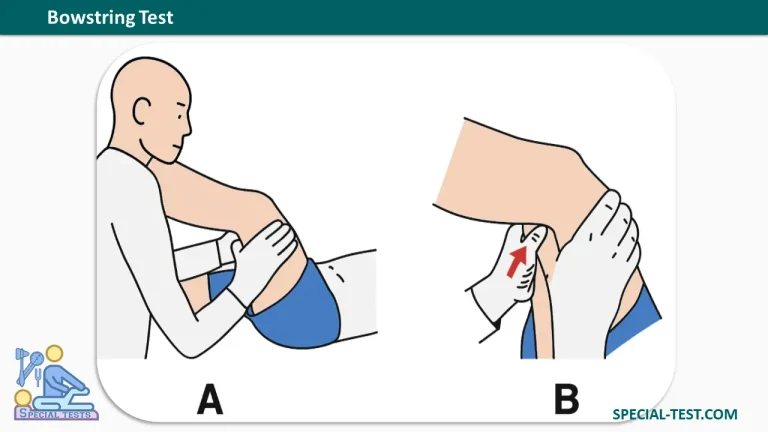
The Bowstring Test, also known as the Bowstring Sign or Popliteal Compression Test, is a clinical examination technique used to assess sciatic nerve irritation and increased neural tension in patients with suspected lumbar radiculopathy or sciatica.
It is commonly performed as a modification of the Straight Leg Raise (SLR) Test, helping clinicians determine whether radiating leg pain may be associated with neural structures rather than muscle tightness alone.
The examination involves reproducing the patient’s symptoms during a straight leg raise, relieving those symptoms through slight knee flexion, and subsequently applying pressure over the nerve structures in the popliteal fossa behind the knee.
A positive Bowstring Test occurs when this pressure reproduces the patient’s characteristic radiating pain, tingling, or paresthesia. Although the finding supports possible neural involvement, it does not independently confirm lumbar disc herniation or nerve root compression. [1,2]
What Is the Bowstring Test Used For?
The primary purpose of the Bowstring Test is to evaluate sciatic nerve mechanosensitivity, particularly in patients experiencing low back pain accompanied by radiating symptoms in the lower extremity.
Clinicians may use the test when assessing:
- Lumbar radiculopathy: Irritation or dysfunction of lumbar or sacral nerve roots, potentially causing radiating pain, numbness, tingling, or weakness.
- Sciatica: Pain radiating along the distribution of the sciatic nerve, frequently involving the buttock, posterior thigh, calf, or foot.
- Lumbar disc herniation: Disc displacement that may irritate or compress adjacent spinal nerve roots.
- Sciatic nerve irritation: Increased sensitivity of neural tissue during movement or mechanical loading.
- Neural versus muscular symptoms: Assessment of whether posterior thigh discomfort could be related to neural sensitivity rather than hamstring tightness alone.
The Bowstring Test should be interpreted alongside the patient’s medical history, neurological examination, and other relevant orthopedic tests.
How to Perform the Bowstring Test
Two commonly described examination techniques are the supine Bowstring Test and the seated sciatic tension test (Deyerle’s Sign).
1. Supine Bowstring Test
The supine technique is the conventional method and is generally performed following the Straight Leg Raise Test.
Patient Position: The patient lies supine on an examination table with both lower extremities relaxed.
Examiner Position: The examiner stands beside the symptomatic lower extremity.
Procedure:
- Perform the Straight Leg Raise Test: Passively elevate the affected leg while maintaining knee extension until the patient experiences their characteristic radiating leg pain or paresthesia.
- Slightly flex the knee: Without substantially changing the hip position, flex the patient’s knee approximately 20–30 degrees. This maneuver reduces neural tension and typically relieves the previously provoked symptoms.
- Apply popliteal pressure: While maintaining the slightly flexed knee position, carefully apply localized pressure with the thumb or fingers over the relevant neural structures within the popliteal fossa, particularly along the course of the tibial or common fibular nerve divisions.
- Assess symptom reproduction: Ask whether the pressure recreates the same radiating pain, tingling, or paresthesia experienced during the initial Straight Leg Raise Test.
Positive Result: Reproduction of the patient’s familiar sciatic or radicular symptoms following popliteal pressure constitutes a positive Bowstring Test.
The examiner should distinguish recognizable radiating symptoms from isolated discomfort caused by local pressure. [1–3]
2. Seated Bowstring Test (Deyerle’s Sign)
The seated variation, historically described as the Sciatic Tension Test or Deyerle’s Sign, evaluates neural symptoms with the patient in a sitting position.
Patient Position: The patient sits on the edge of an examination table with the hips and knees flexed and the lower legs hanging freely.
Examiner Position: The examiner stands or sits facing the symptomatic leg.
Procedure:
- Extend the knee: Passively extend the patient’s affected knee until familiar radiating leg pain or sciatic symptoms are provoked.
- Reduce neural tension: Slightly flex the knee until the symptoms diminish or disappear.
- Stabilize the leg: Maintain the partially flexed knee position. In the traditionally described technique, the examiner stabilizes the patient’s lower extremity between their own knees.
- Apply pressure: Using the fingers of both hands, carefully apply pressure over the neural structures within the popliteal space.
- Evaluate the response: Determine whether the pressure reproduces the patient’s original sciatic pain or paresthesia.
Positive Result: Reproduction of the familiar radiating symptoms suggests increased sensitivity of the sciatic nerve or associated neural structures.
This examination technique is associated with the work of Deyerle and May, who described the sciatic tension test in 1956. [1,4]
What Does a Positive Bowstring Test Mean?
A positive Bowstring Test occurs when symptoms initially provoked by the Straight Leg Raise Test decrease with knee flexion but return when pressure is applied to the neural structures behind the knee.
This response suggests neural mechanosensitivity and may be associated with:
- Lumbar nerve root irritation: Particularly involving the lower lumbar or upper sacral nerve roots.
- Lumbar disc herniation: Commonly at the L4–L5 or L5–S1 spinal levels.
- Sciatic nerve irritation: Increased sensitivity of the sciatic nerve or its branches.
- Lumbosacral radicular pain: Radiating symptoms potentially arising from irritated spinal nerve roots.
The interpretation becomes more clinically meaningful when the reproduced symptoms closely match the patient’s usual pain distribution.
However, a positive test does not establish a definitive diagnosis of lumbar radiculopathy. Additional clinical findings are required to determine whether true nerve root dysfunction is present.
What Does a Negative Bowstring Test Indicate?
A negative Bowstring Test occurs when pressure within the popliteal fossa fails to reproduce the patient’s characteristic radiating symptoms.
Possible interpretations include:
- Posterior thigh discomfort associated with hamstring tightness.
- Musculoskeletal pain unrelated to the sciatic nerve.
- Absence of demonstrable neural mechanosensitivity during the examination.
- Neural symptoms that are not reproduced by this particular maneuver.
Importantly, a negative result does not exclude sciatica, lumbar disc herniation, or nerve root pathology.
Bowstring Test vs. Straight Leg Raise Test
Although the Bowstring Test and Straight Leg Raise Test assess related clinical symptoms, they employ different methods.
| Feature | Bowstring Test | Straight Leg Raise Test |
|---|---|---|
| Primary purpose | Assess neural symptom reproduction with popliteal pressure | Assess radiating symptoms during passive leg elevation |
| Patient position | Supine or seated | Usually supine |
| Main maneuver | Knee flexion followed by popliteal pressure | Hip flexion with the knee extended |
| Positive finding | Reproduction of familiar radiating symptoms with pressure | Reproduction of characteristic radiating leg symptoms |
| Clinical use | Supplementary assessment of neural mechanosensitivity | Common examination for suspected lumbosacral radicular pain |
The Bowstring Test can provide additional clinical information after an SLR examination, but its independent diagnostic accuracy is not sufficiently established to use it as a confirmatory test.
Research evaluating the Straight Leg Raise Test also demonstrates that neurodynamic findings should be interpreted cautiously and combined with other examination results. [5,6]
Clinical Significance of the Bowstring Test
The Bowstring Test is a supplementary examination maneuver in the assessment of patients presenting with sciatica or suspected lumbar radiculopathy.
One potential benefit is its ability to explore whether the patient’s posterior thigh pain behaves like a neural symptom rather than simple muscular stretching discomfort.
For example, hamstring-related stretching discomfort commonly decreases when the knee is flexed. If subsequent pressure over neural structures reproduces the patient’s familiar radiating symptoms, this raises suspicion of neural mechanosensitivity.
Nevertheless, local tenderness, overlapping musculoskeletal conditions, and peripheral nerve disorders can complicate interpretation.
For a comprehensive evaluation, clinicians should combine the Bowstring Test with:
- Straight Leg Raise and crossed Straight Leg Raise tests.
- Slump Test, when clinically appropriate.
- Lower-extremity muscle strength testing.
- Sensory examination and dermatomal assessment.
- Deep tendon reflex testing.
- Assessment of gait and relevant functional limitations.
Clinical practice guidelines support combining neurological assessment, symptom distribution, and provocative tests rather than relying on one isolated examination maneuver. [7]
The examination should be performed by a trained healthcare professional using controlled pressure, without unnecessarily provoking severe symptoms.
Patients with new bladder or bowel dysfunction, saddle anesthesia, or progressive neurological weakness require urgent medical evaluation rather than continued provocative testing. [8]
Frequently Asked Questions (FAQ)
1. What is the purpose of the Bowstring Test?
The Bowstring Test is used to evaluate possible sciatic nerve irritation and increased neural mechanosensitivity. It helps clinicians investigate radiating lower-extremity symptoms associated with suspected sciatica or lumbar radiculopathy.
2. What indicates a positive Bowstring Test?
A positive result occurs when pressure over the neural structures in the popliteal fossa reproduces the patient’s familiar radiating leg pain or paresthesia after the symptoms were reduced by slight knee flexion.
3. Is the Bowstring Test the same as the Straight Leg Raise Test?
No. The Straight Leg Raise Test provokes symptoms through passive hip flexion with the knee extended. The Bowstring Test adds slight knee flexion and pressure over the popliteal neural structures to reassess symptom reproduction.
4. Does a positive Bowstring Test confirm lumbar disc herniation?
No. A positive result may support suspicion of neural irritation associated with disc herniation, but it cannot independently confirm a herniated disc or identify the affected spinal level. Diagnosis requires correlation with the history, neurological findings, and imaging when clinically indicated.
5. Can the Bowstring Test distinguish sciatica from hamstring tightness?
It may assist in distinguishing neural symptoms from muscular stretching discomfort. Reproduction of the patient’s characteristic radiating pain after popliteal pressure supports neural involvement, but the distinction is not definitive based on this test alone.
6. What is Deyerle’s Sign?
Deyerle’s Sign is a seated sciatic tension examination in which knee extension provokes symptoms, slight knee flexion relieves them, and subsequent pressure over the popliteal region may reproduce the patient’s familiar pain.
7. Which spinal nerve roots are commonly associated with a positive Bowstring Test?
Sciatic symptoms frequently involve the L5 or S1 nerve roots, often in association with L4–L5 or L5–S1 disc pathology. However, the Bowstring Test cannot reliably determine the precise nerve root involved.
8. Can a negative Bowstring Test rule out sciatica?
No. A negative result only indicates that the examination did not reproduce the expected symptoms under the conditions tested. Sciatica or lumbar radiculopathy may still be present.
Conclusion
The Bowstring Test is a supplementary clinical examination used to assess sciatic nerve irritation and neural mechanosensitivity in patients with suspected sciatica or lumbar radiculopathy.
It is performed by provoking radiating symptoms with a Straight Leg Raise or seated knee-extension maneuver, reducing the symptoms through slight knee flexion, and applying controlled pressure over the neural structures in the popliteal fossa.
A positive result is characterized by reproduction of the patient’s familiar radiating pain or paresthesia.
Although the Bowstring Test may help distinguish neural symptoms from muscular discomfort, it should always be considered alongside the clinical history, neurological findings, and other relevant diagnostic procedures.
References
- OrthoFixar. Bowstring Test: Purpose, Procedure, and Clinical Interpretation.
https://orthofixar.com/special-test/bowstring-test/ - Genevay S, et al. Inadequacies of the Lasègue test, and how the Slump and Bowstring tests are useful for the diagnosis of sciatica. Joint Bone Spine. 2021;88(1):105030.
https://pubmed.ncbi.nlm.nih.gov/32561431/ - StatPearls. Sciatica. National Center for Biotechnology Information (NCBI Bookshelf).
https://www.ncbi.nlm.nih.gov/books/NBK507908/ - Deyerle WM, May VR Jr. Sciatic tension test. Southern Medical Journal. 1956;49(9):999–1005.
https://pubmed.ncbi.nlm.nih.gov/13360467/ - Nee RJ, et al. Diagnostic accuracy of the straight leg raise test for lumbosacral radicular pain: A systematic review with meta-analysis. Musculoskeletal Science and Practice. 2026;86:103666.
https://pubmed.ncbi.nlm.nih.gov/42843217/ - Nee RJ, Coppieters MW, Boyd BS. Reliability of the straight leg raise test for suspected lumbar radicular pain: A systematic review with meta-analysis. Musculoskeletal Science and Practice. 2022;59:102529.
https://pubmed.ncbi.nlm.nih.gov/35245880/ - Recommendations for Diagnosis and Treatment of Lumbosacral Radicular Pain: A Systematic Review of Clinical Practice Guidelines. PubMed.
https://pubmed.ncbi.nlm.nih.gov/34205193/ - StatPearls. Low Back Pain: Evaluation and Management. NCBI Bookshelf.
https://www.ncbi.nlm.nih.gov/books/NBK538173/