Bechterew Test: Purpose, Procedure, Positive Signs and Clinical Significance
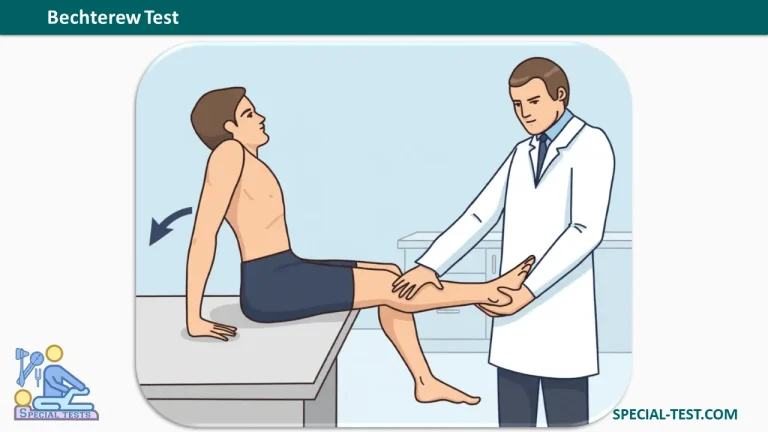
The Bechterew Test, also known as the Sitting Straight Leg Raise Test, is a clinical orthopedic examination used to assess sciatic nerve irritation and possible lumbar nerve root involvement. This neurological tension test helps clinicians evaluate patients presenting with lower back pain, sciatica, or radiating leg symptoms.
The Bechterew Test is performed while the patient is seated, making it a practical alternative to the traditional supine Straight Leg Raise (SLR) Test. It shares similarities with the Slump Test, although the latter incorporates additional movements to assess neural mechanosensitivity.
The test is particularly useful as part of a comprehensive physical examination for suspected lumbar radiculopathy.
What Is the Bechterew Test Used For?
The primary purpose of the Bechterew Test is to identify symptoms suggestive of sciatic nerve irritation or lumbosacral nerve root involvement.
During the examination, knee extension places mechanical tension on the sciatic nerve and associated neural structures. This movement may reproduce characteristic symptoms in patients with increased neural mechanosensitivity.
Clinicians commonly use the Bechterew Test when evaluating patients with:
- Lumbar radiculopathy: Pain, numbness, or tingling associated with irritation or dysfunction of a lumbar or sacral nerve root.
- Sciatica: Radiating pain extending from the lower back or buttock into the posterior lower extremity.
- Lumbar disc herniation: A condition in which displaced intervertebral disc material may irritate or compress adjacent nerve roots.
- Suspected neural tension: Symptoms reproduced or modified by movements that mechanically load peripheral nerves and associated tissues.
Although the test may contribute to the clinical evaluation of these conditions, a positive result does not establish a specific diagnosis.
Anatomical Basis of the Bechterew Test
The Bechterew Test primarily assesses the mechanical sensitivity of the sciatic nerve and its associated lumbosacral nerve roots.
The sciatic nerve originates from the L4–S3 spinal nerve roots and travels through the pelvis into the posterior thigh, where its major branches continue toward the leg and foot.
When the patient sits with the hips flexed and progressively extends the knees, mechanical loading occurs along the posterior neural structures.
In individuals with irritated or mechanically sensitive neural tissues, this movement may reproduce radiating pain, tingling, or other familiar symptoms.
However, knee extension also stretches the hamstring muscles. Therefore, clinicians must distinguish normal muscular stretching sensations from symptoms suggestive of neural involvement.
How to Perform the Bechterew Test
The Bechterew Test is performed with the patient seated on an examination table. The procedure consists of three sequential phases.
Patient Position
The patient sits upright near the edge of the examination table with:
- Both hips flexed to approximately 90 degrees.
- Both knees initially flexed and feet resting flat on the floor.
- The thighs adequately supported by the examination table.
- Hands resting on the table for balance and stability.
The examiner explains the procedure and asks the patient to report any pain, tingling, numbness, or other symptoms during the movements.
Phase 1: Uninvolved Leg Testing
The examination begins with the asymptomatic or less symptomatic lower extremity.
The patient is instructed to actively extend the knee, gradually straightening the leg while maintaining a relatively stable seated posture.
The examiner observes the available knee extension, any symptom reproduction, and compensatory movements.
The patient then slowly returns the foot to the starting position.
Phase 2: Involved Leg Testing
The patient repeats the same movement with the symptomatic lower extremity.
During knee extension, the examiner assesses whether the movement reproduces the patient’s familiar radiating leg pain.
Particular attention should be given to:
- Pain radiating below the knee.
- Inability to achieve full knee extension because of pain.
- Protective knee flexion or trunk movement.
- Backward leaning or bracing against the examination table.
The symptomatic response should be compared with the findings from the uninvolved side.
Phase 3: Bilateral Knee Extension
If unilateral testing does not reproduce the patient’s symptoms, the examiner may ask the patient to extend both knees simultaneously.
This maneuver increases the overall mechanical loading of the posterior neural and musculoskeletal structures.
Some patients may tolerate unilateral knee extension but develop symptoms when both legs are extended together.
The examiner records the location, intensity, and nature of any symptoms and whether the patient needs to alter their posture to complete the movement.
Testing should be discontinued if significant pain or neurological symptoms develop.
What Is a Positive Bechterew Test?
A positive Bechterew Test is suggested when knee extension reproduces the patient’s familiar sciatic or radicular symptoms.
Common positive findings include:
1. Reproduction of radicular pain
The patient experiences shooting, burning, or electric-like pain radiating from the buttock or posterior thigh toward the lower leg, frequently extending below the knee.
Reproduction of the patient’s familiar symptoms is more clinically meaningful than nonspecific stretching discomfort.
2. Inability to achieve full knee extension
The patient may be unable to straighten the knee fully because the movement provokes pain or substantial discomfort.
This finding requires careful interpretation because hamstring tightness, joint restrictions, and other musculoskeletal conditions can also limit knee extension.
3. Positive tripod sign
The patient instinctively leans backward and supports the upper body with the hands on the examination table while attempting to straighten the knee.
This compensatory posture, known as the tripod sign, may reduce tension on the irritated neural structures and decrease symptoms.
The tripod sign is supportive rather than diagnostic because similar postural compensation can occur with hamstring tightness.
Additional findings may include tingling, numbness, muscle guarding, or reproduction of familiar lower back discomfort.
Bechterew Test vs. Slump Test
Both the Bechterew Test and the Slump Test are seated neurodynamic examinations used in patients with suspected lumbar radicular pain.
The primary difference is the sequence and number of movements involved.
The Bechterew Test focuses predominantly on knee extension while the patient maintains a seated position.
In contrast, the Slump Test incorporates spinal flexion, cervical flexion, knee extension, and often ankle dorsiflexion to assess symptom responses under different neural loading conditions.
The Slump Test also allows clinicians to evaluate whether modifying neck or ankle position changes the patient’s symptoms.
Neither test should be interpreted independently of the patient’s history and neurological examination.
Diagnostic Accuracy and Clinical Limitations
Although the Bechterew Test is a useful bedside examination maneuver, its diagnostic accuracy as an independent test has not been firmly established.
A study involving 71 patients with symptoms consistent with lumbar radiculopathy compared seated and supine Straight Leg Raise testing. The seated test demonstrated a sensitivity of 41%, compared with 67% for the supine test when MRI evidence of lumbar nerve root compression was used as the reference standard.
These findings suggest that a negative seated Straight Leg Raise Test cannot reliably exclude lumbar nerve root compression.
Furthermore, a 2026 systematic review and meta-analysis concluded that the traditional Straight Leg Raise and crossed Straight Leg Raise tests have limited standalone diagnostic accuracy for lumbosacral radicular pain.
These results concern the broader Straight Leg Raise examination rather than a separately validated Bechterew-specific protocol.
Consequently, the Bechterew Test should be interpreted alongside sensory testing, muscle strength assessment, deep tendon reflexes, other neurodynamic tests, and the patient’s clinical history.
Clinical Significance of the Bechterew Test
The Bechterew Test offers a quick, practical method of assessing possible neural irritation without requiring the patient to lie on an examination table.
It may be particularly helpful for patients who have difficulty assuming a supine position.
However, clinicians should remember that a positive Bechterew Test suggests possible neural mechanosensitivity rather than confirming lumbar disc herniation or nerve root compression.
A negative result also does not eliminate the possibility of lumbar radiculopathy.
The greatest clinical value of the test comes from integrating its findings with a comprehensive musculoskeletal and neurological assessment.
Frequently Asked Questions (FAQ)
What is the Bechterew Test?
The Bechterew Test is a seated orthopedic examination used to assess possible sciatic nerve irritation and lumbar radicular symptoms through active knee extension.
What is another name for the Bechterew Test?
The Bechterew Test is also called the Sitting Straight Leg Raise Test or Seated Straight Leg Raise Test.
What does a positive Bechterew Test indicate?
A positive test suggests possible irritation or increased mechanical sensitivity of the sciatic nerve or associated lumbosacral nerve roots. It may occur in patients with sciatica or lumbar radiculopathy but does not confirm a specific diagnosis.
What is the tripod sign in the Bechterew Test?
The tripod sign occurs when a seated patient leans backward and braces with the hands while extending the knee, potentially reducing discomfort associated with neural or hamstring tension.
How is the Bechterew Test different from the Straight Leg Raise Test?
The main difference is patient positioning. The Bechterew Test is performed while seated, whereas the traditional Straight Leg Raise Test is performed with the patient lying supine.
Can the Bechterew Test diagnose a herniated disc?
No. The Bechterew Test may reproduce symptoms associated with lumbar disc herniation, but it cannot independently confirm disc pathology. Diagnosis requires correlation with clinical findings and, when appropriate, imaging.
Is the Bechterew Test the same as the Slump Test?
No. Both are seated neurodynamic tests, but the Slump Test includes additional spinal, cervical, and often ankle movements. The Bechterew Test primarily involves extending one knee at a time, followed by bilateral knee extension when appropriate.
Medical References
- Orthofixar. Bechterew Test: Seated Evaluation for Lumbar Disc Protrusions.
- Rabin A, et al. The sensitivity of the seated straight-leg raise test compared with the supine straight-leg raise test. Archives of Physical Medicine and Rehabilitation. 2007.
- Nee RJ, et al. Diagnostic accuracy of the straight leg raise test for lumbosacral radicular pain: A systematic review with meta-analysis. Musculoskeletal Science and Practice. 2026.
- Scaia V, Baxter D, Cook C. The pain provocation-based straight leg raise test for diagnosis of lumbar disc herniation, lumbar radiculopathy, and/or sciatica: A systematic review. 2012.
- Accuracy of Clinical Tests in Detecting Disk Herniation and Nerve Root Compression in Subjects With Lumbar Radicular Symptoms. 2018.