Shrug Sign Test: Procedure, Positive Sign & Clinical Meaning
What Is the Shrug Sign Test?
The Shrug Sign Test is a clinical shoulder examination used to identify abnormal shoulder movement, weakness, and restricted range of motion. It assesses whether a patient can actively abduct the arm to 90 degrees without compensatory elevation of the scapula or shoulder girdle.
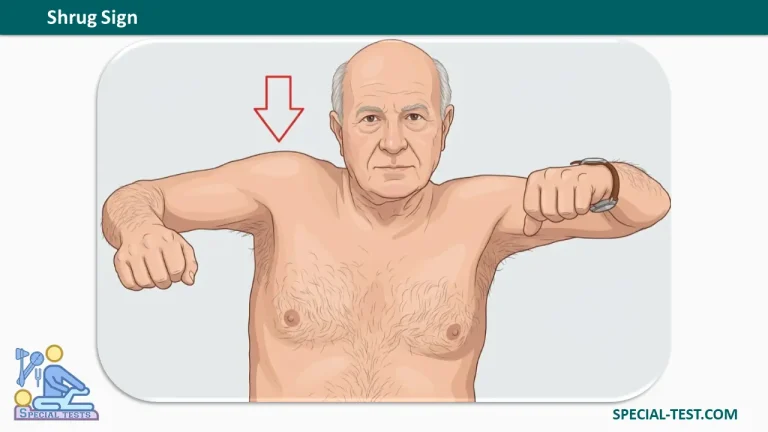
A positive Shrug Sign occurs when the patient must elevate the shoulder girdle, producing a shrugging movement, to bring the arm to shoulder height.
The test is particularly useful in evaluating patients with shoulder stiffness, reduced active abduction, and suspected rotator cuff dysfunction.
Although traditionally associated with rotator cuff tears, research demonstrates that the Shrug Sign is not specific to one shoulder disorder. It is frequently observed in patients with adhesive capsulitis (frozen shoulder), glenohumeral arthritis, and massive rotator cuff tears.
The Shrug Sign should therefore be interpreted as an indicator of impaired shoulder function rather than a definitive diagnostic test.
How to Perform the Shrug Sign Test
The Shrug Sign Test is simple and requires no specialized equipment. It is performed during the assessment of active shoulder range of motion.
Patient Position
The patient stands or sits upright with both arms relaxed at the sides. Both shoulders should be visible so the examiner can observe scapular movement and compare the affected shoulder with the opposite side.
Examination Procedure
- Position the patient: Ask the patient to stand or sit comfortably with the arms resting beside the body.
- Instruct shoulder abduction: Ask the patient to slowly raise both arms sideways in the coronal plane toward 90 degrees of abduction.
- Observe scapular movement: Watch for excessive elevation of the scapula or shoulder girdle as the patient raises the arms.
- Compare both shoulders: Evaluate differences in shoulder elevation, range of motion, and compensatory movements between the affected and unaffected sides.
- Identify a positive finding: Determine whether the patient must shrug the shoulder to achieve 90 degrees of arm abduction.
- Assess additional findings: Record associated pain, weakness, restricted movement, and the angle at which compensatory shoulder elevation begins.
The movement should be performed actively without assistance from the examiner.
Normal Shoulder Abduction
Normal shoulder abduction typically ranges from approximately 170 to 180 degrees, allowing the arm to reach an overhead position.
Full abduction requires coordinated movement between the glenohumeral joint, scapula, and clavicle. This coordinated movement is called scapulohumeral rhythm.
Normal scapular upward rotation is an essential component of shoulder elevation and should not be confused with abnormal shoulder shrugging.
During the Shrug Sign Test, the examiner specifically looks for excessive elevation of the entire shoulder girdle as a compensatory movement before the arm reaches 90 degrees.
What Is a Positive Shrug Sign?
A positive Shrug Sign Test is present when the patient cannot abduct the arm to 90 degrees without elevating the scapula or shoulder girdle.
Instead of smoothly raising the arm to shoulder level, the patient compensates by lifting the entire shoulder girdle.
This movement may result from:
- Weakness of the shoulder abductors or rotator cuff muscles.
- Restricted glenohumeral joint mobility.
- Pain that interferes with normal muscle activation.
- Shoulder stiffness and capsular contracture.
- Altered coordination between the scapula and humerus.
A positive result suggests abnormal shoulder mechanics but does not independently establish the underlying diagnosis.
Negative Shrug Sign
A negative Shrug Sign occurs when the patient successfully abducts the arm to 90 degrees without excessive compensatory elevation of the shoulder girdle.
However, a negative test does not exclude rotator cuff disease or other shoulder pathology.
Clinical Significance of the Shrug Sign
The Shrug Sign is associated with several important shoulder conditions, particularly disorders that produce stiffness, reduced range of motion, or weakness.
1. Adhesive Capsulitis (Frozen Shoulder)
Adhesive capsulitis is characterized by progressive shoulder pain and restriction of both active and passive range of motion.
Because the glenohumeral joint becomes stiff, patients may compensate for restricted movement by elevating the scapula.
This makes the Shrug Sign particularly common in patients with frozen shoulder.
2. Glenohumeral Arthritis
Glenohumeral arthritis causes degenerative changes in the shoulder joint, frequently resulting in pain, stiffness, and limited movement.
As shoulder mobility decreases, compensatory scapular elevation may become more pronounced during attempted abduction.
A positive Shrug Sign in these patients can reflect restricted joint movement and impaired shoulder function.
3. Massive Rotator Cuff Tears
The rotator cuff muscles stabilize the humeral head and contribute to controlled arm elevation.
Massive rotator cuff tears can substantially impair shoulder strength and disrupt normal movement patterns.
Patients with significant rotator cuff weakness may compensate by elevating the shoulder girdle when attempting to raise the arm.
However, not all patients with rotator cuff tears demonstrate a positive Shrug Sign.
Diagnostic Accuracy of the Shrug Sign Test
A clinical study by Jia et al. (2008) evaluated the Shrug Sign in 982 patients undergoing shoulder surgery.
The researchers found a positive Shrug Sign in 51.3% of the patients.
The frequency of positive results differed considerably according to the underlying shoulder disorder.
| Shoulder Condition | Positive Shrug Sign |
|---|---|
| Adhesive capsulitis | 94.7% |
| Glenohumeral arthritis | 90.5% |
| Massive rotator cuff tear | 74.5% |
| Full-thickness rotator cuff tear | 62.1% |
| Partial-thickness rotator cuff tear | 43.2% |
| Rotator cuff tendinosis | 33.3% |
These percentages represent the proportions of patients with a positive test within each diagnostic group in this surgical population. They should not be interpreted as the probability of having a particular diagnosis after obtaining a positive Shrug Sign.
When evaluating rotator cuff disease as a combined diagnostic category, the study reported:
- Sensitivity: 46.4%
- Specificity: 48.1%
These findings demonstrate that the Shrug Sign has limited diagnostic accuracy for identifying rotator cuff disease in isolation.
The researchers concluded that the test is more useful as a general indicator of abnormal shoulder function, especially when stiffness or muscle weakness is present.
Why Does the Shoulder Shrug During Abduction?
Shoulder abduction depends on coordinated activation of the deltoid, supraspinatus, rotator cuff, and scapular muscles.
When the shoulder joint cannot move normally, the body may recruit the upper trapezius and other scapular elevators to compensate.
This compensatory mechanism raises the shoulder girdle to assist arm elevation.
In patients with adhesive capsulitis or glenohumeral arthritis, stiffness can restrict normal glenohumeral movement.
In patients with significant rotator cuff tears, muscular weakness may interfere with arm elevation.
The resulting excessive shoulder elevation produces the characteristic positive Shrug Sign.
It is important to distinguish this compensation from normal scapular rotation, which occurs naturally during shoulder elevation.
Clinical Interpretation and Additional Examination
A positive Shrug Sign should prompt further evaluation of shoulder mobility, muscular strength, and associated symptoms.
The examiner should assess active and passive shoulder range of motion, particularly abduction and external rotation.
When both active and passive movement are restricted, the findings may suggest a stiff shoulder condition such as adhesive capsulitis or glenohumeral arthritis.
When active elevation is markedly limited but passive movement is relatively preserved, significant muscular weakness or rotator cuff dysfunction should be considered.
Additional shoulder examinations may include the Drop Arm Test, Jobe’s Empty Can Test, and external rotation strength testing.
Diagnostic imaging, such as radiographs, ultrasound, or MRI, may be appropriate depending on clinical findings and the suspected condition.
The Shrug Sign is most valuable when incorporated into a comprehensive shoulder examination rather than used as a standalone diagnostic tool.
Frequently Asked Questions (FAQ)
What does a positive Shrug Sign indicate?
A positive Shrug Sign indicates compensatory elevation of the shoulder girdle during active shoulder abduction. It is associated with shoulder stiffness, muscle weakness, and reduced range of motion. Common associated conditions include adhesive capsulitis, glenohumeral arthritis, and massive rotator cuff tears.
How do you perform the Shrug Sign Test?
Ask the patient to raise both arms sideways to 90 degrees while observing shoulder girdle movement. The test is positive if the patient must elevate the scapula or shrug the shoulder to achieve the required arm position.
Is the Shrug Sign positive in frozen shoulder?
Yes. The Shrug Sign is frequently positive in adhesive capsulitis because restricted glenohumeral motion causes compensatory scapular elevation. In the study by Jia et al., 94.7% of the 19 patients with adhesive capsulitis demonstrated a positive result.
Can the Shrug Sign diagnose a rotator cuff tear?
No. Although patients with rotator cuff tears may demonstrate a positive Shrug Sign, the test lacks sufficient sensitivity and specificity to diagnose rotator cuff pathology independently. Additional clinical examination and, when indicated, imaging are necessary.
What is the difference between the Shrug Sign and the Drop Arm Test?
The Shrug Sign assesses abnormal shoulder girdle elevation during active arm abduction. The Drop Arm Test evaluates the patient’s ability to control lowering the arm from an abducted position. Both tests may help identify shoulder dysfunction, but they assess different aspects of movement and muscular control.
What is the normal range of shoulder abduction?
Normal shoulder abduction is approximately 170–180 degrees, although the available range varies between individuals. The Shrug Sign specifically evaluates compensatory shoulder elevation during active abduction to 90 degrees.
Does a negative Shrug Sign rule out shoulder pathology?
No. A negative Shrug Sign indicates that the patient can abduct the arm to 90 degrees without excessive shoulder girdle elevation. However, rotator cuff disease, arthritis, and other shoulder disorders may still be present.
Why is the Shrug Sign clinically important?
The Shrug Sign provides a quick assessment of compensatory shoulder movement and functional impairment. It can help clinicians recognize patients who require further evaluation for shoulder stiffness, restricted mobility, or muscular weakness.
References
- Jia X, Ji JH, Petersen SA, Keefer J, McFarland EG. Clinical evaluation of the shoulder shrug sign. Clinical Orthopaedics and Related Research. 2008;466(11):2813–2819. PubMed PMID: 18543050. DOI: 10.1007/s11999-008-0331-3.
- Orthofixar. Shoulder Range of Motion: Complete Clinical Examination Guide & Normal Values. Orthofixar.com.
- Orthofixar. Scapular Asymmetry Test: Clinical Assessment of Scapular Position and Movement. Orthofixar.com.