Drop Arm Test: Procedure, Positive Sign, and Diagnostic Accuracy
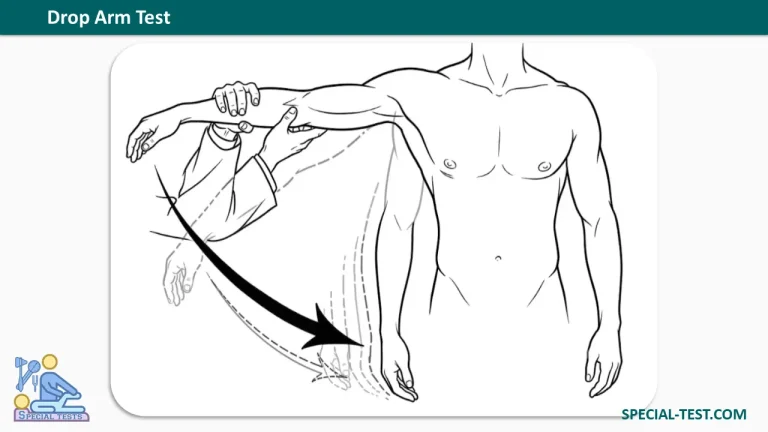
The Drop Arm Test and Drop Sign are clinical examination maneuvers used to assess rotator cuff function and identify possible rotator cuff tears. They help clinicians evaluate shoulder weakness, particularly involving the supraspinatus and infraspinatus muscles.
Although the terms are sometimes used interchangeably, the classic Drop Arm Test and the Drop Sign performed at 90° of shoulder elevation are distinct examination maneuvers. Understanding this difference is important for accurate clinical assessment.
What Is the Drop Arm Test Used For?
The classic Drop Arm Test evaluates a patient’s ability to control shoulder abduction and lower the arm slowly. A positive result suggests significant rotator cuff dysfunction, particularly a potentially large supraspinatus tear.
The Drop Sign at 90° of shoulder elevation, also described as the external rotation lag sign at 90°, primarily assesses the function of the infraspinatus muscle, with contributions from other posterosuperior rotator cuff structures.
These tests are useful when evaluating patients with suspected rotator cuff injuries, shoulder pain, or weakness. They should be interpreted alongside the patient’s history, other physical examination findings, and appropriate imaging when indicated.
Anatomy and Clinical Significance
The rotator cuff consists of four muscles and their tendons:
- Supraspinatus: Assists with shoulder abduction and helps stabilize the humeral head.
- Infraspinatus: Primarily produces external rotation of the shoulder.
- Teres minor: Assists with external rotation and shoulder stabilization.
- Subscapularis: Primarily produces internal rotation and contributes to shoulder stability.
A positive Drop Arm Test may indicate substantial supraspinatus dysfunction. A positive Drop Sign performed in external rotation at 90° of elevation suggests posterosuperior rotator cuff dysfunction, particularly involving the infraspinatus.
How to Perform the Drop Sign at 90° of Shoulder Elevation
Patient position
- Ask the patient to sit upright with their back facing the examiner.
- Position the affected shoulder at approximately 90° of elevation in the scapular plane.
- Flex the patient’s elbow to 90°.
- Passively externally rotate the shoulder to near its maximum comfortable range.
Examination technique
- Support the patient’s elbow with one hand while positioning the wrist with the other.
- Ask the patient to actively maintain the externally rotated position.
- Release the wrist while continuing to support the elbow.
- Observe whether the patient can maintain the position without the forearm or shoulder drifting back toward internal rotation.
- If a lag occurs, document its magnitude and compare the findings with the opposite shoulder when appropriate.
The patient’s ability to maintain external rotation primarily depends on infraspinatus function in this position.
Clinical note: Perform this maneuver gently and avoid forcing the shoulder into painful end-range motion.
What Is a Positive Drop Sign?
The test is positive when the patient cannot maintain the externally rotated position and a lag or drop occurs after the examiner releases the wrist.
A positive result suggests weakness or dysfunction of the posterosuperior rotator cuff, particularly the infraspinatus. Depending on the clinical context, it may raise suspicion of a substantial or full-thickness rotator cuff tear.
A negative result does not exclude a rotator cuff tear. Clinical examination tests have limitations, and results should be interpreted in conjunction with other findings.
How to Perform the Classic Drop Arm Test
The classic Drop Arm Test uses a different movement:
- Position the patient sitting or standing.
- Passively or actively raise the affected arm to approximately 90° of abduction.
- Ask the patient to lower the arm slowly and in a controlled manner toward the side of the body.
- Observe the patient’s ability to control the descent.
Positive result: The patient is unable to lower the arm smoothly, the arm drops suddenly, or the patient cannot maintain the abducted position.
This finding suggests significant rotator cuff dysfunction, especially a potentially large supraspinatus tear.
Diagnostic Accuracy of the Drop Arm Test
The diagnostic accuracy of shoulder examination maneuvers varies according to the patient population, the definition of a positive result, and the reference standard used to identify rotator cuff tears.
Reported values for the classic Drop Arm Test include:
| Diagnostic measure | Reported value |
|---|---|
| Sensitivity | 73% |
| Specificity | 98% |
These figures should be treated as estimates from a particular study or reference rather than universal values. Published studies report a wide range of sensitivity and specificity for the Drop Arm Test.
How should these values be interpreted?
- Sensitivity (73%): In the population studied, the test identified approximately 73% of patients who had the target condition.
- Specificity (98%): In the population studied, approximately 98% of patients without the target condition had a negative test.
The high reported specificity means that a positive result can strengthen suspicion of a rotator cuff tear in an appropriate clinical setting. However, a negative result cannot reliably rule out a tear.
The American Academy of Orthopaedic Surgeons emphasizes that combining clinical examination findings improves diagnostic assessment compared with relying on a single test.
Limitations and Clinical Considerations
The Drop Arm Test and Drop Sign are components of the shoulder examination, not standalone diagnostic tests.
Important considerations include:
- Pain-related weakness: Pain may interfere with active movement and affect the examination result.
- Tear characteristics: Partial-thickness and smaller tears may not produce a positive Drop Arm Test.
- Muscle-specific assessment: The Drop Sign at 90° of elevation primarily assesses external rotation function and should not be interpreted as a direct test of supraspinatus integrity alone.
- Additional examination: Other rotator cuff tests, range-of-motion assessment, and strength testing may help refine the clinical assessment.
- Imaging: Ultrasound or MRI may be indicated when the clinical findings warrant further investigation.
A clinician should integrate the examination findings with the patient’s symptoms, injury mechanism, functional limitations, and overall clinical presentation.
Frequently Asked Questions (FAQ)
1. What does the Drop Arm Test assess?
The classic Drop Arm Test assesses the patient’s ability to control shoulder abduction and lower the arm in a controlled manner. A positive result suggests significant rotator cuff dysfunction, particularly involving the supraspinatus.
2. What does a positive Drop Sign indicate?
A positive Drop Sign at 90° of shoulder elevation indicates an inability to maintain external rotation after the examiner releases the wrist. It suggests dysfunction of the posterosuperior rotator cuff, particularly the infraspinatus.
3. What is the difference between the Drop Arm Test and the Drop Sign?
The classic Drop Arm Test evaluates controlled lowering of an abducted arm. The Drop Sign at 90° evaluates the ability to maintain external rotation with the shoulder elevated and the elbow flexed. The maneuvers assess related but different aspects of rotator cuff function.
4. Which muscle is primarily assessed by the Drop Sign at 90°?
The infraspinatus is the primary muscle responsible for maintaining external rotation in this position. Other posterosuperior rotator cuff structures may also contribute.
5. What is the sensitivity and specificity of the Drop Arm Test?
Sensitivity of 73% and specificity of 98% have been reported in some references. However, published estimates vary considerably across studies. These figures should not be generalized to every patient population or examination technique.
6. Can a negative Drop Arm Test rule out a rotator cuff tear?
No. The test may be negative in patients with partial-thickness tears, smaller tears, or other forms of rotator cuff pathology. A negative result should be interpreted alongside the history, other examination maneuvers, and imaging when clinically indicated.
7. Does a positive Drop Arm Test confirm a full-thickness rotator cuff tear?
No. A positive result raises suspicion of significant rotator cuff dysfunction but does not independently confirm the presence, location, or extent of a tear. Further clinical evaluation and, when indicated, imaging may be necessary.
8. What other tests can be used to assess rotator cuff integrity?
Other examination maneuvers include the Jobe (Empty Can) Test, Full Can Test, external rotation lag sign, and resisted external rotation testing. Combining relevant tests generally provides a more informative assessment than relying on any single maneuver.
References and Further Reading
- American Academy of Orthopaedic Surgeons (AAOS). Rotator Cuff Tears: diagnosis and evaluation.
https://orthoinfo.org/diseases–conditions/rotator-cuff-tears/ - American Academy of Orthopaedic Surgeons (AAOS). Management of Rotator Cuff Injuries: Clinical Practice Guideline.
https://www.aaos.org/quality/quality-programs/rotator-cuff/ - Clinical Examination of the Rotator Cuff. Review of shoulder examination maneuvers, including the Drop Sign and external rotation lag signs.
https://pmc.ncbi.nlm.nih.gov/articles/PMC3826176/ - Tests for Diagnosing Subacromial Impingement Syndrome and Rotator Cuff Disease. Review of the diagnostic role and limitations of shoulder examination tests.
https://pmc.ncbi.nlm.nih.gov/articles/PMC4935057/ - Supraspinatus Tears: Predictability of Magnetic Resonance Imaging Findings Based on Clinical Examination. Diagnostic accuracy study of shoulder examination maneuvers.
https://pubmed.ncbi.nlm.nih.gov/33675978/