Shoulder Load and Shift Test: Procedure, Grading & Accuracy

The Shoulder Load and Shift Test is a clinical orthopedic examination used to assess glenohumeral joint instability, particularly anterior and posterior shoulder instability. This physical examination technique evaluates the amount of translation of the humeral head relative to the glenoid fossa and helps clinicians identify excessive shoulder joint laxity.
Originally described by Silliman and Hawkins in 1993, the Load and Shift Test is commonly performed by orthopedic surgeons, sports medicine physicians, and physical therapists during the assessment of patients with suspected shoulder instability.
The examination can be performed with the patient lying supine or sitting upright. Its findings should be interpreted alongside the patient’s symptoms, medical history, and other shoulder instability tests.
What Is the Purpose of the Shoulder Load and Shift Test?
The primary purpose of the Load and Shift Test is to evaluate the stability of the glenohumeral joint by assessing how far the humeral head moves anteriorly or posteriorly within the glenoid.
The test is particularly useful for:
- Assessing anterior glenohumeral instability.
- Evaluating posterior shoulder instability.
- Identifying excessive translation of the humeral head.
- Comparing shoulder joint laxity between the affected and unaffected shoulders.
- Supporting the clinical assessment of patients with recurrent shoulder subluxations or dislocations.
Importantly, shoulder laxity and symptomatic instability are not identical. Some individuals naturally have greater joint translation without pain, apprehension, or functional limitations.
Therefore, the Load and Shift Test should not be used as the sole diagnostic criterion for shoulder instability.
How to Perform the Shoulder Load and Shift Test
The Shoulder Load and Shift Test consists of two distinct components:
Load phase: The examiner gently centers or seats the humeral head within the glenoid fossa.
Shift phase: The examiner applies a controlled anterior or posterior force to assess the degree of humeral head translation and the quality of the joint’s endpoint.
1. Load and Shift Test in the Supine Position
The supine technique allows the clinician to stabilize the scapula while assessing glenohumeral translation.
Step-by-step procedure:
- Position the patient lying supine on an examination table, ensuring that the shoulder muscles are relaxed.
- Stand beside the shoulder being examined.
- Stabilize the scapula against the thorax using one hand and forearm to minimize unwanted scapular movement.
- Position the examining hand around the proximal humerus and glenohumeral joint, allowing palpation of the humeral head and joint line.
- Gently center the humeral head within the glenoid fossa. This is the load phase of the examination.
- Apply a controlled anteromedial force to translate the humeral head anteriorly and assess anterior shoulder stability.
- Apply a controlled posterolateral force to assess posterior glenohumeral translation.
- Evaluate the amount of movement, the resistance encountered, the endpoint of translation, and any reproduction of the patient’s instability symptoms.
- Repeat the examination on the opposite shoulder to establish a comparison.
The examiner should perform the maneuver carefully and avoid excessive force, particularly in patients with a history of recurrent shoulder dislocation.

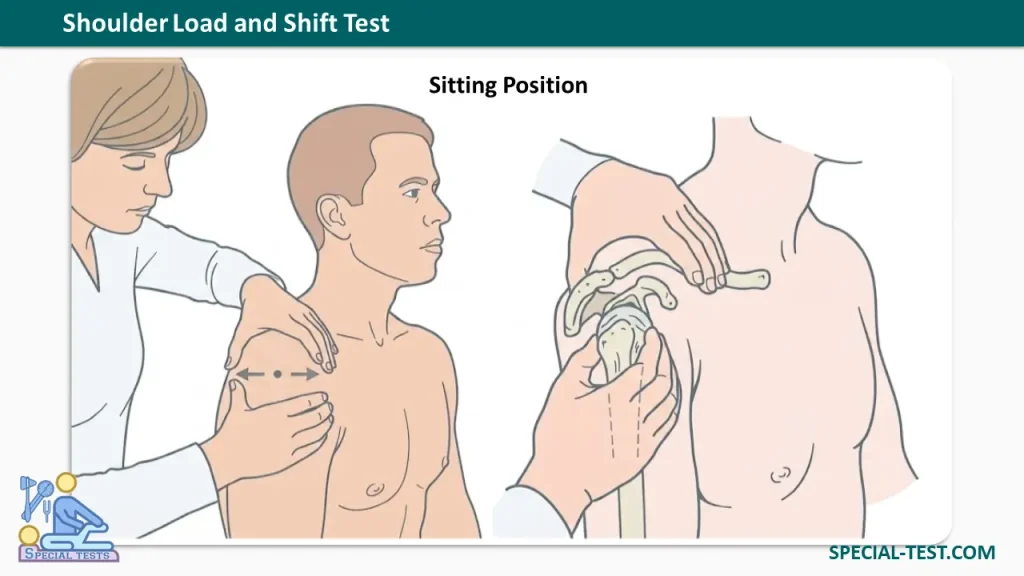
2. Load and Shift Test in the Sitting Position
The sitting variation provides an alternative technique for evaluating shoulder instability in a comfortable upright position.
Step-by-step procedure:
- Ask the patient to sit upright with the affected arm resting comfortably beside the body.
- Keep the shoulder relaxed, with the forearm resting across the lap.
- Stand behind the patient.
- Stabilize the scapula with one hand, positioning the fingers anteriorly near the coracoid process and the thumb posteriorly near the acromion.
- Use the opposite hand to grasp and control the proximal humerus.
- Gently center the humeral head within the glenoid.
- Translate the humeral head anteriorly and posteriorly while maintaining scapular stabilization.
- Assess the degree of translation, endpoint resistance, and reproduction of symptoms.
- Compare the findings with those of the contralateral shoulder.
Both examination positions aim to identify abnormal humeral head movement while minimizing interference from scapular motion.
What Is a Positive Shoulder Load and Shift Test?
A positive Load and Shift Test is generally characterized by increased anterior or posterior translation of the humeral head compared with the opposite shoulder, particularly when the abnormal movement reproduces the patient’s symptoms of instability.
Clinical findings that may support shoulder instability include:
- Excessive humeral head translation.
- Asymmetrical joint movement compared with the opposite shoulder.
- A soft or poorly defined endpoint.
- Reproduction of a sensation of slipping, subluxation, or apprehension.
- Movement of the humeral head beyond the glenoid rim.
However, increased translation alone does not necessarily indicate pathological instability. The examiner must consider normal anatomical variation and the patient’s clinical presentation.
Normal Shoulder Translation
Some degree of anterior and posterior translation is expected in a healthy glenohumeral joint.
Traditionally described reference values include:
- Anterior translation: Approximately 25% or less of the humeral head diameter may be considered normal.
- Posterior translation: Translation approaching 50% of the humeral head diameter may occur in a normal shoulder.
These are approximate clinical descriptions rather than universally accepted diagnostic thresholds. Normal translation varies among individuals, making comparison with the opposite shoulder particularly important.
Shoulder Load and Shift Test Grading
The Load and Shift Test can be graded according to the amount of humeral head translation relative to the glenoid rim.
| Grade | Clinical Finding |
|---|---|
| Grade 0 | Minimal or no appreciable humeral head translation. |
| Grade 1 | The humeral head translates up the glenoid slope without passing over the glenoid rim. |
| Grade 2 | The humeral head passes over the glenoid rim but spontaneously reduces when the applied force is released. |
| Grade 3 | The humeral head passes beyond the glenoid rim and remains dislocated after the force is removed. |
Higher grades indicate greater translation and potentially more significant instability. Nevertheless, the grading system must be interpreted alongside symptoms and clinical findings rather than in isolation.
Shoulder Load and Shift Test Sensitivity and Specificity
The diagnostic accuracy of the Load and Shift Test varies between studies and examination methods.
Commonly reported estimates include:
- Sensitivity: 50–55%
- Specificity: 78–100%
These values suggest that the test may be more useful for supporting a diagnosis of shoulder instability when positive than for excluding instability when negative.
Sensitivity describes the ability of a test to identify patients who have the condition. A sensitivity of approximately 50–55% indicates that a proportion of patients with shoulder instability may have a negative result.
Specificity describes the ability to correctly identify patients without the condition. Higher specificity means that a positive result can provide stronger evidence supporting the suspected diagnosis.
However, these reported percentages should be regarded as approximate literature estimates rather than fixed performance characteristics applicable to every patient.
A review by Tzannes and Murrell (2002) highlighted the diagnostic value of positive load and shift findings while noting the limitations of negative findings for excluding certain directions of shoulder instability.
Clinical Reliability and Limitations
The reliability of the Load and Shift Test depends on examiner experience, patient relaxation, stabilization technique, shoulder position, and consistent interpretation of translation.
Research by Tzannes and colleagues (2004) reported good interexaminer agreement for several variations of the test. Agreement was particularly favorable for anterior translation with the shoulder abducted to 90 degrees and posterior translation with the arm at the side.
Despite these findings, manual assessment of shoulder laxity remains partly subjective.
For a comprehensive evaluation, clinicians may combine the Load and Shift Test with other clinical examinations, including the Shoulder Apprehension Test, Relocation Test, Release Test, and Sulcus Sign.
In patients with suspected structural injuries or inconclusive examination findings, additional imaging may be considered according to the clinical presentation.
Clinical Significance of the Load and Shift Test
The Shoulder Load and Shift Test is a valuable component of the physical examination for suspected glenohumeral instability.
Its main clinical advantage is the ability to assess anterior and posterior humeral head translation directly while comparing movement between shoulders.
Nevertheless, no single physical examination maneuver can reliably diagnose every form of shoulder instability. The most useful interpretation combines abnormal translation with the patient’s symptoms, history of instability episodes, and findings from complementary examinations.
The maneuver should be performed by a trained healthcare professional, particularly when significant instability, acute injury, or previous dislocation is suspected.
Frequently Asked Questions (FAQ)
1. What does the Shoulder Load and Shift Test assess?
The Shoulder Load and Shift Test evaluates anterior and posterior glenohumeral joint translation to identify excessive shoulder laxity and support the diagnosis of shoulder instability.
2. What indicates a positive Load and Shift Test?
A positive result generally involves excessive humeral head translation compared with the opposite shoulder. Reproduction of the patient’s apprehension or sensation of instability provides additional clinical significance.
3. What is the difference between the load and shift phases?
The load phase centers the humeral head within the glenoid fossa, whereas the shift phase applies an anterior or posterior force to assess joint translation and endpoint resistance.
4. What is the normal amount of posterior shoulder translation?
Posterior translation of approximately 50% of the humeral head diameter has traditionally been described as within normal limits. However, normal laxity varies, and comparison with the opposite shoulder remains essential.
5. How accurate is the Shoulder Load and Shift Test?
Reported sensitivity is approximately 50–55%, while specificity ranges from 78–100%. Accuracy varies according to technique, patient characteristics, and diagnostic criteria. A negative result does not reliably exclude shoulder instability.
6. Can the Load and Shift Test detect posterior shoulder instability?
Yes. The examiner can evaluate posterior glenohumeral instability by applying a controlled posterior translation force and assessing the amount of movement, endpoint, and symptom reproduction.
7. Can the Load and Shift Test be performed while sitting?
Yes. The test can be performed in either a sitting or supine position, provided the examiner adequately stabilizes the scapula and controls the proximal humerus.
8. Is the Shoulder Load and Shift Test painful?
The maneuver is not intended to cause significant pain. However, patients with shoulder instability may experience discomfort or apprehension during translation. The examiner should avoid forcing the joint and stop the maneuver if concerning symptoms occur.
9. What is the difference between shoulder laxity and shoulder instability?
Shoulder laxity refers to the amount of passive movement permitted within the joint. Shoulder instability describes symptomatic abnormal translation that may cause apprehension, subluxation, dislocation, or functional problems. Increased laxity does not always mean that a shoulder is clinically unstable.
10. Can the Load and Shift Test diagnose a shoulder dislocation?
The test helps assess shoulder instability but is not intended to diagnose or provoke an acute shoulder dislocation. Suspected acute dislocations require appropriate medical evaluation, and clinicians should avoid provocative translation maneuvers in that setting.
Medical References
- Orthofixar. Load and Shift Test: Procedure, Grading, and Diagnostic Accuracy.
- Tzannes A, Murrell GAC. Clinical Examination of the Unstable Shoulder. Sports Medicine. 2002;32(7):447–457.
- Tzannes A, Paxinos A, Callanan M, Murrell GAC. An Assessment of the Interexaminer Reliability of Tests for Shoulder Instability. Journal of Shoulder and Elbow Surgery. 2004;13(1):18–23.
- Lizzio VA, Meta F, Fidai M, Makhni EC. Clinical Evaluation and Physical Exam Findings in Patients with Anterior Shoulder Instability. Current Reviews in Musculoskeletal Medicine. 2017;10(4):434–441.
- Intertester Reliability of Clinical Shoulder Instability and Laxity Tests in Subjects With and Without Self-Reported Shoulder Problems.