Sulcus Sign: Procedure, Positive Result & Diagnostic Accuracy
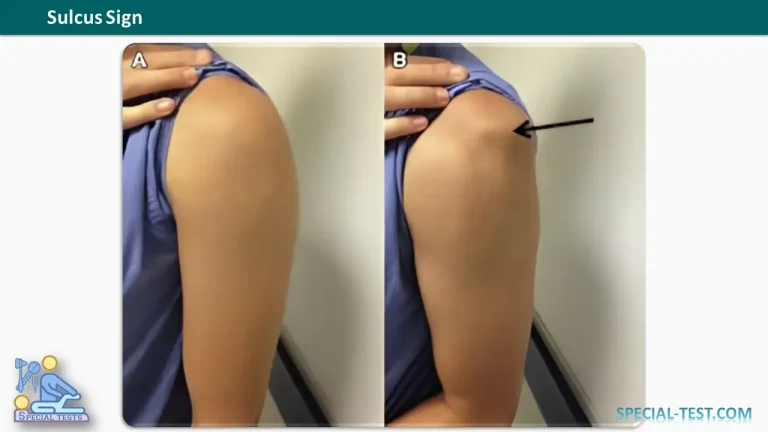
How to Perform the Sulcus Sign Test
The Sulcus Sign is a relatively simple clinical maneuver that should be performed carefully to assess inferior translation of the humeral head.
Patient Position
- Ask the patient to sit or stand comfortably.
- Ensure that the affected arm is relaxed and positioned alongside the body.
- Keep the shoulder in a neutral position, avoiding unnecessary muscle contraction.
Examiner Position and Hand Placement
- Stand beside or in front of the patient so that the shoulder can be observed clearly.
- Stabilize the patient’s opposite shoulder with one hand to minimize compensatory movement of the shoulder girdle.
- Grasp the affected arm around the elbow with the other hand. The elbow may be slightly flexed to allow comfortable application of traction.
Application of Downward Traction
- Apply a gentle, controlled downward pull to the affected arm.
- Observe the region immediately below the acromion for a visible indentation or depression.
- Assess the amount of inferior translation of the humeral head relative to the scapula.
- Repeat the maneuver with the arm in external rotation, keeping the arm at the side, and compare the amount of translation with the neutral-rotation position.
- Compare the findings with the opposite shoulder and determine whether the maneuver reproduces the patient’s symptoms.
The test should be performed by a trained healthcare professional using controlled force. Excessive traction is unnecessary and may cause discomfort.
What Is a Positive Sulcus Sign?
A positive Sulcus Sign occurs when downward traction produces a visible or palpable depression beneath the acromion because the humeral head moves inferiorly relative to the glenoid.
The finding suggests increased inferior glenohumeral laxity. It becomes more clinically significant when the translation is excessive, reproduces the patient’s symptoms, or persists during external rotation.
According to orthopedic examination literature, a sulcus that remains pronounced with the arm in external rotation may indicate dysfunction or laxity of the superior glenohumeral ligament, coracohumeral ligament, and associated rotator interval structures. These structures contribute to inferior stability when the arm is at the side. https://pmc.ncbi.nlm.nih.gov/articles/PMC5646139/
Grading the Sulcus Sign
The Sulcus Sign is commonly graded according to the degree of inferior translation or the measured distance between the acromion and the humeral head.
| Grade | Degree of translation |
|---|---|
| Grade 1+ | Less than 1 cm |
| Grade 2+ | 1–2 cm |
| Grade 3+ | Greater than 2 cm |
These grades describe the degree of laxity rather than independently establishing a diagnosis of shoulder instability. A marked sulcus, particularly one measuring 2 cm or more, may be more suggestive of pathological laxity when accompanied by compatible symptoms and other examination findings. https://pubmed.ncbi.nlm.nih.gov/12015806/
Why Is External Rotation Important?
Repeating the Sulcus Sign with the arm in external rotation helps evaluate the contribution of the superior capsuloligamentous structures and the rotator interval to shoulder stability.
Normally, external rotation changes the tension of structures that help restrain inferior translation. If a pronounced sulcus persists despite external rotation, this may suggest inadequate restraint from the superior glenohumeral ligament, coracohumeral ligament, or rotator interval.
A persistent grade 2+ or 3+ sulcus with external rotation is therefore a concerning finding in the appropriate clinical context. However, it should not be interpreted in isolation because normal anatomical variation and generalized ligamentous laxity can also affect the result.
Sulcus Sign Test Accuracy
The reported diagnostic accuracy of the Sulcus Sign varies according to the patient population, the threshold used to define a positive result, and the reference standard for shoulder instability.
The following values are commonly cited in orthopedic examination resources:
| Diagnostic measure | Reported value |
|---|---|
| Sensitivity | 28% |
| Specificity | 97% |
These figures should be interpreted cautiously because they are not universal estimates for every patient or testing method.
Sensitivity describes the proportion of people with the condition who test positive. A sensitivity of 28% means that the test may miss many cases of multidirectional instability.
Specificity describes the proportion of people without the condition who test negative. A specificity of 97% suggests that a positive result may be useful for supporting the diagnosis in the population from which the estimate was obtained.
A negative Sulcus Sign therefore does not reliably exclude multidirectional instability. A positive result should be correlated with the patient’s symptoms and other examination findings. Reviews of shoulder examination also emphasize that increased laxity can occur in asymptomatic individuals.
Clinical Interpretation and Differential Diagnosis
The Sulcus Sign should be considered part of a comprehensive shoulder assessment rather than a stand-alone diagnostic test.
The clinician should consider the following when interpreting the result:
- Symptom reproduction: Pain, apprehension, or a sensation of slipping during the maneuver may increase clinical concern.
- Comparison with the opposite shoulder: Bilateral laxity may reflect normal variation or generalized hypermobility rather than unilateral pathological instability.
- Other instability tests: The anterior and posterior load-and-shift tests and appropriate apprehension tests can help identify instability in additional directions.
- Patient history: Previous dislocations, recurrent subluxations, trauma, sports participation, and functional limitations help guide interpretation.
- Associated conditions: Rotator cuff disorders, labral injuries, and other shoulder conditions may contribute to symptoms and require separate evaluation.
A visible indentation should also be distinguished from deformity associated with acromioclavicular joint injury. In the Sulcus Sign, the key finding is inferior translation of the humeral head relative to the scapula.
Limitations of the Sulcus Sign
Although the Sulcus Sign is useful for evaluating inferior shoulder laxity, several limitations should be considered.
First, a positive test does not necessarily mean that the patient has symptomatic multidirectional instability. Some people, particularly those with generalized joint hypermobility, may demonstrate considerable shoulder translation without pain or functional problems.
Second, a negative result cannot exclude instability because the test has limited sensitivity in some clinical settings.
Third, examination technique, arm position, muscle guarding, and the amount of applied traction can influence the observed result.
Finally, multidirectional instability is a clinical diagnosis that requires evidence of symptomatic instability in multiple directions. A recent systematic review highlights variation in how MDI has been defined in the research literature, reinforcing the importance of a thorough clinical assessment.
Frequently Asked Questions (FAQ)
1. What is the Sulcus Sign test used for?
The Sulcus Sign is used to assess inferior glenohumeral laxity and help identify multidirectional instability of the shoulder. It evaluates the downward translation of the humeral head when gentle traction is applied to the arm.
2. How do you perform the Sulcus Sign test?
The patient sits or stands with the affected arm relaxed at the side. The examiner stabilizes the opposite shoulder, grasps the affected arm near the elbow, and applies gentle downward traction while observing for a depression beneath the acromion.
3. What makes the Sulcus Sign positive?
The test is positive when downward traction produces a visible or palpable sulcus beneath the acromion due to inferior translation of the humeral head. The finding is more clinically meaningful when it is excessive and consistent with the patient’s symptoms.
4. What does a positive Sulcus Sign indicate?
A positive result suggests inferior glenohumeral laxity and may support a diagnosis of multidirectional shoulder instability when other clinical findings are consistent. It does not independently confirm the diagnosis.
5. Why is the Sulcus Sign repeated in external rotation?
External rotation changes the tension of structures that contribute to shoulder stability. A persistent, pronounced sulcus in this position may suggest inadequate restraint from the superior capsuloligamentous structures or rotator interval.
6. What are the sensitivity and specificity of the Sulcus Sign?
Commonly cited values are 28% sensitivity and 97% specificity. These estimates depend on the study population and diagnostic criteria, so they should not be treated as universal values.
7. Can the Sulcus Sign be positive in a healthy person?
Yes. People with generalized joint hypermobility or naturally lax shoulder capsules may demonstrate a sulcus without experiencing pain or instability. Symptoms and functional limitations are essential to clinical interpretation.
8. Does a negative Sulcus Sign rule out shoulder instability?
No. Because the test has limited sensitivity, a negative result does not exclude multidirectional instability. Additional physical examination maneuvers and a detailed clinical history may be necessary.
9. What is the difference between shoulder laxity and shoulder instability?
Shoulder laxity refers to increased passive movement of the humeral head within the joint. Shoulder instability refers to symptomatic loss of normal joint control, such as recurrent slipping, subluxation, dislocation, or a sense of giving way.
10. What other tests can be used to assess multidirectional shoulder instability?
The clinician may use the anterior and posterior load-and-shift tests, appropriate apprehension tests, and other shoulder examination maneuvers. The choice depends on the patient’s symptoms and suspected direction of instability.
References
- Orthofixar. Sulcus Sign | Inferior Drawer Test.
- Provencher MT, et al. Physical Exam and Evaluation of the Unstable Shoulder. PubMed.
- Tennent TD, et al. Clinical examination of the unstable shoulder. PubMed.
- Comprehensive Examination of the Athlete’s Shoulder. PubMed Central (PMC).
- Multidirectional instability of the shoulder: a systematic review with a novel classification. PubMed.