Protzman Test: How to Perform It and Assess Anterior Shoulder Instability
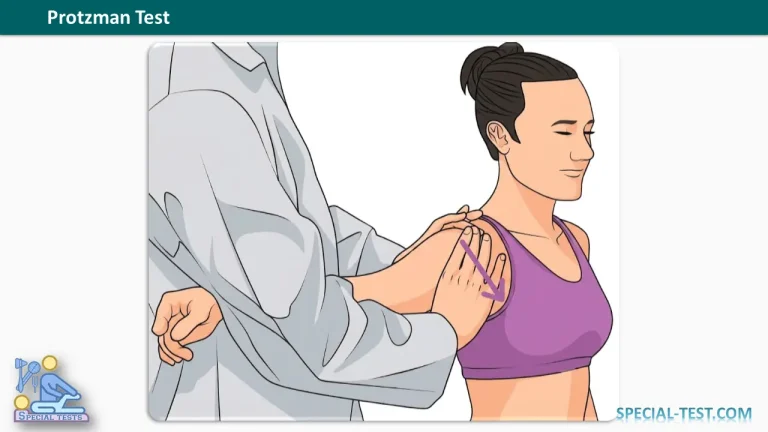
The Protzman Test is an orthopedic physical examination maneuver used to assess anterior shoulder instability, particularly excessive anterior and inferior translation of the humeral head relative to the glenoid cavity. It helps clinicians evaluate the stability of the glenohumeral joint in patients experiencing recurrent shoulder dislocations, subluxations, or a sensation of shoulder instability.
The test involves applying controlled pressure to the humeral head while palpating its movement. Abnormal translation associated with pain or instability symptoms may indicate dysfunction of the structures responsible for maintaining shoulder stability.
The maneuver is named after R. R. Protzman, who published research on anterior shoulder instability in 1980. It is closely related to other shoulder translation tests, particularly the Load and Shift Test.
What Is the Protzman Test Used For?
The primary purpose of the Protzman Test is to evaluate anterior glenohumeral instability, a condition in which the humeral head moves excessively forward relative to the glenoid fossa of the scapula.
The glenohumeral joint provides a wide range of motion but relies heavily on surrounding soft tissues for stability. These structures include the glenoid labrum, joint capsule, glenohumeral ligaments, and rotator cuff muscles.
Injury or insufficiency of these stabilizing structures can result in abnormal humeral head translation.
The Protzman Test may be useful when evaluating patients with:
- Recurrent anterior shoulder dislocations.
- Previous traumatic shoulder subluxation.
- Pain associated with excessive shoulder movement.
- A sensation that the shoulder may slip out of place.
- Suspected anterior capsulolabral injury.
- Shoulder instability during overhead activities or sports.
The test is particularly relevant in athletes participating in throwing, contact, or overhead sports, where repeated stress may contribute to shoulder instability.
How to Perform the Protzman Test
The Protzman Test procedure is generally performed with the patient seated, although a supine variation can also be used.
Protzman Test Procedure: Sitting Position
- Patient positioning: Ask the patient to sit comfortably on an examination table or chair, with the shoulder muscles relaxed.
- Shoulder abduction: Position the patient’s arm at approximately 90 degrees of shoulder abduction.
- Arm support: Support the patient’s arm against the examiner’s hip. This position minimizes muscular activity and facilitates passive assessment of the glenohumeral joint.
- Anterior palpation: Place the fingers of one hand deep within the patient’s axilla to palpate the anterior aspect of the humeral head.
- Posterior hand placement: Position the fingers of the opposite hand over the posterior aspect of the humeral head.
- Apply translational force: Using the posteriorly positioned hand, gently push the humeral head in an anterior and inferior direction.
- Assess movement: Palpate the amount of anteroinferior translation while observing for pain, apprehension, clicking, or abnormal movement.
- Compare both shoulders: When appropriate, repeat the assessment on the opposite shoulder to identify differences in joint translation and symptom reproduction.
The maneuver should be performed slowly and carefully to avoid provoking excessive instability or dislocation.
Protzman Test in the Supine Position
The Protzman Test can also be performed with the patient lying supine.
In this variation, the patient lies on an examination table with the affected shoulder positioned appropriately for examination. The arm is abducted, and the elbow is supported on a pillow to encourage relaxation.
The examiner palpates the anterior and posterior aspects of the humeral head and applies controlled anteroinferior pressure while evaluating the degree of translation.
The supine position may be useful when the patient has difficulty relaxing the shoulder muscles while sitting.
What Is a Positive Protzman Test?
A positive Protzman Test is characterized by abnormal anteroinferior translation of the humeral head associated with pain or reproduction of the patient’s familiar symptoms of shoulder instability.
Findings that may suggest a positive test include:
- Excessive anterior translation: The humeral head moves farther forward than expected relative to the glenoid.
- Inferior displacement: Abnormal downward movement accompanies anterior translation.
- Pain: The applied movement reproduces discomfort associated with the patient’s shoulder problem.
- Apprehension: The patient experiences a sensation that the shoulder may dislocate.
- Palpable clicking: A click or clunk may occur as the humeral head moves across the glenoid rim.
Traditional clinical descriptions often consider anterior translation of approximately 0–25% of the humeral head diameter to represent a lower grade of laxity. However, this is a rough examination guideline rather than a universally validated diagnostic cutoff.
The interpretation should emphasize the amount of translation, its endpoint, the patient’s symptoms, and comparison with the contralateral shoulder.
Important: Increased translation alone does not necessarily indicate pathological shoulder instability. Some individuals have naturally increased joint laxity without pain or functional impairment.
Clinical Significance of the Protzman Test
The Protzman Test provides information about passive stability of the glenohumeral joint, particularly the ability of the anterior capsuloligamentous structures to resist displacement.
Anterior shoulder instability may be associated with damage to the anterior labrum, joint capsule, or inferior glenohumeral ligament complex.
A common structural injury associated with traumatic anterior instability is a Bankart lesion, involving detachment of the anteroinferior labrum from the glenoid rim. Other associated injuries may include a Hill-Sachs lesion or capsular stretching.
Although the Protzman Test can identify abnormal translation, it cannot independently determine which anatomical structure is injured.
Therefore, examination findings must be interpreted alongside the patient’s medical history and other clinical tests.
Protzman Test vs. Load and Shift Test
The Protzman Test resembles the Load and Shift Test because both evaluate humeral head translation.
However, the traditional Load and Shift Test involves centering or loading the humeral head into the glenoid before applying translational forces.
The Protzman maneuver emphasizes direct palpation of the humeral head while applying anteroinferior pressure.
Both techniques are intended to provide information about glenohumeral laxity, but their findings should not be considered interchangeable without accounting for differences in examination technique.
Diagnostic Accuracy and Limitations
Published research provides diagnostic accuracy estimates for several common shoulder instability tests, including the apprehension, relocation, anterior drawer, and Load and Shift tests.
However, well-established sensitivity and specificity values specifically for the Protzman Test are not available from the cited studies.
This is an important limitation when interpreting the examination.
Furthermore, manual assessment of humeral head translation can vary between examiners. Differences in force application, positioning, muscular relaxation, and clinical experience may affect the findings.
Consequently, the Protzman Test should not be used as the sole method of diagnosing anterior shoulder instability.
Clinicians may combine it with the following examinations:
- Anterior Apprehension Test: Evaluates the patient’s sensation of impending anterior shoulder dislocation.
- Jobe Relocation Test: Assesses whether posterior pressure reduces symptoms of anterior instability.
- Load and Shift Test: Evaluates the direction and degree of humeral head translation.
- Anterior Drawer Test: Assesses anterior displacement of the humeral head relative to the glenoid.
- Sulcus Sign: Evaluates inferior glenohumeral laxity and may contribute to assessment of multidirectional instability.
When clinically indicated, radiographs, MRI, or magnetic resonance arthrography may help identify associated structural injuries.
Precautions During the Protzman Test
The test should be performed by a qualified healthcare professional familiar with shoulder instability examinations.
Particular caution is necessary in patients with recent shoulder trauma, suspected fracture, acute dislocation, or marked apprehension.
Forceful translation should be avoided because it may worsen symptoms or provoke subluxation or dislocation.
If the patient experiences severe pain, significant guarding, or a sensation of imminent dislocation, the examiner should stop the maneuver.
Conclusion
The Protzman Test is a clinical examination maneuver used to assess anterior shoulder instability by evaluating anteroinferior humeral head translation.
A positive finding involves excessive movement associated with pain, apprehension, or reproduction of instability symptoms. A palpable click may also occur during abnormal translation.
Although the test can provide useful information about glenohumeral laxity, its diagnostic value depends on interpretation within a comprehensive shoulder examination.
Combining the Protzman Test with the patient’s history, established shoulder instability tests, and appropriate imaging provides a more reliable approach to evaluating suspected anterior glenohumeral instability.
Frequently Asked Questions (FAQ)
1. What is the Protzman Test used for?
The Protzman Test is used to assess anterior shoulder instability by evaluating abnormal anterior and inferior translation of the humeral head relative to the glenoid cavity.
2. How is the Protzman Test performed?
The patient sits with the shoulder abducted to 90 degrees and the arm supported against the examiner’s hip. The examiner palpates the humeral head from the anterior and posterior aspects and applies gentle anteroinferior pressure to assess abnormal translation.
3. What indicates a positive Protzman Test?
A positive test involves excessive anteroinferior movement of the humeral head associated with pain or familiar instability symptoms. Apprehension or a palpable click may also be present.
4. What is the normal amount of anterior humeral head translation?
Some traditional clinical grading descriptions consider anterior translation up to approximately 25% of the humeral head diameter to be within the lower range of laxity. However, normal movement varies between individuals, and this percentage should not be used as an isolated diagnostic threshold.
5. Can the Protzman Test diagnose a Bankart lesion?
No. The Protzman Test may suggest anterior instability, which can be associated with a Bankart lesion, but it cannot directly confirm a labral tear. Imaging and additional clinical evaluation may be required.
6. Is the Protzman Test the same as the Load and Shift Test?
No. Although the tests are similar, the Load and Shift Test includes a distinct loading phase to center the humeral head before translation. The Protzman Test emphasizes palpation during anteroinferior displacement.
7. Is a positive Protzman Test always associated with shoulder instability?
Not necessarily. Increased glenohumeral translation can occur in individuals with generalized ligamentous laxity or asymptomatic hypermobility. A diagnosis of shoulder instability requires correlation with symptoms and other clinical findings.
8. Can the Protzman Test be performed with the patient lying down?
Yes. The test can also be performed in a supine position with the arm appropriately supported and the shoulder muscles relaxed.
9. How accurate is the Protzman Test?
There is insufficient direct evidence to establish reliable sensitivity and specificity values for the Protzman Test itself. It is best used as part of a comprehensive clinical assessment rather than as a standalone diagnostic examination.
References
- Protzman RR. Anterior instability of the shoulder. J Bone Joint Surg Am. 1980;62(6):909–918. PubMed PMID: 7430178.
- Valencia Mora M, Ibán MÁR, Heredia JD, et al. Physical Exam and Evaluation of the Unstable Shoulder. Open Orthop J. 2017;11:946–956. doi:10.2174/1874325001711010946. PubMed Central.
- Farber AJ, Castillo R, Clough M, Bahk M, McFarland EG. Clinical assessment of three common tests for traumatic anterior shoulder instability. J Bone Joint Surg Am. 2006;88(7):1467–1474. PubMed.
- Ellenbecker TS, Bailie DS, Mattalino AJ, et al. Intrarater and interrater reliability of a manual technique to assess anterior humeral head translation of the glenohumeral joint. J Shoulder Elbow Surg. 2002;11(5):470–475. PubMed.
- OrthoFixar. Load and Shift Test: Anterior Instability of the Shoulder. OrthoFixar.