Feagin Test: How to Perform, Positive Results & Accuracy
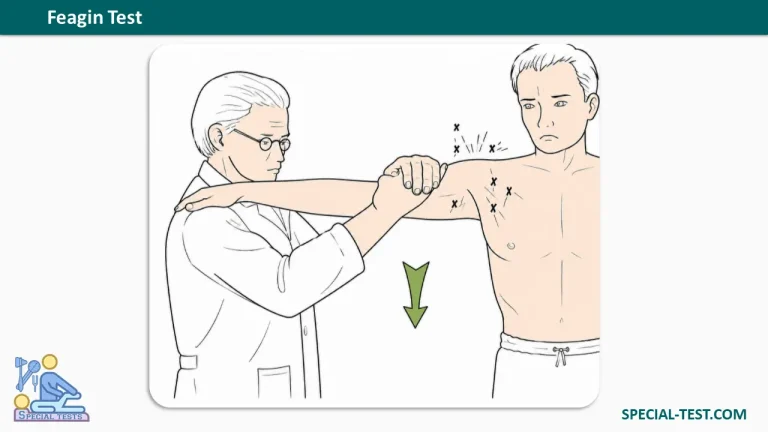
The Feagin test is a clinical shoulder examination maneuver used to assess inferior capsular laxity and help evaluate multidirectional shoulder instability (MDI). It is a modification of the sulcus sign and involves applying a downward and forward force to the humeral head while the shoulder is abducted to 90°.
The test is most useful when interpreted alongside the patient’s symptoms, medical history, and other shoulder instability tests. A positive finding alone does not confirm multidirectional instability because increased joint laxity may also occur in asymptomatic individuals.
What Is the Feagin Test Used For?
The Feagin test is used to assess inferior glenohumeral capsular laxity and support the clinical evaluation of multidirectional shoulder instability.
Multidirectional instability is characterized by symptomatic instability of the glenohumeral joint in two or more directions. Patients may report shoulder pain during activity, a sensation of slipping or giving way, recurrent subluxation, or reduced confidence when performing overhead movements.
The Feagin test modifies the sulcus sign test by positioning the shoulder in 90° of abduction and applying a downward and forward force to the humeral head.
The findings should be interpreted in the context of a comprehensive shoulder examination, as distinguishing physiological laxity from symptomatic instability is essential for an accurate clinical assessment.
How to Perform the Feagin Test
The Feagin test can be performed with the patient standing or sitting. In both positions, the examiner should ensure that the patient is comfortable and that the shoulder musculature is relaxed.
Standing Position
- Ask the patient to stand upright.
- Position the patient’s shoulder in 90° of abduction, with the elbow fully extended and resting on the top of the examiner’s shoulder.
- Clasp both hands over the patient’s humerus, between the upper and middle thirds of the arm.
- Apply a controlled downward and forward force to the humerus.
- Observe the patient’s facial expression and assess for pain, apprehension, or a sensation of instability.
Sitting Position
The Feagin test can also be performed with the patient seated. This variation may allow the examiner to maintain greater control over the patient’s arm and the applied force.
- Ask the patient to sit comfortably, with the shoulder positioned in 90° of abduction.
- Hold the patient’s arm at the elbow with one hand, keeping the elbow extended and supporting the arm against the examiner’s body.
- Place the other hand just lateral to the acromion, over the humeral head.
- Ensure that the patient relaxes the shoulder muscles.
- Apply a controlled downward and forward force to the humeral head.
- Observe the patient’s response, noting any apprehension, pain, or sensation of the shoulder slipping.
The maneuver should be performed gently and stopped if significant pain or a strong sense of instability occurs.
What Is a Positive Feagin Test?
A positive Feagin test is indicated by apprehension or a symptom response suggesting that the shoulder feels unstable during the maneuver. A visible expression of apprehension may be observed, although the patient’s subjective report is important.
A positive result may suggest inferior capsular laxity, but it should not be interpreted in isolation as proof of multidirectional shoulder instability.
Feagin Test and Multidirectional Shoulder Instability
The sulcus sign and Feagin test can provide complementary information when evaluating suspected inferior shoulder laxity.
When both tests are positive, the findings may increase clinical suspicion of multidirectional instability. However, the distinction between laxity and instability is essential:
- Shoulder laxity: Increased passive translation of the humeral head, which may be present without symptoms.
- Shoulder instability: Symptomatic abnormal translation that causes pain, apprehension, subluxation, dislocation, or functional limitations.
For this reason, findings should be considered clinically meaningful when they correspond with the patient’s symptoms, such as activity-related pain, a sensation of the shoulder giving way, or discomfort during overhead movements.
A comprehensive examination may also include anterior and posterior instability tests, assessment of generalized joint hypermobility, and evaluation of shoulder strength and function.
Feagin Test Accuracy: Sensitivity and Specificity
The reported diagnostic accuracy values for the Feagin test are:
| Diagnostic measure | Reported value |
|---|---|
| Sensitivity | 30% |
| Specificity | 90% |
Sensitivity of 30% means that the test identifies a relatively small proportion of individuals who have the condition being assessed. A negative result therefore cannot reliably exclude shoulder instability.
Specificity of 90% means that the test may be negative in a high proportion of individuals who do not have the condition being assessed. However, a positive result does not establish the diagnosis on its own.
These figures should be interpreted cautiously. The available references listed below do not independently establish that these exact values apply specifically to the Feagin test across patient populations. Diagnostic accuracy may vary according to the population studied, the reference standard used, and the clinical definition of instability.
Clinical Significance and Limitations
The Feagin test is an adjunct to the clinical examination rather than a standalone diagnostic tool.
When assessing suspected multidirectional shoulder instability, clinicians should consider:
- The patient’s history of shoulder pain, subluxation, dislocation, or a sensation of instability.
- Whether symptoms occur during sports, overhead activities, or activities of daily living.
- The presence of inferior, anterior, or posterior glenohumeral laxity.
- Comparison with the unaffected shoulder, when appropriate.
- Other examination findings and relevant imaging when clinically indicated.
A systematic clinical assessment is particularly important because increased laxity can occur without pathological instability. The diagnosis of multidirectional instability depends on the combination of symptoms and examination findings rather than a single provocative test.
Frequently Asked Questions (FAQ)
1. What is the Feagin test?
The Feagin test is a shoulder examination maneuver used to assess inferior glenohumeral capsular laxity and help evaluate suspected multidirectional shoulder instability.
2. What does the Feagin test assess?
The test assesses the response to a downward and forward force applied to the humerus while the shoulder is abducted to 90°. The examiner observes for apprehension, pain, or symptoms suggesting instability.
3. How do you perform the Feagin test?
With the patient standing or sitting, position the shoulder in 90° of abduction and keep the elbow extended. Stabilize the arm, place the hands over the humerus or humeral head according to the selected technique, and apply a controlled downward and forward force. Monitor the patient’s symptoms and response.
4. What is a positive Feagin test?
A positive test involves apprehension or a symptom response consistent with shoulder instability. The finding may suggest inferior capsular laxity but must be interpreted alongside the patient’s history and other examination findings.
5. Does a positive Feagin test confirm multidirectional shoulder instability?
No. A positive test alone does not confirm multidirectional instability. The diagnosis requires symptomatic instability in multiple directions and should be based on a comprehensive clinical assessment.
6. What is the difference between the Feagin test and the sulcus sign?
Both tests help assess shoulder laxity, particularly inferior translation. The sulcus sign is performed by applying inferior traction to the arm and observing for a depression beneath the acromion. The Feagin test is a modification performed with the shoulder abducted to 90°, applying a downward and forward force to the humerus.
7. What are the sensitivity and specificity of the Feagin test?
The reported values provided for this test are 30% sensitivity and 90% specificity. These figures should be verified against the original diagnostic accuracy study before being presented as established values. A negative test does not reliably exclude instability.
8. Can the Feagin test be performed with the patient sitting?
Yes. The seated variation allows the examiner to support the abducted arm, stabilize the humeral head, and apply a controlled downward and forward force while monitoring the patient’s response.
9. Why is it important to distinguish shoulder laxity from instability?
Shoulder laxity can be present in healthy individuals without causing symptoms. Shoulder instability refers to symptomatic abnormal translation that affects comfort, confidence, or function. This distinction helps prevent asymptomatic joint mobility from being incorrectly classified as a disorder.
10. Which other tests can help assess multidirectional shoulder instability?
The sulcus sign, load-and-shift test, and appropriate anterior and posterior instability maneuvers can contribute to the assessment. Findings should be interpreted alongside the patient’s symptoms, functional limitations, and overall clinical examination.
References
- Gaskill TR, Taylor DC, Millett PJ. Management of multidirectional instability of the shoulder. J Am Acad Orthop Surg. 2011;19(12):758–767. Read on PubMed
- Hippensteel KJ, Uppstrom T, Rodeo SA, Warren RF. Comprehensive Review of Multidirectional Instability of the Shoulder. J Am Acad Orthop Surg. 2023;31(16):871–880. Read on PubMed
- Magee DJ. Orthopedic Physical Assessment. 7th ed. Elsevier.
- Hippensteel KJ, Brophy R, Smith MV, Wright RW. Comprehensive Review of Provocative and Instability Physical Examination Tests of the Shoulder. J Am Acad Orthop Surg. 2019;27(11):395–404. Read on PubMed