Dynamic Rotary Stability Test (DRST): Purpose, Technique & Interpretation
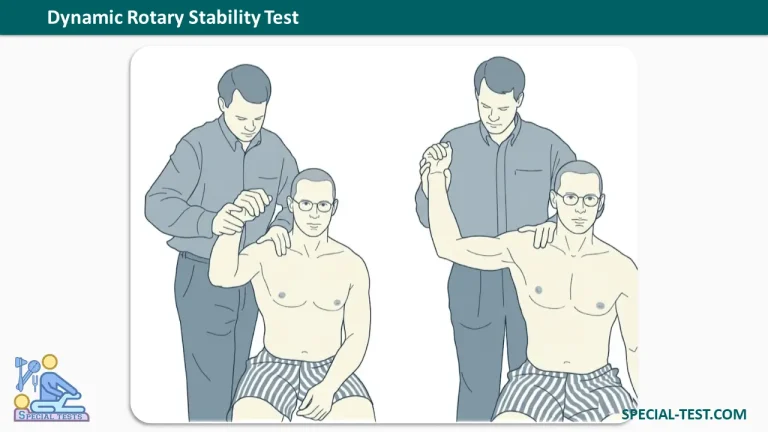
Shoulder pain and instability are not always caused by a structural lesion. In many patients the problem is that the rotator cuff fails to hold the humeral head centred in the glenoid during active movement. The Dynamic Rotary Stability Test (DRST) is a hands-on clinical test designed to find exactly this kind of dynamic control deficit.
What Is the Dynamic Rotary Stability Test (DRST) Used For?
The DRST assesses the ability of the rotator cuff to keep the humeral head centred in the glenoid throughout the arc of rotation. This ability is called arthrokinematic control. The test was described by Magarey and Jones as one of two procedures for evaluating dynamic glenohumeral stability, the other being the Dynamic Relocation Test (DRT) [1]. Later research describes the DRST as particularly useful for detecting humeral head translation caused by abnormal rotator cuff activity, because it is performed in several positions that can mimic functional movement [2].
Unlike static laxity tests, which assess passive restraints such as the capsule and ligaments, the DRST examines the dynamic stabilisers. These are the rotator cuff and the surrounding shoulder muscles [2].
How to Perform the DRST
Patient position
- The patient sits or lies down.
- The arm is abducted to about 90° and the elbow is flexed to about 90°.
Examiner hand placement
- One hand controls the patient’s arm position.
- The other hand palpates the position of the humerus in the glenoid. Palpating along the joint line works best.
Testing sequence
- Place the glenohumeral joint in different combinations of flexion and abduction, close to the positions that reproduce the patient’s symptoms.
- Ask the patient to contract isometrically against light to moderate resistance.
- Then ask for an isotonic contraction, either concentric or eccentric (an eccentric “break”). Choose whichever matches the movement that provokes the patient’s symptoms.
- While the patient contracts, palpate the joint line to detect whether and when arthrokinematic control is lost. Watch for the humeral head slipping or translating.
Interpreting the Result
During a normal test the shoulder girdle stays stable and the humeral head remains centred as the patient contracts. Scapular protraction during the test suggests poor scapular control [1].
A positive test is therefore one in which control is lost. The loss may show as palpable humeral head translation, or as compensatory scapular movement such as protraction. Note the position, the range, the type of contraction and the direction of any translation. Also record whether the patient’s pain is reproduced. These details guide the rehabilitation programme, which usually targets the specific position and contraction type where control fails.
What Does the Evidence Say?
The test is based on clinical reasoning about force couples and motor control around the shoulder [1]. Its measurement properties have been studied, but the evidence is limited. A cross-sectional study of 40 patients with painful musculoskeletal shoulder conditions found good intra-rater reliability and moderate inter-rater reliability for the DRST. Concurrent validity against the University of Pennsylvania Shoulder Score was poor [2].
In practice, the DRST is best seen as a movement-quality and motor-control assessment. It does not diagnose a specific structural lesion, and it should be interpreted together with the history, other physical examination findings and imaging when indicated. Examiner experience also matters, since the test depends on skilled palpation.
Clinical Takeaways
- The DRST evaluates dynamic rotator cuff control of the humeral head, not passive joint laxity.
- Test positions close to the patient’s symptomatic positions.
- Use isometric and then isotonic contractions, matching the movement that provokes symptoms.
- Palpate the joint line to detect when and where control is lost.
- Scapular protraction suggests inadequate scapular control.
- Reliability is acceptable, but validity against functional scores is limited, so combine the DRST with other findings.
Research Limitations
The published evidence on the DRST is small. The reliability study used a convenience sample, and agreement between testers was only moderate. No diagnostic accuracy figures (sensitivity and specificity) were identified in the sources reviewed. This article is for educational purposes and does not replace clinical judgement.
Frequently Asked Questions (FAQ)
1. What is the Dynamic Rotary Stability Test?
It is a manual clinical test that assesses whether the rotator cuff can keep the humeral head centred in the glenoid while the patient contracts against resistance [1].
2. Who developed the DRST?
Mary Magarey and Mark Jones described it, together with the Dynamic Relocation Test, in Manual Therapy in 2003 [1].
3. Does the DRST diagnose a rotator cuff tear?
No. It assesses dynamic joint control, not tissue integrity. Suspected tears need a full clinical examination and, where appropriate, imaging.
4. What counts as a positive DRST?
A positive test is loss of arthrokinematic control, meaning the humeral head slips or translates under palpation during contraction. Scapular protraction suggests poor scapular control [1].
5. Is the DRST reliable?
A cross-sectional study reported good intra-rater and moderate inter-rater reliability, with poor concurrent validity against the Penn Shoulder Score [2].
6. In which patients is the DRST most useful?
It is most useful in patients with shoulder pain or minor instability whose symptoms occur in specific positions or movements, including those with suspected altered rotator cuff motor control [1,2].
7. Why test in positions close to the patient’s symptoms?
Control failures are often position-specific. Testing near the symptomatic range increases the chance of reproducing and detecting the deficit [1].
References
- Magarey ME, Jones MA. Specific evaluation of the function of force couples relevant for stabilization of the glenohumeral joint. Man Ther. 2003;8(4):247-253. PubMed-indexed.
- Reliability and Concurrent Validity of Dynamic Rotator Stability Test: A Cross-Sectional Study. PubMed Central, PMC4551409. https://pmc.ncbi.nlm.nih.gov/articles/PMC4551409