Dynamic Relocation Test: Purpose, Procedure, and Interpretation
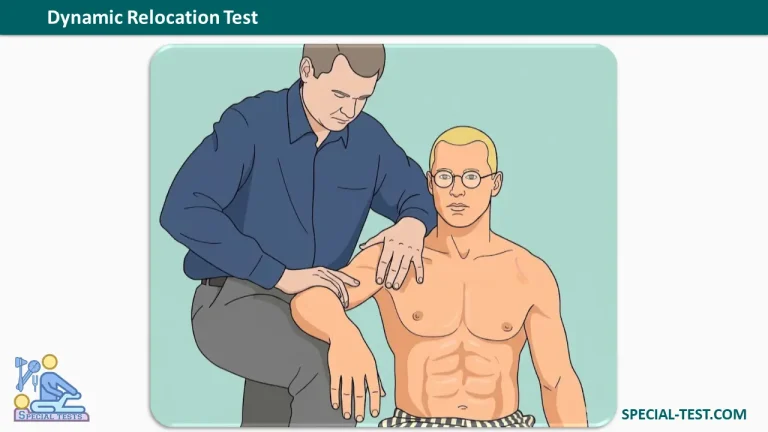
The Dynamic Relocation Test (DRT) is a clinical examination technique used to assess dynamic glenohumeral stability and the ability of the shoulder muscles to control the position of the humeral head during an applied traction force. It focuses on the coordinated activity of the rotator cuff muscles and their contribution to stabilizing the shoulder joint.
Unlike tests that primarily assess pain, passive mobility, or structural injury, the Dynamic Relocation Test emphasizes neuromuscular control. It can help clinicians observe how effectively a patient recruits the rotator cuff while minimizing excessive activation of superficial muscles.
The test was described in the literature on dynamic shoulder stability and is used in clinical assessment and rehabilitation to evaluate shoulder muscle coordination. Research has investigated the muscle activation patterns associated with the test and its potential role in improving shoulder motor control.
What Is the Dynamic Relocation Test Used For?
The Dynamic Relocation Test is used to evaluate the ability of the rotator cuff muscles to maintain the humeral head in a controlled position within the glenoid cavity against a destabilizing force.
The rotator cuff consists of four muscles: the supraspinatus, infraspinatus, teres minor, and subscapularis. Together, these muscles contribute to glenohumeral stability by compressing and controlling the humeral head within the shallow glenoid socket.
During the Dynamic Relocation Test, the examiner applies gentle longitudinal traction to the patient’s arm while asking the patient to actively draw the humeral head into the shoulder socket. The examiner observes and palpates the resulting muscle activity to assess the patient’s ability to produce coordinated stabilization.
The test may be useful for:
- Assessing dynamic glenohumeral stability.
- Evaluating rotator cuff recruitment and coordination.
- Identifying excessive activation of superficial muscles during a stabilization task.
- Assessing motor control in patients with shoulder dysfunction.
- Guiding early-stage shoulder rehabilitation when controlled, low-load muscle activation is appropriate.
A study published in the Journal of Manual & Manipulative Therapy examined muscle activity during a modified Dynamic Relocation Test in asymptomatic individuals. The researchers found that the supraspinatus, infraspinatus, pectoralis major, and latissimus dorsi were among the main muscles activated during the task. These findings emphasize that the test involves coordinated activity across several shoulder muscles rather than isolated contraction of one rotator cuff muscle.
Anatomical Basis of the Dynamic Relocation Test
The shoulder joint depends on both static and dynamic stabilizing mechanisms. Static stabilizers include the joint capsule, glenohumeral ligaments, and glenoid labrum. Dynamic stabilizers include the rotator cuff and other muscles that control shoulder movement.
The rotator cuff is particularly important because the glenoid cavity is relatively shallow compared with the size of the humeral head. Coordinated muscle activity helps maintain joint alignment while the arm moves or encounters external forces.
During the Dynamic Relocation Test, the patient attempts to counteract the examiner’s traction force by actively drawing the humerus toward the glenoid. This task requires controlled muscle recruitment rather than simply generating maximal force.
The subscapularis may be palpated anteriorly as part of the clinical assessment. However, the test should not be considered a selective test of subscapularis strength because several muscles contribute to the movement and stabilization strategy.
Experimental biomechanical research supports the importance of the rotator cuff in dynamic shoulder stability. Lee and colleagues demonstrated that rotator cuff muscles contribute substantially to glenohumeral stability across different shoulder positions.
How to Perform the Dynamic Relocation Test
The test should be performed by a qualified healthcare professional familiar with shoulder examination and rehabilitation.
Patient Position
- Ask the patient to sit comfortably with the trunk upright and the shoulder relaxed.
- Position the affected arm in approximately 60° to 80° of abduction in the scapular plane (scaption).
- Support the arm in a comfortable position and ensure that the patient understands the movement before applying traction.
The scapular plane lies slightly anterior to the frontal plane. Positioning the arm in this plane allows the clinician to assess shoulder muscle coordination during a controlled stabilization task.
Examiner Hand Placement
- Position the middle finger of one hand to palpate the subscapularis region, according to the clinical technique being used.
- Place the thumb along the lateral or outer border of the acromion to help monitor shoulder-girdle movement.
- Use the other hand to grasp and support the patient’s arm so that gentle longitudinal traction can be applied.
Hand placement should allow the examiner to monitor muscle contraction and detect unwanted compensatory movement without causing discomfort.
Application of Traction and Patient Instruction
- Apply gentle longitudinal distraction along the axis of the humerus.
- Ask the patient to actively draw the arm inward and upward toward the shoulder socket, as though pulling the humeral head into the glenoid cavity.
- Maintain gentle traction while the patient attempts to counteract it through controlled muscular activation.
- Palpate the relevant muscles and observe the scapula throughout the maneuver.
The goal is not to overpower the examiner’s traction. Instead, the patient should demonstrate controlled recruitment of the shoulder stabilizers while maintaining appropriate shoulder-girdle positioning.
What Is a Positive Dynamic Relocation Test?
The Dynamic Relocation Test is primarily an assessment of muscle recruitment and motor control. Interpretation depends on the quality of the contraction, the presence of compensatory activity, and the stability of the scapula.
1. Appropriate Rotator Cuff Recruitment
During the maneuver, the examiner assesses whether the patient can activate the rotator cuff while counteracting gentle traction.
Palpable contraction in the subscapularis region may contribute to the assessment. However, the examiner should consider the overall pattern of muscle activation rather than relying on one palpation finding.
Controlled recruitment without excessive superficial muscle activity is generally considered a favorable motor-control response.
2. Excessive Pectoralis Major or Latissimus Dorsi Activity
Excessive activation of superficial muscles may suggest that the patient is using a compensatory strategy rather than demonstrating the intended pattern of shoulder stabilization.
The pectoralis major and latissimus dorsi are particularly relevant because their activity has been investigated during the Dynamic Relocation Test. Depending on the patient’s movement strategy, the examiner may need to palpate these muscles or other accessible shoulder regions to assess unwanted recruitment.
A modified Dynamic Relocation Test study found that these muscles can be active during the task. Therefore, their activation should be interpreted in context rather than automatically classified as abnormal.
3. Scapular Movement During the Test
The examiner should monitor the scapula for unwanted movement, particularly excessive protraction or other compensatory displacement while the patient attempts to stabilize the humeral head.
If the scapula moves excessively, this may indicate altered scapular control or a compensatory movement strategy. However, scapular protraction alone does not establish scapular instability or diagnose a specific shoulder disorder.
The finding should be correlated with the patient’s symptoms, other examination findings, and functional movement assessment.
Clinical Significance of the Dynamic Relocation Test
The Dynamic Relocation Test can help clinicians understand how a patient coordinates the muscles responsible for shoulder stability. This information may be useful when planning rehabilitation for patients who demonstrate impaired shoulder motor control.
In appropriate patients, the maneuver may also be incorporated into rehabilitation as a low-load motor-control exercise. The clinician can provide feedback to help the patient develop a controlled contraction without unnecessary shoulder-girdle compensation.
Nevertheless, the Dynamic Relocation Test should not be used in isolation to diagnose a rotator cuff tear, labral lesion, or glenohumeral instability. A positive or abnormal finding does not independently establish a structural diagnosis.
A comprehensive assessment should include the patient’s history, pain behavior, range of motion, strength, scapular mechanics, relevant orthopedic tests, and additional investigations when clinically indicated.
Limitations of the Dynamic Relocation Test
Although the test provides information about muscle coordination, several limitations should be considered.
- It is not a definitive structural diagnostic test: Abnormal muscle recruitment does not prove that the rotator cuff is torn or that the shoulder is mechanically unstable.
- It involves multiple muscles: The movement cannot be attributed exclusively to the subscapularis or any single rotator cuff muscle.
- Findings depend on examination technique: Patient positioning, traction intensity, examiner experience, and the patient’s understanding of the instructions may influence the observed response.
- Research evidence has limitations: Studies of muscle activation provide useful biomechanical information, but they do not automatically establish diagnostic accuracy or prove that the test predicts clinical outcomes.
The Dynamic Relocation Test is best regarded as one component of a broader shoulder examination, with findings interpreted alongside the patient’s presentation and other clinical assessments.
Frequently Asked Questions (FAQs)
1. What does the Dynamic Relocation Test assess?
The Dynamic Relocation Test assesses dynamic glenohumeral stability and the ability to coordinate shoulder muscle activation while counteracting gentle longitudinal traction applied to the arm.
2. Which muscles are involved in the Dynamic Relocation Test?
The rotator cuff muscles contribute to stabilization, including the supraspinatus, infraspinatus, teres minor, and subscapularis. Other muscles, including the pectoralis major and latissimus dorsi, may also be activated during the maneuver.
3. How is the Dynamic Relocation Test performed?
The patient sits with the arm supported at approximately 60° to 80° of abduction in the scapular plane. The examiner applies gentle longitudinal traction while asking the patient to draw the arm into the shoulder socket. Muscle recruitment and scapular movement are observed and palpated.
4. What is considered a favorable response?
A favorable response involves controlled shoulder muscle activation while the patient counteracts gentle traction, with minimal unnecessary superficial muscle activity and without excessive compensatory scapular movement.
5. Does a positive Dynamic Relocation Test indicate a rotator cuff tear?
No. The test evaluates dynamic stabilization and motor control rather than directly identifying a tendon tear. Suspected rotator cuff injury requires a comprehensive clinical assessment and, when indicated, imaging.
6. What does excessive pectoralis major activity indicate during the test?
Excessive pectoralis major activity may suggest a compensatory muscle recruitment strategy. However, this finding must be interpreted in context because the pectoralis major can normally contribute to shoulder muscle activity during the maneuver.
7. Does scapular protraction mean that the scapula is unstable?
Not necessarily. Excessive scapular protraction may indicate altered scapular control or compensation during the task, but it is not sufficient on its own to diagnose scapular instability.
8. Can the Dynamic Relocation Test be used as a rehabilitation exercise?
Yes. In selected patients, a modified version can be used as a low-load exercise to practice shoulder muscle coordination and dynamic stabilization. The exercise should be adapted to the patient’s symptoms, functional limitations, and rehabilitation goals.
9. Is the Dynamic Relocation Test the same as the shoulder relocation test?
No. The Dynamic Relocation Test evaluates active muscle recruitment and dynamic shoulder stabilization against traction. The conventional shoulder relocation test is commonly used in the assessment of anterior shoulder instability and involves evaluating symptoms, particularly pain or apprehension, after a posteriorly directed force is applied to the humeral head in a provocative shoulder position.
References
- Ribeiro DC, Shemmell J, Falling C, Sole G. Shoulder muscle activity during the modified dynamic relocation test and side-lying shoulder external rotation: a cross-sectional study on asymptomatic individuals. Journal of Manual & Manipulative Therapy. 2016. PubMed.
- Lee SB, Kim KJ, O’Driscoll SW, Morrey BF, An KN. Dynamic glenohumeral stability provided by the rotator cuff muscles in the mid-range and end-range of motion. Journal of Bone and Joint Surgery. 2000. PubMed.
- Speer KP, Hannafin JA, Altchek DW, Warren RF. An evaluation of the shoulder relocation test. American Journal of Sports Medicine. 1994. PubMed.