Clunk Test of the Shoulder: Purpose, Procedure, Positive Results & Clinical Significance
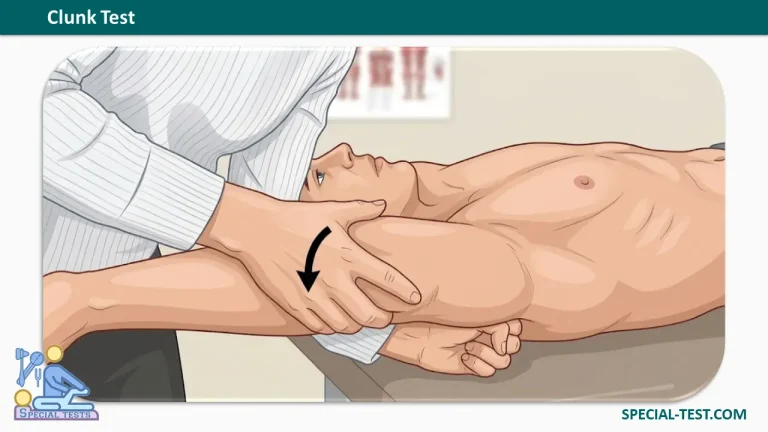
The Clunk Test is a physical examination maneuver used to assess the glenoid labrum of the shoulder, particularly when a superior or anterior-posterior labral injury is suspected. The test involves abducting the patient’s arm overhead while applying anterior pressure to the humeral head and rotating the humerus externally. During this maneuver, the examiner evaluates the shoulder for an audible or palpable clunk, grinding sensation, or symptoms of instability.
The shoulder labrum is a ring of fibrocartilaginous tissue that surrounds the glenoid cavity. It deepens the relatively shallow socket of the shoulder joint, contributes to joint stability, and provides attachment points for important structures, including the long head of the biceps tendon. Labral injuries may develop following trauma, repetitive overhead activities, or episodes of shoulder instability.
Although the Clunk Test is traditionally described as a clinical test for glenoid labral tears, its findings should be interpreted alongside the patient’s history, other physical examination findings, and appropriate imaging studies. A positive result does not independently confirm a labral tear.
What Is the Clunk Test Used For?
The Clunk Test is primarily used to evaluate suspected glenoid labral pathology and may provide additional information when shoulder instability is present.
Its main clinical applications include:
- Superior glenoid labral tears: The test may help identify symptoms associated with injury to the superior labrum, including lesions involving the biceps anchor.
- Anterior-posterior labral tears: It may be used when a tear extending across the glenoid labrum is suspected.
- Shoulder instability: The maneuver may reproduce apprehension or symptoms in patients with anterior glenohumeral instability.
- Mechanical symptoms: An audible or palpable clunk, catching sensation, or grinding during shoulder movement may raise suspicion of intra-articular pathology.
The Clunk Test is one component of a comprehensive shoulder examination. It should not be used as the sole method of diagnosing a superior labrum anterior-to-posterior (SLAP) lesion or another type of labral injury.
Relevant Shoulder Anatomy
The glenoid labrum is a fibrocartilaginous structure attached to the rim of the glenoid cavity of the scapula. It increases the effective depth of the socket and contributes to the stability of the glenohumeral joint.
The labrum has several important clinical relationships:
- The superior labrum is closely associated with the attachment of the long head of the biceps tendon.
- The anterior labrum contributes to the stability of the shoulder against anterior translation of the humeral head.
- The posterior labrum contributes to posterior stability and may be injured in certain traumatic or repetitive loading mechanisms.
A labral tear can produce shoulder pain, clicking, catching, reduced function, or a feeling of instability. However, some labral abnormalities may be present without symptoms, particularly in people who perform repetitive overhead activities.
How to Perform the Clunk Test
The Clunk Test is performed with the patient lying supine while the examiner carefully positions and rotates the affected shoulder.
Patient Position
- Ask the patient to lie supine on the examination table.
- Ensure that the patient is relaxed and that the affected shoulder can move freely.
- Explain the procedure and instruct the patient to report any pain, catching, or feeling of instability.
Examiner Hand Placement
- Place one hand over the posterior aspect of the shoulder, positioning it over the humeral head.
- Use the other hand to hold the patient’s upper arm just above the elbow.
- Maintain control of the shoulder throughout the maneuver to avoid sudden or excessive movement.
Test Procedure
- Gradually abduct the patient’s arm, bringing it overhead toward full abduction as tolerated.
- Apply anteriorly directed pressure to the humeral head using the hand positioned over the shoulder. Some descriptions of the maneuver use a closed fist to provide this pressure.
- While maintaining the anterior pressure, externally rotate the humerus using the hand controlling the upper arm.
- Observe and palpate the shoulder for a distinct clunk, catching, grinding sensation, or reproduction of the patient’s symptoms.
- The examiner may vary the degree of abduction and move the arm through different positions to assess the shoulder during a broader range of motion.
The maneuver should be performed gently and within the patient’s tolerance. It should be stopped if severe pain, marked apprehension, or a feeling of impending dislocation occurs.
Clinical Considerations
The examiner should distinguish a mechanical clunk from nonspecific joint clicking. The patient’s reported symptoms, the location of discomfort, the presence of apprehension, and the overall pattern of shoulder instability all contribute to interpretation.
Changing the arm’s position may alter the structures under stress, but the test should not be considered a precise method for mapping the location or extent of a labral tear.
What Is a Positive Clunk Test?
The Clunk Test is considered positive when the maneuver reproduces a distinct mechanical clunk or grinding sensation in the shoulder. The examiner should also note any associated pain, catching, or apprehension.
Positive findings may include:
- Audible clunk: A noticeable clicking or clunking sound occurs during the maneuver.
- Palpable clunk: The examiner feels an abnormal mechanical movement of the humeral head or a clunk within the shoulder joint.
- Grinding or catching: The patient experiences a grinding sensation, catching, or mechanical restriction during movement.
- Shoulder apprehension: The patient feels that the shoulder may dislocate or slip out of place, potentially suggesting anterior shoulder instability.
- Reproduction of symptoms: The maneuver reproduces the patient’s familiar deep shoulder pain or mechanical symptoms.
An audible or palpable clunk may raise suspicion of a glenoid labral tear, but it is not specific to this condition. Likewise, apprehension may indicate instability rather than a labral tear alone.
Diagnostic Accuracy and Clinical Limitations
The diagnostic accuracy of the Clunk Test has not been adequately established. Clinicians should therefore avoid interpreting a positive result as definitive evidence of a labral tear.
A systematic review published in JAMA found that the Clunk Test and several other shoulder examination maneuvers had limited diagnostic value for identifying shoulder instability or labral lesions. The authors emphasized that the available studies had important methodological limitations. [1]
Research examining shoulder examination tests more broadly also indicates that no single physical examination maneuver reliably identifies every type of labral injury. The diagnostic value of a test depends on the suspected lesion, the patient’s clinical presentation, and the quality of the supporting evidence. [2,3]
For this reason, the Clunk Test should be interpreted alongside:
- The patient’s history of trauma, dislocation, or repetitive overhead activity.
- The location and nature of shoulder pain.
- Other examination findings related to labral pathology and instability.
- Imaging studies when clinically indicated.
Magnetic resonance imaging (MRI) or magnetic resonance arthrography may be used to investigate suspected labral pathology. Arthroscopy may provide direct visualization of the labrum when surgical evaluation is indicated.
Differential Diagnosis
A positive Clunk Test does not necessarily indicate a labral tear. Other conditions may cause clicking, catching, pain, or instability-like symptoms, including:
- Glenohumeral instability or recurrent shoulder subluxation.
- Rotator cuff pathology.
- Biceps tendon disorders.
- Other intra-articular abnormalities.
- Benign joint clicking without clinically significant structural injury.
The clinician should correlate the test findings with the overall clinical picture rather than relying on the sound or sensation alone.
Frequently Asked Questions (FAQ)
1. What does the Clunk Test assess?
The Clunk Test is used to assess suspected glenoid labral pathology, particularly superior and anterior-posterior labral tears. It may also reproduce symptoms associated with anterior shoulder instability.
2. How is the Clunk Test performed?
The patient lies supine. The examiner abducts the affected arm overhead, places one hand over the posterior aspect of the shoulder, and holds the upper arm with the other hand. Anterior pressure is applied to the humeral head while the arm is externally rotated. The examiner assesses for a clunk, grinding sensation, or reproduction of symptoms.
3. What is a positive Clunk Test?
A positive result is traditionally defined by an audible or palpable clunk or grinding sensation during the maneuver. Pain, catching, or apprehension may also occur and should be documented separately.
4. Does a positive Clunk Test confirm a labral tear?
No. A positive result may raise suspicion of labral pathology, but the test’s diagnostic accuracy has not been adequately established. Further clinical assessment and imaging may be necessary.
5. Can the Clunk Test detect a SLAP tear?
The test may be used when a superior labral tear, including a SLAP lesion, is suspected. However, it cannot reliably confirm or exclude a SLAP tear on its own.
6. Can the Clunk Test indicate shoulder instability?
Yes. The maneuver may reproduce apprehension in patients with anterior shoulder instability. However, dedicated instability tests, including the apprehension and relocation tests, may provide more useful diagnostic information when instability is the primary concern.
7. Is the Clunk Test painful?
The maneuver may reproduce pain or discomfort, particularly when shoulder pathology is present. It should be performed gently by a trained clinician and stopped if severe pain or marked apprehension develops.
8. What should be done after a positive Clunk Test?
The clinician should review the patient’s symptoms, assess shoulder stability and other potential sources of pain, and consider additional examination maneuvers or imaging when indicated. The findings should be interpreted in the context of the patient’s complete clinical presentation.
References
- Hegedus EJ, et al. Does this patient have an instability of the shoulder or a labrum lesion? JAMA. 2004. Available from: PubMed.
- Munro W, Healy R. The validity and accuracy of clinical tests used to detect labral pathology of the shoulder: a systematic review. Manual Therapy. 2009;14(2):119–130. PubMed.
- Physical examination tests of the shoulder: a systematic review and meta-analysis of diagnostic test performance. British Journal of Sports Medicine. 2017. PubMed.
- Andrews JR, Carson WG Jr, McLeod WD. Glenoid labrum tears related to the long head of the biceps. American Journal of Sports Medicine. 1985;13(5):337–341. PubMed.
- Clunk Test. OrthoFixar. Available from: https://orthofixar.com/special-test/clunk-test/.
- Clunk Test. Physiopedia. Available from: https://www.physio-pedia.com/Clunk_Test.